
You put on the same earbuds, play the same album, and sit in a room that is technically just as quiet as it was an hour ago. But now everyone has left. And somehow the music sounds different — fuller, closer, more detailed. The bass registers somewhere in the chest, not just the ears. You catch a guitar line you’ve heard a hundred times but never quite noticed before. Nothing about the hardware changed. Something about you did.
Why You Notice Sound Quality More When You’re Alone
The same earbuds, the same music, the same room — but alone, it sounds more detailed, more immersive, and more real. The explanation isn’t in the hardware. It’s in the way the human brain allocates attention, manages social awareness, and responds to the presence of other people even when nothing is being said.
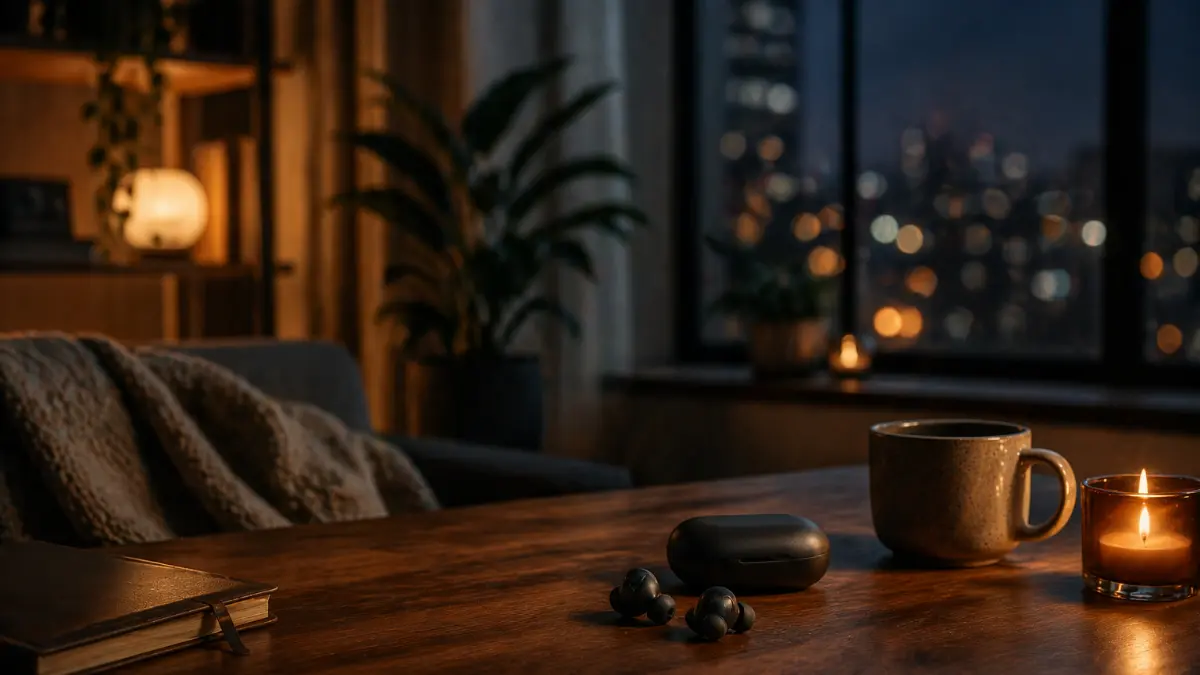
Most people have had this experience and attributed it to mood, to the time of day, or simply to luck. You were in the right headspace. The music happened to hit differently. You filed it under the vague category of a good listening session and moved on.
But the pattern is consistent enough to deserve a more precise explanation. The circumstances under which music sounds most detailed and emotionally immediate are not random. They cluster, reliably, around a single condition: solitude. And the reason for that clustering runs deeper than atmosphere or personal preference. It touches on how auditory attention is allocated, how the nervous system responds to the presence of others, and why perception itself — not hardware — is the primary variable in any listening experience.
Understanding this doesn’t require being an audiophile or a neuroscientist. It requires taking seriously the idea that the brain is the most important component in your audio chain, and that its performance varies considerably depending on the environment you place it in.
In This Article
- Why Sound Feels More Detailed When You’re Alone
- The Role of Attention and the Brain
- Social Awareness and Hidden Cognitive Load
- Why Even Quiet People Change the Experience
- The Nervous System: Relaxed vs Alert Listening
- Why Music Feels Closer When You’re Alone
- When Being Alone Doesn’t Help
- How to Recreate That Alone Listening Effect
- Final Verdict
- Frequently Asked Questions
Why Sound Feels More Detailed When You’re Alone
The detail you perceive in a piece of music is not a fixed quantity delivered by the hardware. It is the product of how much cognitive processing your brain applies to the incoming audio signal. Earbuds and headphones set an upper ceiling on the information available — but how much of that information actually reaches conscious awareness depends almost entirely on how much attentional bandwidth you direct toward it.
Auditory perception operates through a combination of bottom-up and top-down processing. Bottom-up processing is automatic — your auditory cortex receives the signal, identifies frequencies, and registers timing relationships without conscious effort. Top-down processing is deliberate and resource-dependent — it’s what allows you to follow a single instrument through a dense mix, notice the way a vocal sits in reverb, or register the precise moment a snare hits relative to a kick drum.
Top-down auditory processing requires available cognitive resources. It competes for those resources with everything else your brain is managing at the same time. When you are alone, the field of competing demands is narrower. The signal-to-noise ratio of your cognitive environment improves, and more processing capacity is available for the music itself. The earbuds didn’t change. The room didn’t change. The allocation of mental resources did — and that allocation is what determines perceived detail.
This is also why the physical acoustic environment interacts with psychological state in ways that are difficult to separate. The acoustic properties of a room affect how sound is perceived, but the psychological state of the listener affects how deeply that perception is processed. Both variables matter, and solitude tends to optimize both simultaneously.
The Role of Attention and the Brain
Selective attention — the brain’s ability to prioritize specific inputs from among many — is one of the most studied phenomena in cognitive psychology, and one of the most relevant to the listening experience. The cocktail party effect, first described by Colin Cherry in 1953, demonstrated that humans can focus on a single voice in a room full of competing voices. What is less often discussed is the cost of that focusing: directing attention toward one stream of information necessarily reduces what is available for other streams.
When you listen to music in a social environment, your auditory attention is already partially committed. Even if no one is speaking to you, the brain allocates monitoring resources to the people around you as a baseline function. It tracks whether voices are rising in pitch, whether someone is moving toward you, whether an expression or gesture requires a response. This monitoring is not deliberate and largely not conscious. It runs in the background, continuously, as a product of the same social processing systems that made human cooperation possible. And it consumes attention that would otherwise be available for music.
The result is a kind of perceptual thinning. The music is present, the hardware is performing, but the depth of processing applied to it is reduced. You hear the music rather than listening to it — a distinction that any experienced listener will recognize intuitively, even if the neural mechanism behind it is rarely articulated.
Social Awareness and Hidden Cognitive Load
The cognitive cost of being around other people is systematically underestimated, partly because most of it is invisible. People tend to assess their own cognitive load based on what they are consciously doing — working, reading, having a conversation. The background processes that run continuously in social environments don’t register as effort in the same way, so they don’t get counted.
But the load is real. Whenever another person is present, the brain activates a suite of social cognitive processes: reading facial expressions and body language, modeling the other person’s mental state, managing self-presentation, predicting likely behavioral sequences. These processes are automatic and deeply ingrained — they evolved long before language, and they run regardless of whether the social situation requires active engagement. Two people sitting silently in the same room, each listening to their own earbuds, are still generating this mutual cognitive overhead.
For listening purposes, this matters because the same neural resources involved in social processing overlap with those used for sustained attention and perceptual depth. The default mode network — which handles internally directed thought, self-referential processing, and to some extent emotional response to music — is suppressed in social contexts where external monitoring is active. The overlap is not total, but it is significant enough that the presence of even one other person measurably alters the listening brain’s operating state.
This is not a theoretical concern. It is why concert listening, despite the superior acoustic environment and the shared social energy, is a fundamentally different experience from headphone listening alone. Both have value. They are simply different states of engagement.
Why Even Quiet People Change the Experience
A common intuition is that the distraction of other people is primarily acoustic — that the issue is noise, voices, and competing sound sources. If that were true, good noise-cancelling earbuds would solve the problem entirely. They don’t, and the reason tells you something important about what is actually happening.
Active noise cancellation eliminates or reduces the acoustic signal from external sources. The difference between active noise cancellation and passive isolation comes down to which frequencies each approach handles and how completely each method removes the incoming signal. Both approaches address the acoustic layer of distraction effectively. Neither addresses the cognitive layer.
The cognitive layer is where the real listening happens — and it persists regardless of what the earbuds are doing. A person sitting silently two meters away, visible in your peripheral vision, still activates the social monitoring systems described above. The brain tracks their breathing rate, their stillness or movement, their gaze direction. None of this is heard through the earbuds. All of it occupies attentional resources that could otherwise be directed at the music.
This explains a common experience: putting on noise-cancelling earbuds in a busy office and noticing that the acoustic environment improves dramatically while the sense of deep immersion in music remains elusive. The sound is cleaner, the distraction is lower, but the listening state hasn’t fully shifted. True immersion requires both acoustic separation and the cognitive release that comes from genuine solitude — from the absence of other people in the monitoring field, not just the absence of their voices in the audio channel.
The Nervous System: Relaxed vs Alert Listening
Beyond attention and social cognition, there is a more fundamental physiological variable: the state of the autonomic nervous system. The nervous system operates along a continuum between two broad modes — sympathetic activation, associated with alertness, readiness, and stress response, and parasympathetic activation, associated with rest, recovery, and openness to experience.
Social environments, even comfortable and unthreatening ones, tend to maintain a mild sympathetic bias. The presence of others keeps the system slightly elevated — not stressed, but prepared. Heart rate and cortisol levels sit fractionally higher than in true solitude. Muscle tone in the face and shoulders is marginally increased. The perceptual system, calibrated for a world where social information could be survival-relevant, stays slightly more oriented toward the environment than toward internal experience.
This matters for listening because the depth of emotional and perceptual engagement with music is partly a function of nervous system state. Research in music psychology consistently shows that listeners in parasympathetic-dominant states report greater emotional resonance, richer perceptual detail, and stronger physiological responses — chills, changes in breathing rate, sensations of depth or space — than listeners in elevated arousal states. The music is the same. The body receiving it is not.
Alone and settled, the system drops toward its resting baseline. The small vigilance costs of social presence are withdrawn. The perceptual window widens. Music that sounded competent a few minutes ago begins to sound immersive — not because the earbuds improved, but because the physiological receiving state became more favorable to the kind of processing that deep listening requires.
Why Music Feels Closer When You’re Alone
There is a qualitative shift that experienced listeners describe in solitary listening that goes beyond noticing more detail. The music feels closer. Not louder — closer. The spatial impression is more intimate, the emotional content more immediate, the sense of being inside the recording rather than observing it from outside.
This shift has a plausible neural basis. The default mode network, which supports internally directed cognition, autobiographical memory, and emotional self-reference, is more active in states of solitude and rest. Music engages this network strongly when it connects to personal memory, emotional associations, or states of absorption. When the default mode network is operating freely — not suppressed by the demands of external social monitoring — music can more readily access these associative networks, producing a richer and more personally resonant experience.
The result is not just that you hear more, but that what you hear means more. A melody that carries an old memory lands with its full emotional weight. A chord progression that creates tension resolves with a physical sense of release. The music is no longer ambient or background. It is the primary experience, and the brain is fully oriented toward it in a way that social environments structurally prevent.
This is also why the listening context interacts with music selection in important ways. Ambient or instrumental music — which relies heavily on texture, space, and emotional atmosphere rather than lyrical content — tends to show the solitude effect most clearly. The subtlety of that music type depends on the kind of deep, undistracted processing that solitude enables.
When Being Alone Doesn’t Help
Solitude is a necessary but not sufficient condition for deep listening. Physical aloneness without psychological aloneness — a distinction worth making explicitly — produces the same degraded listening state as social presence, through a different mechanism.
If you are alone but mentally occupied — running through a conversation that just happened, anticipating something later in the day, composing a message in your head — the attentional resources that should be available for music are still committed elsewhere. The nervous system may be physiologically relaxed, but the cognitive environment is cluttered. The music plays, the processing is shallow, and the sense of immersion fails to develop despite the absence of other people in the room.
Rumination, worry, and planning all produce a form of internal social cognition — rehearsing what others think, modeling future interactions, reviewing past ones — that generates cognitive load functionally similar to actual social presence. For listening purposes, a mind actively rehearsing a difficult conversation may be less available to music than a calm mind in a room with one quiet friend.
This also connects to why the same pair of earbuds can sound dramatically different on different days with no change in context. A well-rested, psychologically settled listener will consistently perceive more richness and detail from the same hardware than a tired, preoccupied one. This is one of the reasons that gear reviews — conducted under controlled but often mentally loaded conditions — frequently underrepresent how good equipment can sound in genuinely optimal listening states.
How to Recreate That Alone Listening Effect
Understanding the mechanism suggests practical approaches. The goal is not simply to be physically alone — it is to arrive at a state where attentional and physiological resources are available for music rather than committed to something else.
Use Noise Cancellation Intentionally
Active noise cancellation is most useful not for masking loud environments, but for removing the low-level acoustic cues that keep the social monitoring system active. A distant conversation, a television in another room, footsteps from upstairs — these sounds are processed as social signals even at low volume. Removing them with effective ANC reduces the stimulus load on the monitoring system and helps shift the brain toward a more receptive listening state. This is a different use case than ANC on a plane, and it is arguably the more valuable one for serious listening at home.
Build a Consistent Listening Ritual
The nervous system responds to pattern. A consistent pre-listening routine — the same time of day, the same physical position, the same first track or album — trains the brain to associate those cues with a shift toward the internal, receptive state that deep listening requires. Over time, the ritual becomes a trigger. The transition from ambient awareness to focused listening happens faster and more completely because the conditions have been established repeatedly. This is not mystical; it is basic associative conditioning applied to attentional state management.
Let the First Five Minutes Pass Without Judgment
The transition from a socially active or cognitively loaded state to a genuine listening state takes time. Most people abandon a listening session during this transition period — the music feels flat or unengaging, and they attribute the problem to the earbuds or the recording rather than to their own incomplete attentional shift. Allowing five to ten minutes for the brain to settle, without evaluating or adjusting, is often enough for the listening state to develop naturally. The detail and immersion that characterize the best sessions are usually not present from the first moment. They emerge as the shift completes.
Address the Source Quality
A listening state optimized for depth will also more clearly reveal the ceiling imposed by source quality. Switching to a lossless stream or local high-quality file during a genuine deep listening session often produces a more noticeable improvement than the same switch during casual background listening — because the brain is now processing deeply enough to perceive the difference. This is one reason why budget earbuds can sound impressive at first but reveal their limitations over extended, attentive listening — it takes a settled, fully engaged listening state to hear what a piece of hardware is actually doing.
Final Verdict
The experience of music sounding richer, more detailed, and more emotionally present when you are alone is not a coincidence, and it is not simply a matter of mood. It is the predictable outcome of a set of well-understood mechanisms: reduced cognitive competition for attentional resources, lower social monitoring load, a more favorable autonomic nervous system state, and greater availability of the neural networks involved in emotional processing and perceptual depth.
None of this diminishes the value of the hardware. Better earbuds raise the ceiling on what is available to be heard. But the relationship between that ceiling and what you actually experience on any given listen is mediated almost entirely by the state of the brain receiving the signal. A person in a deep, settled, solitary listening state with mid-range earbuds will frequently have a richer experience than the same person in a socially loaded environment with flagship hardware.
This has a practical implication that is easy to overlook: if you want to hear what your earbuds are actually capable of — their full spatial presentation, their dynamic range, their tonal character — you need to create the internal conditions for deep listening, not just the external ones. Solitude is the most reliable path to those conditions. It is not the only path, but it is the one that removes the most variables simultaneously and the one that most consistently produces the listening experience that makes people fall in love with audio in the first place.
Frequently Asked Questions