
Cambridge Audio Melomania A100 Review: The Audiophile Earbuds That Refuse to Cost Too Much
aptX Lossless and LDAC in the same earbud, Class A/B amplification borrowed from Cambridge’s full-size separates, Adaptive ANC, IPX5 water resistance, and up to 39 hours of total battery — all engineered in London and priced around €140. The Melomania A100 may be the most over-specified mid-range earbuds available in 2026.
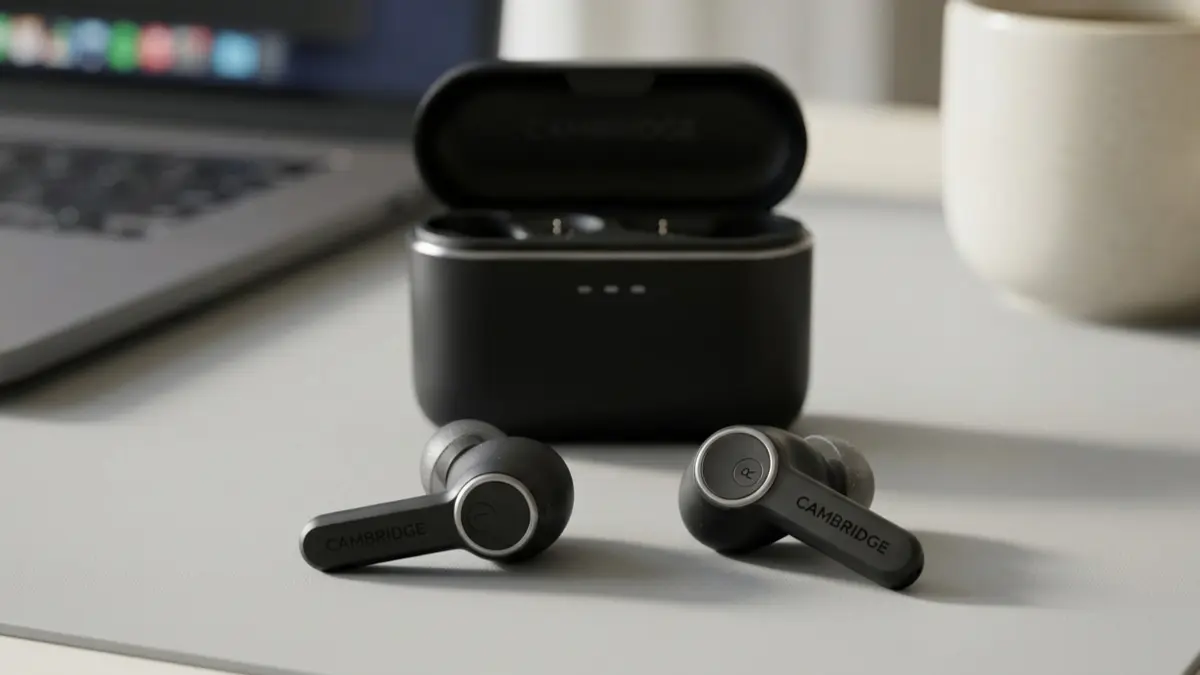
Cambridge Audio has been building hi-fi electronics since 1968. The company’s reputation rests on decades of amplifier and DAC engineering at every price point — and when they brought that philosophy to true wireless earbuds with the Melomania series, the engineering rigour travelled with it. The Melomania A100, launched in June 2025 at approximately £119 / $149 / €140, is the most ambitious application of that thinking in a product you can actually afford.
What Cambridge Audio has assembled here is an unusually rare combination at this price: dual high-resolution codec support — both aptX Lossless and LDAC simultaneously — alongside Class A/B amplification carried over from their full-size amplifier range, a Qualcomm QCC3091 chipset with dual-core Kalimba DSP, Adaptive Active Noise Cancellation with six microphones, and IPX5 water resistance. On paper it reads like a product from a manufacturer charging twice the price. After extended evaluation, the hardware largely makes good on that specification with a musicality and precision that is genuinely uncommon in the mid-range segment.
Quick Verdict
The Cambridge Audio Melomania A100 is among the most technically accomplished true wireless earbuds available under €150 in 2026. It is one of the very few earphones at this price that combines both aptX Lossless and LDAC codec support — delivering high-resolution wireless audio to Qualcomm-equipped Android devices and LDAC-compatible smartphones alike — with genuine hi-fi tuning via Class A/B amplification. Add Adaptive ANC that competes above its price tier, 39 hours of total battery (ANC off), IPX5 water resistance, and a comprehensive companion app, and the result is a remarkably complete package for the money.
Buy them if sound quality is your primary criterion and you want the best-sounding earbuds your money can buy at this tier. Consider alternatives if you regularly make calls in very noisy environments, where the A100’s call microphone performance shows its one meaningful weakness.
Check the latest price and availability for the Cambridge Audio Melomania A100 on Amazon.
Check Price on AmazonAs an Amazon Associate, Topivo earns from qualifying purchases.
Specifications
| Driver | 10mm recycled Neodymium dynamic driver |
| Amplification | Class A/B (analogue, from Cambridge Audio separates) |
| Chipset | Qualcomm QCC3091 + dual-core 240MHz Kalimba DSP |
| Bluetooth Version | 5.4 |
| Audio Codecs | aptX Lossless, aptX Adaptive, LDAC, AAC, SBC |
| Battery — Earbuds (ANC off) | Up to 11 hours |
| Battery — Earbuds (ANC on) | Up to 6.5 hours |
| Battery — Total (ANC off) | Up to 39 hours |
| Battery — Total (ANC on) | Up to 21 hours |
| Fast Charge | 10 min → ~2h (ANC on) or ~3.2h (ANC off) |
| Wireless Charging | Qi-compatible (not Qi-certified) |
| Charging Port | USB-C |
| Water Resistance | IPX5 (earbuds) |
| Weight per Earbud | 4.7g |
| Case Dimensions | 61 × 25 × 45mm (W×D×H) |
| Microphones | 6 mics (ANC + call + voice assistant) |
| Active Noise Cancellation | Adaptive ANC + Transparency Mode |
| Multipoint | Yes — 2 devices simultaneously |
| App | Melomania Connect (iOS & Android) |
| Colors | Matte Black, White |
| Gaming Mode Latency | <80ms |
Design & Build Quality
The Melomania A100 adopts a stem-style in-ear design — an AirPods Pro-influenced silhouette that positions the driver housing in the ear canal and extends a flat stem downward. Cambridge Audio has executed this form factor with a smooth, sculpted finish and subtle silver detailing on the stem that reads premium without being ostentatious. Available in Matte Black and White, both colorways carry a restrained, professional aesthetic equally at home in a boardroom or on a train platform.
At 4.7 grams per earbud, the A100 is among the lighter stem-style earbuds in its class. The charging case is notably compact for the feature set it supports — measuring 61×25×45mm, genuinely pocketable and marginally slimmer than the cases of several direct competitors. It supports both USB-C wired charging and Qi-compatible wireless charging, a capability that most mid-range earbuds omit at this price. One minor ergonomic trade-off: the slim profile positions the earbuds slightly closer together, making them marginally trickier to remove one-handed.
Cambridge Audio has made a notable environmental commitment here: the A100 is constructed with 50% recycled plastics and uses reclaimed Neodymium drivers recovered from manufacturing waste streams. This is not a compromised green product — the recycled materials do not affect acoustic or build performance — but it is a meaningful step for a consumer audio brand.
IPX5 water resistance is applied to the earbuds, providing protection against sustained water jets from any direction. In practice this covers heavy sweat, rain, and the general moisture exposure of daily use. The case does not carry an IP rating and should be kept away from water.
Comfort & Fit
Cambridge Audio supplies multiple ear tip sizes with the A100, accommodating a wide range of ear canal geometries. Correct tip selection matters here: passive seal directly determines both bass reproduction quality and ANC effectiveness. Users who take time to find their correct size consistently report an excellent comfort experience across multi-hour sessions; the 4.7g earbud weight helps ensure the driver housing sits without undue pressure on the ear canal.
The stem design distributes weight across the tragus and lower ear, which most users find more sustainable for extended wear than purely canal-inserted designs. The touch control surface sits at the top of the stem at a natural reach point, and wear detection that pauses playback on removal is responsive and accurate in practice.
For gym and sporting use, IPX5 handles sweat without concern, and the sealed silicone tip design provides more secure physical retention than open-fit alternatives during vigorous movement. The A100 functions convincingly as a sports earphone as well as a listening-focused daily driver.
Sound Quality
Sound quality is the Melomania A100’s defining achievement and its clearest point of separation from the mid-range competition. Cambridge Audio’s engineering philosophy — balance, accuracy, resolution, and dynamics rather than consumer-friendly frequency exaggeration — is applied here in full. The result is an earphone that rewards attention rather than flattering inattention.
The acoustic architecture begins with a 10mm recycled Neodymium dynamic driver — meaningfully larger than the 6–8mm drivers common at this price — driven by genuine Class A/B analogue amplification, the same circuit topology Cambridge Audio uses in its home separates. Almost every portable audio product uses Class D switching amplifiers to minimise power consumption; Class A/B draws more current but delivers lower distortion, better transient response, and a more natural character that distinguishes hi-fi components from consumer electronics. At €140, this is an unusual and deliberate technical choice.
Processing is handled by a dual-core 240MHz Qualcomm Kalimba DSP, which manages signal refinement and Cambridge’s proprietary DynamEQ — a real-time dynamic equalisation system that adjusts bass and treble response to maintain tonal balance at any listening volume. At low levels, DynamEQ compensates for the ear’s reduced sensitivity to low and high frequencies, keeping music sounding full rather than thin.
In listening, the A100 produces what reviewers consistently describe as an unusually wide and realistic soundstage for in-ear earphones — extending laterally in a way that resembles loudspeaker listening more than typical in-ear isolation. Vocal reproduction is particularly strong: voices sit clearly in the mix with natural presence and texture, free of the forward, hyped presentation that consumer tuning uses to simulate clarity. Bass is extended and controlled, with real weight in the lower registers when the music calls for it. Treble is detailed without artificial brightness or listening fatigue.
One important qualification: the A100 sounds best with ANC engaged. Without noise cancellation active, some reviewers note a slightly thinner low-frequency character — a consequence of the unsealed acoustic path that ANC processing partially compensates for. For most real-world use, ANC will be on, and this nuance is primarily relevant for quiet-environment listening without cancellation.
Active Noise Cancellation
The Melomania A100’s Adaptive ANC is powered by the Qualcomm QCC3091 chipset and six microphones — three per earbud — handling both feedforward (external) and feedback (internal) noise sensing. The “Adaptive” designation means the system monitors ambient conditions in real time and adjusts cancellation processing dynamically, rather than applying a fixed curve regardless of environment.
Performance is consistently strong in the transit environments where ANC matters most: trains, the Underground, buses, and aircraft cabins. Low-frequency drone — the most prevalent noise type on public transport — disappears cleanly and with the natural, pressure-free quality of well-calibrated ANC. High-frequency noise from crowds and station announcements is meaningfully reduced. Reviewers who have used the A100 across months of daily commuting consistently rate its ANC performance as competitive with earphones costing significantly more.
Transparency mode is implemented naturally. Tonal character changes minimally when switching between ANC and Transparency — a sign of careful tuning rather than an afterthought. Voice intelligibility in Transparency is good, making it practical for brief conversations without removing the earbuds.
Wind noise is the ANC system’s primary weakness, shared with most earbuds in this category. In breezy outdoor conditions, the feedforward microphones can pick up turbulence and audibly disrupt the cancellation processing. This is a known architectural limitation rather than a Cambridge-specific flaw, but worth noting for users who listen regularly in exposed outdoor environments.
Battery Life & Charging
Cambridge Audio rates the A100 at up to 11 hours per earbud charge with ANC off and up to 6.5 hours with ANC active. Combined with the charging case, total endurance reaches 39 hours ANC-off, or 21 hours with ANC consistently on. These figures align with real-world performance — the 6.5-hour ANC-on figure reflects the Class A/B amplification’s higher power draw relative to Class D alternatives. For the sound quality gain, this is a justified trade-off; 6.5 hours per charge with ANC active remains sufficient for a full commuting day.
Fast charging via USB-C provides approximately 2 hours of ANC-on playback — or roughly 3.2 hours ANC-off — from just 10 minutes on charge. Full charge from empty takes approximately 70 minutes. The case supports Qi-compatible wireless charging in addition to USB-C; note that it is Qi-compatible rather than formally Qi-certified, so compatibility with all charging pads may vary.
Connectivity
Bluetooth 5.4 is the wireless standard in the A100, representing the latest generation available in true wireless earbuds as of 2025–2026. Connection stability is excellent — sustained across multiple rooms and in environments with high wireless device density without the dropouts associated with older Bluetooth implementations. Google Fast Pair enables one-tap pairing with nearby Android devices. Bluetooth multipoint allows simultaneous connection to two devices — a phone and a laptop, for example — with automatic source switching based on audio activity.
Gaming mode reduces latency below 80ms, effectively eliminating the perception of audio delay for mobile gaming, video calls, and any lip-sync-sensitive content. Mono mode allows independent use of a single earbud, and Sleep Mode disables touch controls to prevent accidental activation during overnight wear.
Call Quality
Call quality is the Melomania A100’s only meaningful weakness, and it is worth addressing plainly. In quiet environments — a home office, a calm street, a quiet café — the six-microphone array delivers intelligible and reasonably natural voice reproduction, with call recipients reporting adequate clarity without significant complaints.
Performance degrades in noisy conditions. On busy public transit, in loud open-plan offices, or wherever sustained background noise is present, the AI microphone filtering struggles to isolate voice with the consistency of competitors from Sony or Samsung that have invested more specifically in call microphone tuning. Voice pick-up becomes less defined and background noise bleeds through more audibly. Wind outdoors compounds this, disrupting both outgoing and incoming audio.
For users whose calls are primarily from home, quiet offices, or calm locations, the A100’s call performance is fully adequate. For users who regularly conduct important calls from loud or variable environments, this limitation warrants serious consideration. Cambridge Audio has optimised the A100 around listening performance rather than call performance, and the product reflects those priorities transparently.
App & Features
The Melomania Connect app is available natively on both iOS (App Store) and Android (Google Play and Galaxy Store) — no sideloading required on any major platform. It is one of the stronger companion applications in its price category, offering a feature depth that rewards exploration rather than a set-and-forget approach.
The seven-band graphic equaliser allows per-band adjustment across the full frequency spectrum, with six preset profiles (Flat, Natural, Rock, Blues, Voice, Electronic) as starting points. Flat and Natural presets reflect Cambridge Audio’s reference tuning; genre presets apply targeted adjustments for different content types. Custom EQ profiles can be saved and switched via the app or touch controls, giving the A100 more acoustic adaptability than most earphones at this price.
DynamEQ can be toggled independently of other settings. ANC intensity is adjustable on a continuous scale rather than preset steps, allowing precise control over the trade-off between suppression depth and battery draw. The app also manages wear detection, gaming mode, sleep mode, mono mode, voice assistant access, auto-off timer, and firmware updates. All touch gestures — single tap, double tap, triple tap, press-hold — are independently remappable to any available function. This level of customisation is uncommon at this price and reflects the maturity of the Melomania platform.
Melomania A100 vs Competitors
The A100 competes in the mid-range true wireless segment alongside Sony, Soundcore, and Jabra. Each model prioritises different capabilities, and identifying which matters most to you is the key to the correct choice.
| Feature | Cambridge Audio A100 | Sony WF-C710N | Soundcore Liberty 4 NC | Jabra Evolve2 Buds |
|---|---|---|---|---|
| Amplification | Class A/B (analogue) | Class D (digital) | Class D (digital) | Class D (digital) |
| Hi-Res Codecs | aptX Lossless + LDAC | SBC, AAC only | LDAC only | None |
| Bluetooth | 5.4 | 5.2 | 5.3 | 5.2 |
| Total Battery (ANC off) | 39h | ~35h | ~50h | ~33h |
| Total Battery (ANC on) | 21h | ~28h | ~40h | ~24h |
| ANC Quality | Excellent | Very Good | Good | Excellent |
| Call Quality | Average (noisy environments) | Good | Good | Excellent |
| IP Rating | IPX5 | IPX4 | IPX4 | IPX5 |
| Wireless Charging | Yes (Qi-compatible) | No | No | Yes |
| Price Tier | Mid ~€140 | Mid ~€100 | Mid ~€60 | Pro ~€200+ |
Against the Sony WF-C710N — the A100’s most direct competition by price — Cambridge Audio offers a stronger Bluetooth version, dual hi-res codec support (the WF-C710N is limited to SBC and AAC, with no LDAC or aptX Lossless), Class A/B amplification, Qi-compatible wireless case charging, and IPX5 vs IPX4 water resistance, at a modest price premium. Sony’s call quality in noisy conditions is better, which remains the deciding factor for heavy call users. For dedicated listening, the A100 is the stronger acoustic product by a clear margin.
The Soundcore Liberty 4 NC undercuts the A100 significantly on price and leads on ANC-off battery endurance (up to 50 hours), though its advantage narrows substantially with ANC on (~40 hours) and further with LDAC active (~25 hours). It lacks aptX Lossless and Class A/B amplification. For budget-conscious buyers who prioritise ANC and battery above sound quality, the Liberty 4 NC is a well-executed choice; for listeners who want the best available sound at this tier, the A100 operates in a different league.
The Jabra Evolve2 Buds is a professional product aimed squarely at call use and enterprise integration — outstanding microphone performance and Microsoft Teams certification at a considerably higher price, but no hi-res codec support and no tuning for music. If calls are your primary use case, Jabra is the professional choice. If music is, the A100 wins clearly.
Pros & Cons
Pros
- An unusually rare combination at this price: aptX Lossless and LDAC simultaneously
- Class A/B analogue amplification — uncommon in mid-range true wireless earbuds
- Exceptional hi-fi-tuned sound quality with wide, realistic soundstage
- Adaptive ANC that competes with earphones at significantly higher prices
- 39h total battery (ANC off) / 21h (ANC on); fast charge: 10 min → ~2h ANC-on
- Qi-compatible wireless charging case — rare at this price tier
- IPX5 water resistance — stronger than most mid-range competitors
- Bluetooth 5.4 with Google Fast Pair and dual-device multipoint
- Comprehensive Melomania Connect app: 7-band EQ, full gesture remapping
- Compact, genuinely pocketable charging case
- Built with 50% recycled plastics and reclaimed Neodymium drivers
Cons
- Call quality degrades meaningfully in noisy environments
- Slightly thinner low-frequency character without ANC active
- 6.5h ANC-on per charge — competitive but not class-leading
- Wind noise disrupts ANC and call microphones outdoors
- Slim case makes earbuds slightly tricky to remove one-handed
- No aptX Lossless benefit on iPhone — AAC only for iOS users
Who Should Buy the Melomania A100?
The Melomania A100 is built for a specific type of listener: one who prioritises how their music sounds above everything else, who wants the technical capability to access high-resolution audio without paying flagship prices, and who accepts a modest compromise on call quality in exchange for genuinely exceptional acoustic performance. They stream from Tidal, Qobuz, or Amazon Music HD and want earbuds that can actually deliver the resolution being transmitted. They commute and need effective ANC, but do not conduct frequent calls from loud, unpredictable environments.
Who Should Skip It?
If call quality is your primary criterion — if you conduct regular professional calls from trains, open offices, or busy outdoor locations — the A100’s microphone performance in noisy conditions will disappoint. The Jabra Evolve2 Buds or Sony WF-C710N are better choices for call-first users. iPhone users who cannot benefit from aptX Lossless (iOS routes audio via AAC regardless of earbud capability) will find the codec premium over LDAC-only alternatives reduced, though the Class A/B amplification and sound quality advantage remain. If maximum ANC-on battery per charge is your priority, the Soundcore Liberty 4 NC offers around 8 hours ANC-on per charge at a meaningfully lower price. And if raw ANC suppression depth for the most demanding environments is the requirement, the Sony WF-1000XM6 or Bose QuietComfort Ultra Earbuds lead that specific category at a higher price.
Final Verdict
The Melomania A100 review keeps returning to the same conclusion: Cambridge Audio has built a product that substantially raises the bar for what is achievable at its price point. The combination of Class A/B amplification, dual hi-res codec support (aptX Lossless and LDAC simultaneously), genuinely strong Adaptive ANC, Qi-compatible wireless charging, IPX5 durability, and Bluetooth 5.4 at €140 is an unusually rare specification set at this price. The hardware largely delivers on it, with a musicality and precision that most mid-range earphones cannot match.
The single meaningful limitation — call quality in loud environments — is real and worth knowing before purchasing. For listeners who buy earbuds primarily to listen to music rather than to run calls from busy platforms, it is not a disqualifying trade-off. It is a deliberate prioritisation in favour of acoustic performance, and for the target buyer, it is the correct one.
For anyone outside Apple’s ecosystem who values sound quality and wants to hear their music the way it was recorded — these are among the best earbuds to buy under €150 in 2026.
Score: 9.1 / 10 — Outstanding sound quality and codec specification at a mid-range price. Highly recommended for music-focused listeners.
Check the latest price and availability for the Cambridge Audio Melomania A100 on Amazon.
Check Price on AmazonThis is an affiliate link. We may earn a commission at no extra cost to you.
Frequently Asked Questions