
You’ve noticed it without having a name for it. The same earbuds, the same playlist — but the music sounds fuller and more engaging in your bedroom than it does at a coffee shop, or on the commute, or at the office. Here is the full explanation.
Why Your Earbuds Sound Better in Some Rooms Than Others
Your earbuds haven’t changed. Your music hasn’t changed. But the experience clearly has. The reason involves room acoustics, background noise, cognitive attention, and some genuinely surprising facts about how the brain processes sound depending on where it finds itself.
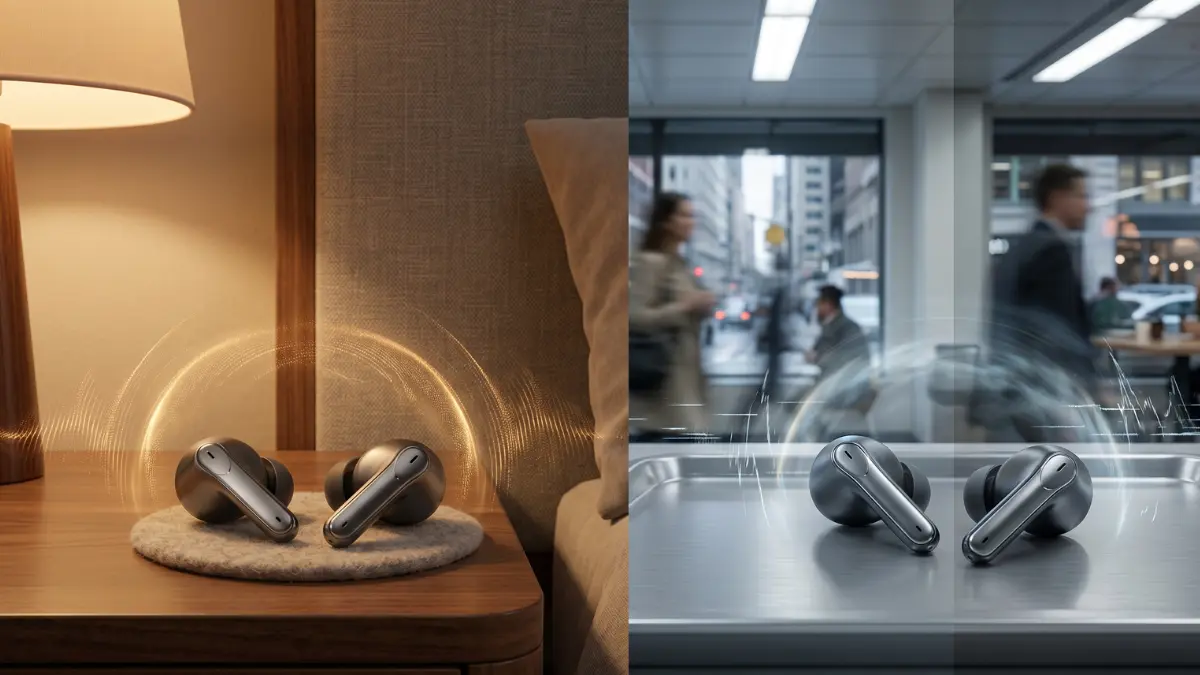
You’re at your desk at home, late evening, everything quiet. You put your earbuds in and the music opens up in a way that feels almost effortless — the bass is present, the details are clear, and you find yourself genuinely absorbed in the sound. It’s one of those listening sessions that reminds you why you like music in the first place.
The next morning, you’re in a coffee shop with the same earbuds, the same playlist at roughly the same volume. Something is off. The sound feels compressed, slightly thin, lacking the depth it had the night before. You turn the volume up a notch. It doesn’t quite help. The music is present but you’re not in it the same way.
This experience is near-universal among people who listen to music seriously, and it’s almost never discussed in reviews or buying guides. Hardware reviews measure earbuds in anechoic chambers under controlled conditions. They don’t measure how earbuds perform inside the actual environments people use them in — and the gap between those two situations is substantial.
What’s really happening when the same earbuds sound dramatically different from one location to the next involves several distinct mechanisms that interact in ways that are more interesting than most people expect.
In This Article
- Room Acoustics: What They Actually Affect
- Background Noise and the Masking Effect
- Cognitive Attention: The Brain’s Role
- Why Your Nervous System State Matters
- Why Home Usually Sounds Best
- Why the Coffee Shop Sounds Worse
- The Commute Problem
- Where ANC Fits In
- How to Make Any Room Sound Better
- Final Verdict
- Frequently Asked Questions
Room Acoustics: What They Actually Affect
The first thing to get right is what room acoustics actually change — and what they don’t. This is a point of genuine confusion, because room acoustics have an enormous effect on speakers but a much more limited direct effect on in-ear earbuds.
When a speaker plays sound, it projects audio waves into the room. Those waves bounce off walls, floors, ceilings, and furniture before reaching the listener’s ears. A room with hard, parallel surfaces — bare concrete floors, glass walls, no soft furnishings — creates dense, uncontrolled reflections that arrive at the ears milliseconds after the direct sound. The result is a smearing of transients, artificial reverb, and a general muddiness that degrades clarity regardless of how good the speakers are.
A room treated with absorptive materials — carpets, bookshelves lined with books, upholstered furniture, heavy curtains — absorbs many of those reflections. The direct sound reaches the ear with less interference, and the perceived clarity improves substantially.
In-ear earbuds that seal the ear canal bypass most of this. The acoustic signal travels directly from driver to eardrum through a sealed column of air. The room’s surfaces don’t participate meaningfully in that signal path. If you’re wearing well-sealing in-ear monitors, you could be in a reverberant bathroom or a carpeted bedroom and the frequency response your eardrums receive would be nearly identical.
Open-back headphones and earphones without a seal sit in a middle ground. Because they don’t isolate the ear canal, ambient sound and some degree of room reflection does bleed into the listening experience. For the majority of consumers using standard silicone-tip earbuds, however, the acoustic isolation means room acoustics are acting through psychological and environmental channels, not physical ones.
Background Noise and the Masking Effect
The most direct and measurable way a room affects earbud listening is through its ambient noise floor. Every environment has one — the hum of refrigerators and HVAC systems at home, conversation and coffee machine noise in a café, engine rumble and friction noise on public transit. The level of this background noise has concrete, measurable consequences for what you can and cannot hear in your music.
The phenomenon is called auditory masking. When two sounds occupy similar frequency ranges simultaneously, the louder sound partially or completely obscures the quieter one. Low-frequency noise — the kind produced by engines, ventilation systems, and street traffic — is particularly effective at masking bass frequencies in music. This is why the bass in your earbuds seems to disappear on the bus or subway, even at volumes that sounded full and present at home. The ambient noise isn’t just competing with the music; it’s actively occupying the same frequency space and winning.
High-frequency ambient noise — conversational speech in a busy café, the clatter of cups and cutlery — masks upper midrange and treble details. The subtle overtones of a guitar, the breath of a vocalist, the precise attack of a hi-hat — all of these exist in frequency ranges that get buried when there’s competing noise in the same band.
What remains audible in a noisy environment tends to be the loudest, most energetically prominent elements: punchy kick drums, sustained synth notes, the broadest strokes of the mix. The texture and detail that makes music feel three-dimensional and alive gets masked first. The result is that your earbuds sound like a degraded version of themselves — not because they are, but because the room’s noise floor is functionally equalizing your listening experience in real time.
The Lombard Effect and Volume Compensation
Most people respond to ambient noise by turning up the volume — an instinctive, often unconscious behavior that psychologists call the Lombard effect, originally described in the context of voices but equally applicable to how people adjust music playback. The problem is that raising volume doesn’t restore the masked details the way it might seem like it should. Masking is a ratio relationship. If the noise floor rises, the entire music signal needs to rise proportionally to maintain the same perceptual signal-to-noise ratio. The details that were being masked at 60% volume are still being masked at 80%, because the ambient noise is still present and competing in the same frequency ranges.
Higher volumes in noisy environments also introduce a different problem: listening fatigue. The auditory system processes loud sounds with more strain, attention narrows, and the engagement that makes music rewarding starts to diminish even as the absolute volume increases. This is why the volume compensation instinct rarely solves the noisy café problem — it often compounds it.
Cognitive Attention: The Brain’s Role in Audio Quality
Hearing is not a passive process. The auditory cortex doesn’t simply receive and record sound the way a microphone does. It actively processes, filters, and prioritizes incoming audio information based on what the brain has determined is relevant, meaningful, or potentially threatening in the current context. This processing is shaped by attention — and attention is a finite, allocatable cognitive resource.
In a quiet, familiar environment, a large portion of your attentional capacity is available for music. The brain can afford to process subtle information: the spatial imaging of the mix, the dynamic range between soft and loud passages, the harmonic overtones that give instruments their characteristic timbres. These are low-priority signals in survival terms, and they only get processed richly when there’s cognitive bandwidth to spare.
In a busy, novel, or cognitively demanding environment — a coffee shop, an airport, a new city — the auditory system is doing double duty. It’s simultaneously processing the music and scanning the environment for meaningful signals: a name that sounds like yours, a sudden loud noise, a snippet of conversation that might be relevant. This environmental monitoring is automatic and largely unconscious, but it consumes attentional resources. The music gets fewer cognitive cycles, and the result is that its subtleties register less.
This is not a placebo effect or a matter of imagination. Neuroimaging studies of auditory attention consistently show that the same acoustic signal is processed differently by the brain depending on what else is demanding attention at the time. The musical experience you have — its richness, its emotional impact, its perceived detail — is a product of both the signal entering your ears and the cognitive resources your brain allocates to interpreting it. The room shapes the latter even when it has no effect on the former.
Why Your Nervous System State Matters
There’s a deeper layer beneath cognitive attention that is less often discussed: the state of your autonomic nervous system. The nervous system operates on a spectrum between sympathetic activation — the alert, vigilant, ready-to-respond state associated with stress, novelty, and public environments — and parasympathetic activation — the relaxed, at-rest state associated with safety, familiarity, and private space.
These two states don’t just affect mood. They change the physiology of hearing in measurable ways. In a sympathetically activated state, auditory sensitivity shifts toward frequencies and patterns associated with threat and communication — roughly the 2–4 kHz range where speech intelligibility and alerting sounds live. The nervous system effectively narrows its sonic focus to what might be important for survival. Music, particularly its low-frequency body and its spatial qualities, becomes peripherally processed.
In a parasympathetically activated state — relaxed, at home, low sensory demand — the auditory system broadens. The full frequency range receives more equal processing weight. The bass that grounds a track, the space around instruments, the subtlety of a performance — all of it is more accessible to perception when the brain isn’t preoccupied with readiness.
This explains why many people find that music sounds best late at night in a quiet home, or during a relaxed morning before the day has begun to create cognitive demands. It isn’t that the earbuds are better at those times. It’s that the listener is in a physiological state that allows deeper audio engagement. The hardware hasn’t changed. The receiver has.
Why Home Usually Sounds Best
The home listening environment tends to outperform nearly every other location for a convergence of reasons that now make clear sense.
Noise floors at home are typically the lowest of any environment most people regularly occupy. There’s no competing speech, no machinery, no street noise beyond what seeps through the building. The masking problem is at its minimum. The full frequency range of the music — including the low-level details that ambient noise buries first — remains audible at moderate listening volumes.
The home environment is also deeply familiar. The auditory system has extensively mapped its sonic characteristics — the particular resonance of the rooms, the typical sounds of appliances, the baseline auditory texture of the space. Familiarity reduces the cognitive load of environmental monitoring. There’s no need to scan for novel or potentially meaningful sounds, because the brain knows this environment and has decided it’s safe. Attentional resources flow toward music rather than away from it.
Physical comfort matters too. At home, you’re likely seated or lying in a position you’ve chosen. Your body is relaxed. Muscle tension — which can alter earphone fit and seal quality even if subtly — is lower. The parasympathetic nervous system is more likely to be dominant. The cognitive state that maximizes audio engagement is the natural resting state of being at home, not a condition you need to engineer.
Why the Coffee Shop Sounds Worse
The coffee shop is almost the inverse of the home listening environment in every relevant dimension. Its noise floor is one of the most challenging of any public space — a complex, spectrally rich mixture of espresso machines, ambient music from speakers, conversational speech at multiple distances and volumes, footsteps, and the acoustic reflections of hard surfaces. The masking load this imposes on any earbuds is substantial.
The environment is also novel and socially charged. Human brains are extraordinarily sensitive to speech — the auditory system has dedicated neural resources for processing language, and background speech activates those resources even when you’re not trying to listen to it. A coffee shop full of conversations isn’t just ambient noise. It’s a constant stream of language signals that your auditory cortex is processing in the background whether you want it to or not. This is the cocktail party problem in its everyday form, and it consumes cognitive bandwidth that would otherwise go toward music.
The social environment adds another layer. In a public space, self-consciousness and social awareness remain at least partially active. You may be aware of your surroundings, making occasional eye contact, monitoring whether anyone is approaching or speaking to you. This low-level social vigilance is sympathetic in character — it keeps the nervous system in the alert, environment-monitoring state that reduces deep engagement with passive stimuli like music.
The Commute Problem
Public transit is one of the most acoustically hostile environments for earbuds, and understanding why clarifies several things about noise, masking, and why earbuds always seem to underperform during a commute.
Trains and buses generate intense low-frequency noise from engines, wheels on tracks, and structural vibration — exactly the frequency range where bass in music lives. This isn’t incidental overlap. The 50–300 Hz range is simultaneously where transit noise is loudest and where musical bass and low-midrange warmth reside. The physical masking here is severe. No amount of volume compensation meaningfully restores the bass that’s being buried by a subway car’s mechanical drone.
There’s also the motion factor. Vibration from the vehicle reaches the body, including the ears and the earbuds themselves. The physical seal of the earbuds is subject to micro-movement. The vestibular system — which handles balance and spatial orientation — is actively processing motion input, and the brain’s integration of vestibular and auditory signals during motion is a cognitively demanding task that competes with music attention.
The commute also tends to be a time of functional stress. You’re moving toward an obligation, operating on a schedule, navigating crowds and platforms. The sympathetic nervous system is typically activated. The deep relaxation that enables the richest audio engagement is structurally unavailable regardless of how good your earbuds are.
This is one of the most honest arguments for active noise cancellation — not because ANC makes earbuds sound better in an absolute sense, but because it reduces the low-frequency noise floor of transit environments, which partially restores the bass response that masking was burying. The improvement ANC provides in these conditions isn’t primarily about isolation comfort. It’s about recovering masked audio information. For a direct comparison of how ANC and passive isolation handle these conditions differently, our ANC vs. passive isolation breakdown covers the specifics.
Where ANC Fits In
Active noise cancellation is often discussed as though its primary benefit is comfort — a way to make travel less tiring, to create a sense of quiet. That framing is accurate but incomplete. ANC’s effect on audio quality is real and follows directly from what we’ve covered about masking.
When ANC reduces the ambient noise floor by 20–30 dB in the frequencies it handles well — primarily below 500 Hz — it lowers the masking threshold in those ranges. Low-frequency musical details that were being obscured by transit or HVAC noise become audible again at the same listening volume. The bass returns. The music regains some of the depth and body that the noise floor was swallowing.
This is a genuine, physics-based improvement in the listening experience in high-noise environments. It’s not psychoacoustic in character — it’s a direct consequence of removing the masking stimulus. People who find that their earbuds sound dramatically better with ANC on during a commute are not experiencing placebo. They’re hearing information that was objectively inaudible before the noise floor was reduced.
The limits of ANC are equally important to understand, though. ANC handles low-frequency, consistent noise well. It handles irregular, mid-to-high frequency noise — conversational speech, the clatter of dishes — poorly. The cognitive attention and nervous system effects of a busy coffee shop are not addressed by ANC at all. You can cancel the background hum of the HVAC and still find that the café’s social energy and conversational noise degrades your listening engagement in ways that no hardware can fix.
How to Make Any Room Sound Better
Understanding the mechanisms behind room-dependent listening quality points toward practical interventions that are more effective than most people realize — and most of them cost nothing.
Reduce the Noise Floor First
Before adjusting any setting on the earbuds or the phone, address the room’s ambient noise level. Close doors and windows against street noise. Turn off fans and appliances that aren’t necessary. Move away from HVAC vents. The noise floor of the listening environment is the single most impactful variable, and every decibel you remove from the ambient background directly improves the signal-to-noise ratio your ears are operating with.
Choose the Right Physical Space
Not all spaces within the same building are equivalent. A carpeted room with bookshelves and upholstered furniture is quieter and less reverberant than a tiled kitchen or an echoey hallway. The bedroom is usually quieter than the living room, which has more ambient social activity. These differences matter even for sealed earbuds because the noise floor they create affects masking. Choosing to listen in the quieter room isn’t audiophile fussiness — it’s a rational response to real acoustic physics.
Time the Listening Session
Environmental noise floors vary by time of day in ways that are consistent and predictable. Early morning and late evening are almost universally quieter than midday. Domestic activity — cooking, conversations, appliances — rises through the day and falls in the evening. If you have flexibility about when you listen, these temporal patterns in noise floor are worth using. The late-night listening session that sounds inexplicably better than the same music at noon is often explained simply by a lower ambient noise floor and a more relaxed nervous system state.
Reduce Cognitive Load Before Listening
This sounds abstract but has practical implications. Starting a focused listening session immediately after a stressful meeting or an intense task leaves the auditory attention system depleted. A brief transition — five minutes of not looking at screens, a short walk, anything that allows the cognitive state to shift toward baseline — can meaningfully improve the quality of the subsequent listening experience. The earbuds perform the same. You receive them differently.
Match the Listening Context to the Genre
Some genres are more tolerant of noisy environments than others. High-energy electronic music with prominent bass and bright treble — the frequencies that survive masking best — can be satisfying during a commute in a way that an intimate jazz recording or a classical string quartet simply cannot. The latter genres contain much of their meaning in midrange detail, dynamic subtlety, and spatial imaging — precisely the qualities that ambient noise and divided attention suppress. Matching the music to the environment isn’t a compromise. It’s an acknowledgment that different listening contexts have different acoustic and cognitive properties.
Final Verdict
The experience of earbuds sounding dramatically better in some environments than others is not imagined, not a quirk of specific hardware, and not a placebo. It reflects real mechanisms operating at the physical level — ambient noise masking the audio signal in specific frequency ranges — and at the neurological level — cognitive attention and nervous system state directly shaping how richly the brain processes the sound it receives.
Room acoustics matter less for sealed in-ear earbuds than most people assume. What matters more is the noise floor of the environment, the cognitive demands being placed on the listener, and the physiological state the listener is in. A quiet bedroom with a relaxed listener is not just a nicer place to listen — it is objectively a different acoustic and cognitive environment that produces measurably different audio perception from the same hardware.
This has a practical implication that goes beyond earbuds. Reviews conducted in controlled environments miss the most variable part of the listening equation: you, in your actual life, in your actual rooms. The earbuds that sound best in an anechoic chamber don’t always win in a noisy commute or a busy workspace. And the earbuds that seem average in a store demo can sound genuinely excellent in the right room, at the right time, when your brain is ready to actually listen.
Environment is not a footnote. It’s a variable that rivals hardware quality in its effect on the experience. Understanding it doesn’t require better earbuds. It just requires better listening conditions — which are often closer and cheaper to achieve than a new pair of earbuds.
Frequently Asked Questions