
Spending more on earbuds doesn’t guarantee a better listening experience. The science of auditory perception explains why — and the answer has far more to do with your brain than with the hardware inside the earbuds.
Why Expensive Earbuds Don’t Always Sound Better (The Psychology Behind It)
Premium earbuds carry premium prices — but research in psychoacoustics consistently shows that the gap between what you pay and what you actually hear is not linear. Here is the full explanation, from the expectation effect and auditory adaptation to tuning philosophy, fit physics, and the real ceiling of hardware performance.
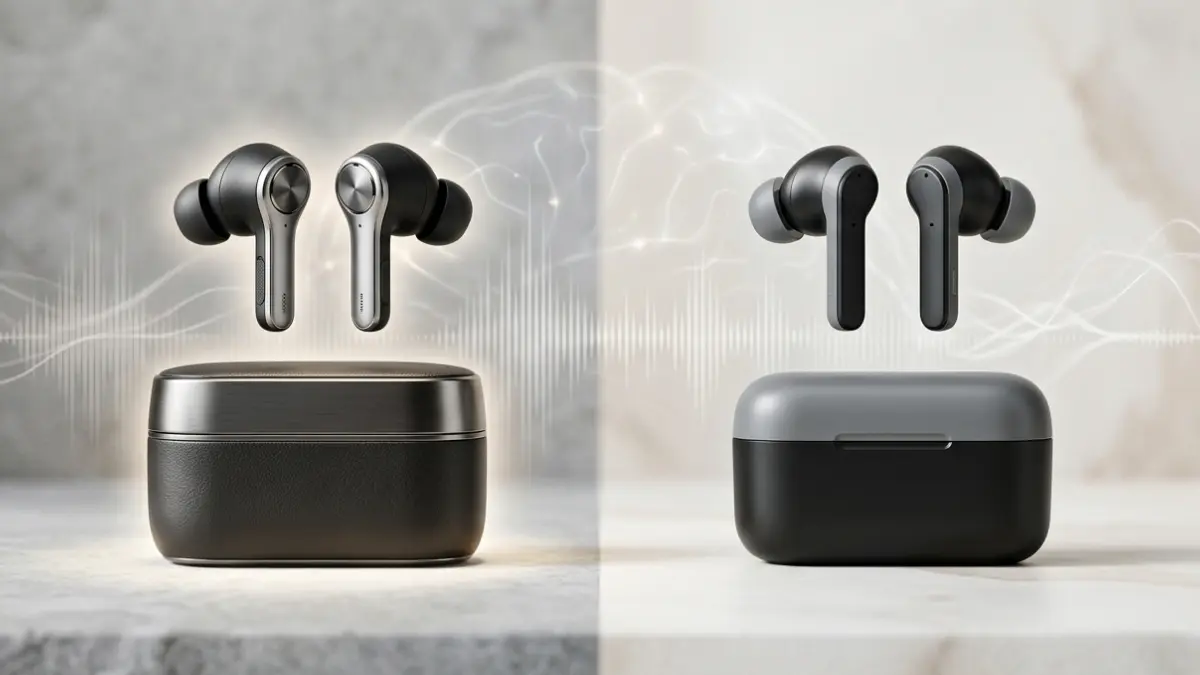
You’ve done it. Spent $300 on a pair of premium earbuds, pressed play on your favorite track, and felt — somehow — underwhelmed. Meanwhile, your friend pulls out a $40 pair and swears they’re the best thing they’ve ever heard. You check your settings. You try a different source. You wonder if you bought the wrong model. Nothing helps.
Or perhaps the opposite: you borrowed an expensive pair expecting to be transformed, and walked away surprised by how ordinary they sounded against your far cheaper daily pair. Something about the bass. Or the lack of it. The whole thing seemed flatter, quieter, less alive than expected.
Neither of these experiences is a malfunction, a bad batch, or a sign of unsophisticated taste. They are the predictable outcome of how human hearing actually works — and of how the audio industry has learned, sometimes deliberately, to exploit it.
In This Article
The Expectation Effect: Why Price Changes What You Hear
In 2008, researchers at the California Institute of Technology ran a study that has since become a reference point in both marketing science and neuroscience. Participants were asked to taste identical wine samples. The only variable was the stated price: $5 per bottle in one condition, $45 in the other. Brain imaging showed measurably greater activity in the medial orbitofrontal cortex — the region associated with experienced pleasure — when participants believed they were drinking the more expensive wine. Their enjoyment wasn’t just reported differently. It was neurologically different.
The wine was the same. The experience was not.
Audio perception follows almost the same mechanism. When you know you are wearing $350 earbuds, your brain enters a state of what researchers call confirmatory listening — a mode in which it actively searches for the qualities it has been primed to expect. Richness. Detail. Warmth. Spatial separation. The brain finds evidence of these qualities because it is looking for them, and because auditory perception is far more top-down than most people assume. What you believe about a sound shapes what you hear from it, in ways that are measurable and repeatable.
When you are wearing budget earbuds — and you know it — the opposite dynamic applies. You are primed to notice shortcomings. Every slightly harsh high frequency or muddy bass note serves as evidence for the hypothesis your brain already arrived with. The expectation precedes the listening and determines much of what gets registered as either quality or flaw.
The audio industry has understood this for decades, even if it rarely says so directly. It explains why premium products arrive in heavy, magnetically sealed boxes with felt-lined interiors. Why the unboxing ritual is engineered with the same care as the acoustic tuning. Why product weight — a variable with zero acoustic relevance — is deliberately designed to feel substantial. Every sensory input before the first note plays is programming the auditory cortex to hear something worth the money. In many cases, that programming is the most effective component in the whole system.
The First Listen Illusion
There is a phenomenon in audio circles sometimes called the honeymoon effect: a new pair of earbuds almost always sounds impressive on first listen, regardless of price. Your auditory system is encountering a new spectral signature for the first time, and novelty registers as quality. The brain’s reward circuitry responds to new perceptual input with a mild surge of engagement that has nothing to do with acoustic accuracy.
For expensive earbuds, this honeymoon can set up a particular kind of disappointment. The listener arrives with high expectations, fueled by reviews, price tags, and marketing copy. The first listen must clear a very high bar. If the tuning is neutral — as many genuinely well-engineered earbuds are — the initial impression may feel underwhelming compared to a bass-heavy budget pair that sounds immediately dramatic and exciting.
This is one of the most consistent findings in audio perception research: accurate earbuds often lose first impressions to exciting ones. A flat frequency response sounds balanced, detailed, and natural — but natural is not exciting. It takes familiarity and calibrated expectations to appreciate neutrality, which is exactly what a first-time listener in an uncontrolled environment does not have.
The implication is counterintuitive but important. Many listeners who dismiss premium earbuds as “not worth it” after a brief comparison are making that judgment from precisely the worst possible evaluative position: high expectation, no adaptation time, no blind methodology, and no familiarity with reference-grade tuning. The earbuds may not have had a fair test at all.
How Brands Tune for Perception, Not Accuracy
The tuning of an earbud is the most controllable variable in the entire design process — and for most manufacturers, it is primarily a psychological decision, not an acoustic one. The question is not: what does this source material actually sound like? The question is: what will make a listener, at this price point, believe they are hearing something excellent?
The answers differ dramatically by market tier. Budget manufacturers almost universally use some version of V-shaped tuning — elevated bass and boosted upper treble, with the midrange pushed back. This produces immediate drama: thumping low end, a shimmer of apparent detail in the high frequencies, and a sense of power and energy that reads as quality to an unacclimated ear. It is deliberately calibrated for the evaluation window — the five to thirty minutes a consumer spends assessing a product before purchase, whether in a store, at a desk, or in an unboxing video. Long-term accuracy is secondary.
Some brands layer an additional tactic on top: a sharp boost in the 8–12 kHz range that adds an impression of “air” and detail resolution. It sounds like the earbuds are revealing information that cheaper hardware couldn’t reach. In practice it is an artifact — an energized shimmer that triggers the psychoacoustic response associated with high-frequency resolution without actually delivering it. The illusion is convincing for exactly as long as the brain hasn’t learned to interpret it as distortion.
Premium manufacturers face a different set of decisions. Sony’s WF-1000XM series uses a relatively balanced tuning profile but invests heavily in signal processing — DSEE Extreme upscaling and 360 Reality Audio create a spatial impression that listeners interpret as resolution and premium quality. Apple’s AirPods Pro builds perceived quality partly through Transparency mode and Spatial Audio, which produce a dimensional listening experience the brain reads as depth and sophistication. Neither approach is dishonest. Both reveal the same underlying truth: tuning is consumer psychology at least as much as it is acoustics. The frequency curve that ships in a consumer product is designed to match a preference target derived from listener research, not objective fidelity to the source recording.
Your Brain Adapts Faster Than You Think
The auditory cortex maintains a running model of the sonic environment it regularly encounters. When it is exposed repeatedly to a consistent stimulus — including a specific frequency response — it recalibrates its internal expectations around that stimulus. Psychoacousticians call this auditory adaptation, and it is one of the most underappreciated mechanisms in consumer audio perception.
The recalibration happens faster than most listeners expect. Research suggests that meaningful adaptation to a new sound signature occurs within roughly 15 to 20 minutes of sustained listening. After that window, the boosted bass that felt dramatic on minute one sounds normal by minute twenty. The bright treble that seemed to reveal detail now simply sounds like the baseline. The earbuds have not changed. The listener’s auditory cortex has shifted its reference point to accommodate them.
This creates a structural problem for how earbuds are evaluated. Almost every review, comparison, and purchasing decision in the consumer audio space is made based on impressions formed within this adaptation window — before the brain has settled in. The judgment being made is not “how do these earbuds actually sound?” It is “how do these earbuds sound compared to whatever I was listening to immediately before?” That is a very different question, and it explains a great deal of why audio perception is so inconsistent and so susceptible to framing effects.
The inverse of this is equally important. Listeners who spend extended time with neutrally tuned earbuds — well-regarded IEMs, reference monitors, or carefully voiced premium earbuds — find that returning to consumer-tuned hardware sounds exaggerated, artificial, and fatiguing. The hierarchy inverts completely. What once seemed exciting now sounds like a caricature. What once seemed flat now sounds accurate. This analysis of why earbuds seem to change over time covers the neuroscience of auditory recalibration in considerably more depth.
When Expensive Earbuds Actually Do Sound Better
This is not an argument that price is irrelevant. In specific contexts, genuine technical advantages that only significant engineering investment can deliver become audible — and meaningful. Knowing which contexts those are is the relevant skill for any audio purchase decision.
Driver Distortion at Volume
At moderate to high listening volumes, budget dynamic drivers begin to distort. The membrane reaches the limits of its excursion range and produces harmonic artifacts — a subtle muddiness or compression that appears first in bass-heavy passages and dense mixes. A well-engineered driver — whether a premium dynamic, a balanced armature, or a planar magnetic design — maintains low total harmonic distortion (THD) at the same volumes. If you listen loud, this difference is real and audible, and no amount of EQ or expectation management compensates for it.
Advanced Noise Cancellation
Adaptive ANC systems in the $200 and above tier use microphone arrays and processing algorithms that are genuinely more capable than their budget counterparts. Sony’s WH/WF-1000XM series and Apple’s AirPods Pro 2 apply real-time environmental analysis to calibrate cancellation continuously. In high-noise environments — aircraft, commuter rail, open-plan offices — the difference between capable and excellent ANC is not a perceptual effect. It is the difference between a usable experience and an exhausting one, and it compounds significantly over multi-hour use.
Soundstage and Imaging in Audiophile IEMs
For listeners playing lossless or high-resolution audio files and using purpose-built IEMs, the spatial imaging advantage of multi-driver designs is real. A three-way crossover IEM from a company like Campfire Audio, Moondrop, or Etymotic creates instrument separation and three-dimensional placement that a single-driver budget earbud cannot replicate — because the underlying architecture produces a fundamentally different spatial presentation. This matters if you listen at that level. It is largely irrelevant if you stream at standard quality through a phone.
What Actually Makes Earbuds Sound Better
Strip away the price, the packaging, and the marketing — and the variables that actually determine listening satisfaction reduce to a short, unglamorous list.
Fit and Acoustic Seal
An earbud that creates a proper acoustic seal in the ear canal produces substantially more bass response than a poorly fitting alternative running identical hardware. The difference can measure 10 to 15 dB at low frequencies — more than any driver upgrade at any price point could deliver. No earphone engineering compensates for a seal that doesn’t work for a particular anatomy. This is why ear tip selection has an outsized impact on the final listening experience, and why switching to foam tips on a budget pair often sounds like a meaningful hardware upgrade.
Tuning Match to Personal Preference
Whether a frequency response aligns with an individual’s established listening baseline determines satisfaction more reliably than objective accuracy. A listener who has spent years with bass-heavy consumer earbuds will find neutral tuning thin and unengaging until their brain has adapted. A listener calibrated to reference sound will find V-shaped tuning fatiguing and artificial. There is no universally correct tuning — there is only match or mismatch between the earbud’s frequency response and the listener’s current expectation model.
Volume Parity
Louder sounds better to most people under casual comparison conditions. This is one of the most consistently demonstrated effects in psychoacoustics, and it is routinely — whether deliberately or not — present in retail and review comparisons. Many earbuds that seem to “sound better” in a side-by-side comparison are simply outputting higher SPL at the same volume setting. Level-matched blind comparisons consistently narrow the perceived quality gap between products. If you are comparing earbuds without controlling for matched output level, you are not measuring audio quality. You are measuring loudness preference.
Source Quality
A $300 earbud playing a 128 kbps stream will sound worse than a $50 earbud playing a lossless local file. Source quality gates the entire listening chain, and most people listen through streaming services at quality settings that make finer distinctions in driver engineering largely irrelevant. The upstream bottleneck renders the downstream investment less meaningful than specifications suggest. If your primary use case is streaming on a phone, driver quality beyond a basic threshold has limited impact on your actual daily experience.
Auditory Adaptation State
What you listened to immediately before shapes what you hear in the next session. Moving from a loud, bass-heavy commute to a quiet room produces dramatically different immediate impressions of the same earbuds. Switching from bass-heavy earbuds to a neutral pair makes the neutral pair sound thin. Switching from a neutral pair back makes V-shaped earbuds sound boosted and artificial. The evaluation context affects the outcome as much as the hardware being evaluated — but it is almost never controlled for in casual comparisons, which is why casual comparisons so often produce inconsistent and misleading conclusions.
Final Verdict
The assumption that expensive earbuds sound better is not wrong as a generalization — but it is dramatically overstated as a rule, and the mechanisms behind it are almost nothing like most people assume.
Much of what is attributed to superior hardware is actually expectation doing the work. Much of what is evaluated as “sound quality” in a quick comparison is tuning philosophy exploiting psychoacoustic reflexes — not driver technology delivering genuine resolution. Much of what listeners experience as improvement over time is auditory adaptation recalibrating the brain’s baseline, not the earbuds changing at all.
Expensive earbuds can and do offer real advantages in specific areas: distortion control at high volumes, advanced noise cancellation, spatial imaging in audiophile configurations. These advantages are real, measurable, and worth paying for in the contexts where they matter. But they do not scale linearly with cost above the $100 threshold, and they are not what most casual listeners are evaluating when they make a quick price comparison.
The more accurate model is this: the most important factor in your listening experience is not what you paid. It is how well the earbuds fit your ears, how their tuning matches your current adaptation state, and what you believe about them before the music starts. That last variable is both the most underestimated and, in practical terms, among the most powerful in the entire chain. For earbuds at every price point that account for these realities, our guide to the best wireless earbuds in 2026 covers real-world picks with this framework in mind.
Frequently Asked Questions