
Best Earbuds for Travel (2026)
Whether you’re crossing time zones on a fourteen-hour flight or navigating a labyrinth of European train stations, the right pair of earbuds can define the entire experience. This is our definitive guide to the best travel earbuds of 2026 — chosen for comfort, portability, reliability, and real-world usability on the move.
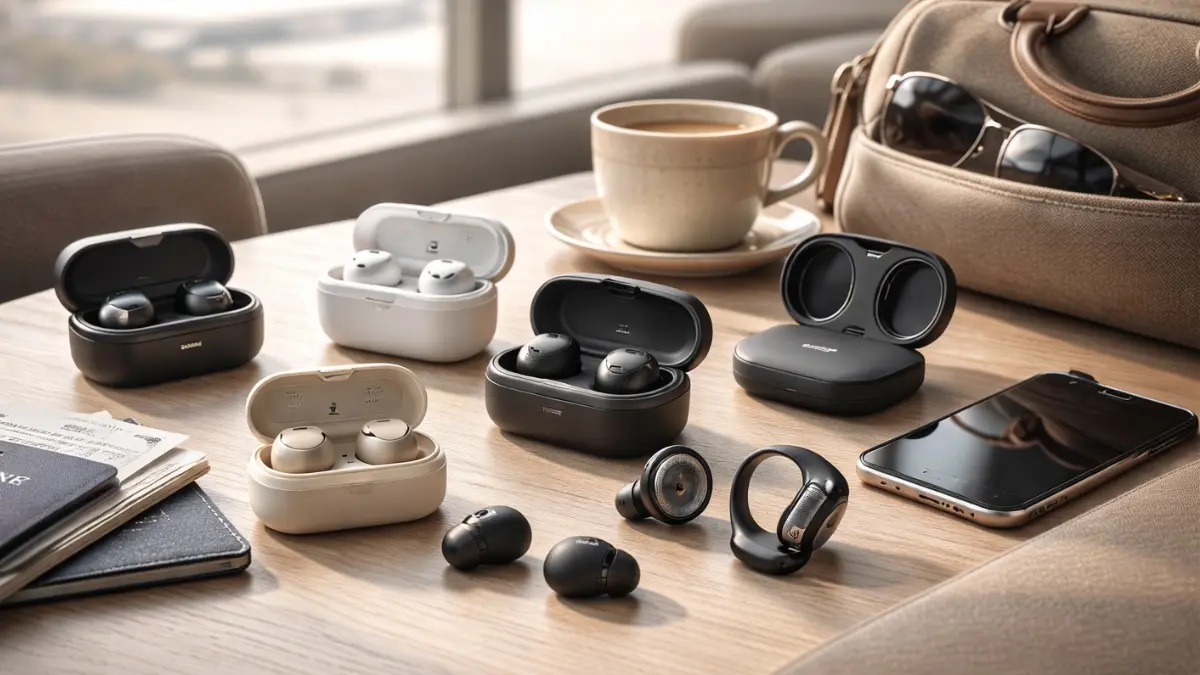
Not all earbuds are created equal, and nowhere does that gap show more clearly than during travel. The earbuds that work beautifully for a morning gym session may fall apart on a ten-hour transatlantic crossing — wrong fit, dying battery, weak seal, or an app that doesn’t behave on airplane mode. The best travel earbuds solve a specific set of problems: they block out the relentless drone of a jet engine, they stay comfortable through passport control and boarding delays and that endless middle stretch over the Atlantic, and they slip into your jacket pocket without drama. Finding earbuds that check every one of those boxes takes more than reading a spec sheet.
This guide is built specifically for travelers — not audiophiles testing in silent rooms, and not gym-goers who need a bomb-proof grip. Our picks are evaluated on the metrics that actually matter mid-journey: noise cancellation depth and consistency, per-charge battery (because you won’t always have a USB port handy), case size and pocketability, transparency mode quality for hearing boarding announcements, call performance in loud terminals, connection stability, and the kind of ergonomic fit that doesn’t start hurting three hours in. We also cover different traveler profiles: budget-conscious, Apple-ecosystem, Android-native, durability-first, and open-ear awareness.
If noise cancellation is your primary and overriding concern for flying, our dedicated guide to the best ANC earbuds for travel goes deeper on that singular priority. But if you want the full picture — the best earbuds for every kind of trip, every kind of traveler — you’re in the right place. Here are the eight best travel earbuds of 2026, ranked and reviewed.
Best Earbuds for Travel (2026): Our Top Picks
Pros
- Best-in-class ANC for planes and trains
- Up to 12 hrs ANC playback (36 with case)
- Refined comfort with foam tip options
- Auto NC Optimizer adjusts to environment
- Excellent sound quality and app control
Cons
- Premium price point
- Case is slightly larger than some rivals
- Earpiece shape may not suit all ears
In This Article
- Best Picks at a Glance
- Best Overall: Sony WF-1000XM6
- Best for iPhone: AirPods Pro 2
- Best ANC: Bose QC Ultra Earbuds
- Best for Android: Galaxy Buds 3 Pro
- Best Budget: Soundcore Liberty 4 NC
- Best Durability: Jabra Elite 8 Active Gen 2
- Best Open-Ear: Shokz OpenFit Pro
- Best Ultra-Budget: TOZO NC9
- What Actually Matters in Travel Earbuds
- Are ANC Earbuds Always Best for Travel?
- How to Choose the Right Travel Earbuds
- Side-by-Side Comparison
- Who Should Buy Travel Earbuds
- Final Verdict
- Frequently Asked Questions
Best Picks at a Glance
A quick-scan overview of all eight picks, ranked by overall travel performance score.
| # | Model | Score | Best For | Battery (Buds + Case) | Price Tier |
|---|---|---|---|---|---|
| 1 | Sony WF-1000XM6 | 9.2 | Best Overall | 12h + 36h | Premium |
| 2 | AirPods Pro 2 (USB-C) | 9.0 | iPhone Users | 6h + 30h | Premium |
| 3 | Bose QC Ultra Earbuds | 8.9 | Strongest ANC | 6h + 24h | Ultra-Premium |
| 4 | Samsung Galaxy Buds 3 Pro | 8.8 | Android Users | 6h + 30h | Premium |
| 5 | Jabra Elite 8 Active Gen 2 | 8.7 | Durability & Calls | 8h + 32h | Mid-Range |
| 6 | Soundcore Liberty 4 NC | 8.6 | Best Budget | 10h + 50h | Budget |
| 7 | Shokz OpenFit Pro | 8.3 | Open-Ear Awareness | 10h + 28h | Mid-Range |
| 8 | TOZO NC9 | 7.9 | Ultra-Budget | 7h + 42h | Budget |
Sony WF-1000XM6
The Sony WF-1000XM6 is the benchmark against which every other travel earbud must measure itself in 2026. Its sixth-generation noise cancellation — driven by Sony’s QN3 processor — achieves a depth and consistency that genuinely transforms the experience of sitting inside a commercial aircraft. The low-frequency engine roar that defines long-haul flying dissolves to almost nothing. What remains is your music, your podcast, or the rare gift of silence somewhere over the Pacific. No rival matches its combination of ANC precision, audio quality, and all-around travel usability at this price point.
Beyond the headline noise-cancellation performance, the XM6 is a thoughtful travel companion in the practical details. Its Auto NC Optimizer automatically measures the atmospheric pressure and fit in your ears — adjusting the cancellation profile accordingly — which matters more than you might expect when the cabin pressure shifts during ascent. The fit itself is secure and ergonomic, with foam tip compatibility for those who need deeper isolation, and the earpieces stay put through the duration of a red-eye without the slow creep of discomfort that afflicts many rivals. Battery life reaches twelve hours with ANC enabled, and the case adds two more full charges, giving you a realistic total that outlasts almost every commercial flight route in existence.
The Sony Headphones Connect app is genuinely one of the better companion apps in this category — clean, stable, and feature-rich without being overwhelming. You get a full equalizer, a library of preset modes, Speak-to-Chat (which pauses playback when it detects you speaking), and granular control over ambient sound levels. The transparency mode is natural-sounding, and the case — while slightly larger than the AirPods Pro’s — fits comfortably in a jeans pocket. If you travel frequently and want one pair of earbuds that handles everything beautifully, the WF-1000XM6 earns its position at the top of this list. You can read our full Sony WF-1000XM6 review for a deeper breakdown.
Pros
- Best-in-class ANC, especially for flight cabin noise
- 12 hours ANC playback (36 total with case)
- Auto NC Optimizer for pressure adjustment
- Excellent app with full EQ and smart features
- Refined comfort, foam tip compatible
Cons
- Premium price — among the most expensive
- Case marginally bulkier than AirPods Pro
- Earpiece design suits most but not all ear shapes
Apple AirPods Pro 2 (USB-C)
For anyone traveling with an iPhone, the AirPods Pro 2 represent something that no other earbuds in this guide can replicate: native, frictionless integration with the world’s most widely used smartphone ecosystem. You open the case near your iPhone, a pairing prompt appears immediately, and from that moment onward the earbuds behave as a seamless extension of your device. Handoff switches audio from your phone to your MacBook the moment you open it. Find My locates the case if it slips between seat cushions. You don’t think about any of it — you just travel. That invisible ease is worth a great deal when you’re already managing boarding passes, customs forms, and timezone arithmetic.
Beyond the ecosystem story, the AirPods Pro 2 are genuinely excellent travel earbuds on their own terms. The H2 chip’s Adaptive Audio feature — which blends ANC and transparency in real time based on what it detects around you — is one of the more genuinely useful innovations in recent earbud history. In an airport, where you simultaneously want to block out gate-area noise and catch your boarding call, it handles the balance with impressive intelligence. The transparency mode itself remains the industry’s clearest reference point: external audio comes through with a naturalness that makes other transparency modes sound electronic by comparison. The ANC, while not quite at the summit occupied by the Sony XM6, handles flight cabin noise excellently and is more than sufficient for the vast majority of routes and journey types.
The case is a particular highlight for travelers — compact enough to sit comfortably in the smallest pocket of a travel bag, MagSafe-compatible for wireless charging at airport lounges equipped with Qi pads, and now USB-C for universal compatibility with modern travel chargers. The per-charge battery of around six hours is the most notable limitation relative to the Sony; for flights beyond twelve hours, you’ll want to have the case accessible for a top-up mid-journey. But for the majority of travel scenarios, and for any iPhone user who values a seamless, no-friction experience from the moment of departure to arrival, the AirPods Pro 2 are the natural and compelling answer.
Pros
- Unmatched iOS/macOS ecosystem integration
- Best-in-class transparency mode (Adaptive Audio)
- Most pocketable premium case on the market
- Excellent call quality in loud environments
- Find My, Handoff, and MagSafe support
Cons
- Only 6 hours per charge with ANC on
- Many smart features are iOS-only
- No LDAC for high-res Android streaming
Bose QuietComfort Ultra Earbuds
If silence on a plane is your non-negotiable, the Bose QuietComfort Ultra Earbuds are the instrument you reach for. Bose’s CustomTune technology — which measures each ear’s acoustic geometry and calibrates the ANC response individually — produces the deepest, most enveloping noise suppression available in any earbud format. The low-frequency drone that defines flight cabin acoustics is practically erased. Engine rumble, pressurization hiss, the compressor noise beneath your feet — all of it recedes to a faint murmur. For travelers who suffer from noise-induced fatigue on long hauls, the Bose QC Ultra earbuds offer a genuinely different kind of relief.
Bose has also made Immersive Audio a signature feature here, layering a spatial processing effect over stereo content that creates a wider, more open soundstage than the earbuds’ physical form suggests. It works better with some content than others, and whether you find it valuable is a matter of taste — but for film watching on a long-haul flight, it adds a welcome dimensionality. Comfort is another Bose strength: the ear tips create a seal without the pressure of canal-deep insertion, and many travelers find they can wear the QC Ultra earbuds for six or more hours without the fatigue associated with a tighter fit.
The trade-offs are real, though, and worth naming honestly. Six hours per charge with ANC enabled is the weakest battery figure among the premium picks in this guide, and the case provides only two further charges — giving a total of around 24 hours before you need a wall socket. For a 14-hour flight followed by a layover, that requires some planning. The case is also noticeably bulkier than the AirPods Pro or Sony’s case, which is a meaningful consideration when every cubic centimeter of bag space counts. The companion app functions well but has a less polished feel than Sony’s equivalent. These are genuine compromises. What the QC Ultra earbuds offer in return is the most powerful noise shield available, and for a specific type of traveler — the one who simply cannot function in cabin noise — that priority trumps everything else.
Pros
- Most powerful ANC of any earbud in 2026
- CustomTune ear calibration for personalized ANC
- Exceptional long-session comfort
- Immersive Audio for cinematic flight viewing
- Reliable USB-C charging
Cons
- Only ~6h per charge — shorter than rivals
- Bulkier case than most competitors
- Ultra-premium price point
Samsung Galaxy Buds 3 Pro
Samsung’s Galaxy Buds 3 Pro occupies the same position in the Android world that AirPods Pro holds for iPhone users — the native-feeling, deeply integrated option for those already inside the ecosystem. The distinct blade-style antenna design gives them an immediately recognizable aesthetic, but beyond looks, the integration with Galaxy devices is what defines the experience. Switching between a Galaxy phone and a Galaxy Tab is instantaneous and automatic. Galaxy AI features — including real-time Live Translate during calls — work natively without any third-party app or workaround. For the Samsung traveler, these earbuds feel like a continuation of the phone, not an accessory bolted on.
The ANC is strong and genuinely useful on flights and trains. Samsung’s Intelligent ANC learns your environment and adjusts dynamically, and the result in practice is consistent, reliable attenuation of low-frequency cabin noise. The earpieces are compact and the case — slim and pocketable — is among the tidiest in the premium tier. IPX7 water resistance provides a level of protection that Sony’s IPX4 does not match, which is a meaningful edge for travelers in unpredictable climates or humid destinations. Six hours per charge with ANC aligns with the AirPods Pro and Bose figures, and the 30-hour case total is comfortable for multi-day trips.
The honest caveat is that the Galaxy Buds 3 Pro reward Galaxy device users far more than anyone else. On a non-Samsung Android phone, the integration is competent but unremarkable — the Galaxy Wearable app is available but the seamless switching and AI features require Samsung hardware. On iOS, functionality is limited further. If you’re already in the Samsung ecosystem, these are a compelling and well-executed travel companion. If you’re not, the Sony WF-1000XM6 or AirPods Pro 2 are likely a better fit regardless of platform.
Pros
- Deep Samsung/Galaxy ecosystem integration
- IPX7 — better water resistance than most rivals
- Compact, elegant case design
- Galaxy AI features including Live Translate
- Strong call quality in busy environments
Cons
- Best features locked to Samsung/Galaxy devices
- 6h per charge — average for this tier
- Limited for non-Samsung Android or iOS users
Jabra Elite 8 Active Gen 2
Travel is rarely clean, controlled, or predictable — and the Jabra Elite 8 Active Gen 2 is built around that reality. Where most earbuds in this guide carry a splash-resistant IPX4 rating, the Elite 8 Active Gen 2 achieves full IP68 dust and water resistance alongside a MIL-STD-810H military-grade durability certification. This earbud has been tested against temperature extremes, altitude changes, humidity, vibration, and shock. For the traveler who moves through genuinely harsh environments — monsoon-season destinations, desert heat, high-altitude trekking routes, or simply the chaos of a backpacker’s bag — that durability profile provides peace of mind that no other pick in this guide matches.
Jabra’s MultiSensor Voice technology, powered by six microphones per earbud, is the other standout feature for travel. Call quality in loud, reverberant spaces — the kind you find in every airport departure hall — is consistently excellent. Voices remain clear and intelligible even against significant ambient noise, without the tinny or processed quality that plagues lesser microphone systems. Eight hours of ANC playback per charge is a meaningful improvement over the six-hour figures from Sony, Apple, and Bose, and the case extends that to a total of 32 hours. The ShakeGrip silicone coating keeps the earbuds securely seated during movement, which matters when you’re rushing between connections.
The ANC performance is solid rather than exceptional — it handles consistent low-frequency drone capably, though it doesn’t quite erase the soundscape the way the Sony or Bose does. The sound profile is balanced and direct, built for intelligibility rather than audiophile depth, which suits travel listening well but may feel less indulgent for dedicated music enjoyment. For travelers who prioritize physical toughness, outstanding call quality, and genuine all-weather reliability over pure sonic refinement, the Jabra Elite 8 Active Gen 2 is the most compelling pick in this guide at its price point.
Pros
- IP68 + MIL-STD-810H — best durability in class
- Outstanding call quality via 6-mic system
- 8h ANC battery (32h total) — above average
- ShakeGrip secure fit for active travel
- All-weather, all-environment reliability
Cons
- ANC solid but not class-leading
- Sound tuning is functional, not audiophile
- Larger earpiece profile than some rivals
Soundcore Liberty 4 NC
The case for not overspending on travel earbuds rests largely on the Soundcore Liberty 4 NC. At a fraction of the price of the Sony, Apple, and Bose options, Anker’s flagship budget travel earbud delivers a travel experience that will satisfy most travelers on most routes. The AI-powered noise cancellation — adapted from Anker’s ACAA 3.0 platform — achieves a genuine and noticeable reduction in cabin drone and ambient airport noise. It won’t match the depth of the QC Ultra, but on a two-hour domestic flight, a commuter train, or a noisy hotel lobby, the difference in real-world listening comfort between the Liberty 4 NC and a premium rival is smaller than the price gap would suggest.
What the Liberty 4 NC genuinely leads this entire guide on is battery. Ten hours of ANC playback per charge, and a case that holds an additional four full charges, puts the total at around 50 hours — almost double the Sony and triple the Bose. For multi-day travel without reliable access to power outlets, that endurance is not a marginal advantage; it’s a transformative one. LDAC support on Android brings high-resolution audio streaming into the picture, a feature usually reserved for earbuds costing considerably more. The Soundcore app is well-built, stable, and includes a full parametric equalizer alongside granular ANC adjustment.
The compromises are present but manageable. The transparency mode, while functional, sounds slightly more processed than the best-in-class options — Apple’s Adaptive Audio and Sony’s ambient mode remain noticeably more natural. Call quality is good but not exceptional; in genuinely loud airport environments, the microphone system captures your voice clearly without the extra layer of wind rejection and spatial processing found in the Jabra. The sound signature leans slightly warm. None of these are dealbreakers for the price, and for any traveler working with a budget, the Liberty 4 NC is the most intelligent purchase in this guide.
Pros
- Outstanding value — fraction of premium price
- 10h ANC battery (50h total) — best in class
- LDAC support for hi-res Android streaming
- Capable AI-powered noise cancellation
- Full-featured Soundcore app with EQ
Cons
- Transparency mode less natural than premium rivals
- Call quality drops in very loud environments
- Sound refinement below Sony and Bose tier
Shokz OpenFit Pro
The Shokz OpenFit Pro represents a genuinely different philosophy about what travel earbuds should do — and for a specific type of traveler, that philosophy is exactly right. Rather than sealing the ear canal and electronically suppressing the outside world, the OpenFit Pro sits just outside the ear, leaving the canal entirely open. The result is full, unfiltered situational awareness at all times. You hear music or podcasts clearly via Shokz’s directional air conduction driver, and simultaneously hear everything around you — gate announcements, taxi horns, the name being called at a hotel reception desk — with perfect clarity. In city travel environments, that awareness is not just convenient; it’s a practical safety advantage.
Ten hours of continuous playback is excellent, and the hook-over-ear design stays secure through the physical reality of travel — rushing between connections, juggling luggage, navigating escalators. The ear canal never becomes fatigued in the way it does with sealed tips under sustained pressure. Travelers who struggle with ear discomfort during long days — or who find traditional earbuds increasingly uncomfortable after hour three — often find the open-ear format transformative for total wear time. Shokz’s OpenBass technology meaningfully extends the low-frequency response for a driver that sits outside the ear, producing a warmer, more complete sound than the format’s physics would suggest. Our full Shokz OpenFit Pro review covers the acoustic engineering in more detail.
The honest limitation is equally important to state: for loud flight cabins, these earbuds are the wrong tool. With no passive seal and no ANC, the engine drone of a commercial aircraft competes directly with your audio, and the only way to overcome it is to raise the volume to a level that is neither comfortable nor healthy for extended listening. The OpenFit Pro belongs in a city-travel context — urban exploration, transit connections, day trips, coastal walks — where situational awareness enhances the experience rather than competing with the need to concentrate in noise. For the right traveler on the right trip, they are exceptional. They work best as a primary pair for ground travel, or as a secondary pair alongside a traditional ANC option for combined journeys.
Pros
- Perfect situational awareness — hear everything naturally
- All-day comfort with no ear canal fatigue
- 10h battery per charge (28h total)
- Secure hook-over-ear fit during travel movement
- OpenBass for fuller low-end sound
Cons
- Zero noise isolation — unsuitable for loud flights
- Competing ambient noise at high volume is fatiguing
- Different use case to traditional sealed earbuds
TOZO NC9
The TOZO NC9 exists at the very bottom of the price ladder in this guide, and its value proposition is genuinely simple: it gives you active noise cancellation, a compact design, IPX6 water resistance, and a combined 49 hours of total battery life for a price that is a rounding error compared to premium options. For a traveler who needs a functional spare pair, a first-time ANC purchase, or earbuds for a single trip without wanting to risk a premium product in unpredictable conditions, the NC9 makes a surprisingly coherent argument for itself. Our TOZO NC9 review covers the specifics in detail.
The noise cancellation is real and measurable — it cuts the harshest edges of low-frequency cabin hum and noticeably reduces the fatigue of sustained noise exposure. It will not perform at the level of the Soundcore Liberty 4 NC, let alone the Sony or Bose. But it functions. The earbuds are light, the semi-transparent case is notably compact, and USB-C charging means it shares a cable with essentially every other modern device in your bag. For casual domestic travel, a budget trip, or as a backup pair in a checked bag, the TOZO NC9 earns its place.
The compromises are worth stating plainly. Sound quality is average — the low end can feel muddy and the soundstage is narrow. Call quality in loud environments is the weakest in this guide, and the transparency mode sounds noticeably artificial. The build materials feel less premium than anything above it in this ranking, and the app’s feature set is minimal. None of this is surprising at the price point, and none of it disqualifies the NC9 from its role as the most accessible entry point to travel ANC earbuds. Go in with calibrated expectations and it will not disappoint. Expect it to compete with the Sony XM6 and it will.
Pros
- Extremely affordable entry to travel ANC
- Light and highly compact case
- 7h + 42h total battery is generous for the price
- IPX6 water resistance
- USB-C charging
Cons
- Sound quality and soundstage below all rivals here
- Weakest call quality in noisy environments
- ANC effective but limited in depth
What Actually Matters in Travel Earbuds
Buying earbuds for travel is a fundamentally different decision from buying earbuds for the gym, the office, or the living room. The evaluation criteria shift, the priorities reorder, and specifications that matter in controlled settings become irrelevant when you’re standing in a terminal at 5 AM holding a boarding pass and a coffee. Here is how to think about what actually matters.
Noise Cancellation — Depth and Consistency
ANC strength is the most discussed travel earbud feature and, on planes in particular, the most important. The relevant metric is not how well the ANC sounds in a quiet room, but how much of the low-frequency 80–120 Hz drone that dominates aircraft cabins it actually attenuates. The best systems — Sony’s QN3, Bose’s CustomTune, and Apple’s H2 — can reduce perceived engine noise by 25–30 dB, which is the difference between a relaxed flight and an exhausting one. Budget ANC systems can do 10–15 dB, which is still meaningful. Adaptive ANC, which adjusts to your ear geometry and environment in real time, produces the most consistent results across different aircraft and seat positions.
Battery Life — Per Charge, Not Just Total
Total battery figures (including the case) are useful for multi-day planning, but per-charge earbud battery is the number that matters mid-journey. A 14-hour flight requires earbuds with at least 6–7 hours of ANC playback, ideally more — because you’re not going to stop mid-flight to charge. The Sony WF-1000XM6’s 12-hour ANC battery is the most comfortable margin in the premium tier. The Soundcore Liberty 4 NC’s 10-hour figure is remarkable for the price. The 6-hour figures from Apple, Bose, and Samsung mean you may need one mid-flight top-up on very long routes — which is manageable, but worth planning for.
Portability — Case Size and Pocketability
Earbud case size is a legitimate variable in travel packing. The AirPods Pro 2 case is the smallest premium option on the market — it slips into a jeans watch pocket. The Bose QC Ultra case is noticeably larger and will occupy meaningful space in a small personal item. The difference sounds minor until you’re reorganizing a 20-liter daypack. Look for cases smaller than 60 × 50 × 30 mm for true pocketability.
Fit Security and Comfort — Over Hours, Not Minutes
Earbuds that feel fine for 30 minutes in a store can become painful after 4 hours on a plane. The shape of the earpiece stem, the pressure of the ear tip seal, and the overall weight distribution all contribute to long-session comfort. Foam tips generally provide better passive isolation and slightly more even pressure distribution than silicone. Wings or fins help retain earbuds during movement but can add pressure discomfort over time. If you know you have sensitive ear canals, prioritize earbuds with multiple tip sizes and foam options — or consider the open-ear Shokz format entirely.
Transparency Mode — Practical Airport Utility
A good transparency mode is genuinely undervalued as a travel feature. Being able to hear a gate announcement, a security instruction, or a taxi driver without removing your earbuds — without breaking the seal and re-establishing it — saves more small moments of friction than any other feature. Apple’s Adaptive Audio is the most seamless implementation. Sony’s ambient sound mode is excellent. Budget options work but sound more processed. The Shokz OpenFit Pro, as an open-ear option, offers total unfiltered awareness without any electronic processing at all.
Call Quality — Airports Are Loud
Calling from an airport departure hall or a train station is a test that reveals the microphone quality gap between budget and premium earbuds very clearly. The Jabra Elite 8 Active Gen 2, with its six-microphone MultiSensor Voice system, leads this guide on call performance. Apple’s AirPods Pro 2 and Sony’s WF-1000XM6 are close behind. Budget options handle quiet calls adequately but struggle against heavy background noise.
Are ANC Earbuds Always Best for Travel?
The assumption built into most travel earbud coverage is that active noise cancellation is the defining feature — the reason you’re buying travel-specific earbuds at all. And for flying, especially on long-haul routes, ANC is genuinely transformative. But ANC is not universally the best approach for every travel context, and understanding the exceptions makes for smarter purchasing decisions.
For city-based travel — walking between museums, navigating transit systems, cycling between neighborhoods — ANC creates a hazard that is the opposite of the comfort it delivers on a plane. Blocking out street traffic, cyclists, pedestrians, and station announcements increases cognitive load and reduces physical awareness in environments where being alert matters. The Shokz OpenFit Pro, and open-ear formats generally, are designed precisely for this context. They let you engage fully with your environment while still enjoying audio. For a traveler whose trip consists primarily of city exploration with occasional short flights, an open-ear option may be a more intelligent primary pair than an ANC model.
There’s also the question of ANC intensity relative to journey type. On a 2-hour domestic flight, even moderate ANC from a budget option like the Soundcore Liberty 4 NC or TOZO NC9 makes a meaningful difference. The case for spending premium prices on class-leading ANC strengthens as flight duration increases — on a 14-hour crossing, the difference between average and exceptional ANC compounds across every hour of the journey. For short trips, the ROI on premium ANC is lower and the case for a budget option is stronger.
How to Choose the Right Travel Earbuds for Your Trip Style
The best travel earbuds are the ones that match your specific travel pattern — not the ones with the highest scores in a review. Here is a practical framework for narrowing the choice based on how you actually travel.
Frequent Long-Haul Flyers
Prioritize ANC depth and per-charge battery above all else. The Sony WF-1000XM6 is the best single answer — its ANC is among the deepest available, and 12 hours per charge means you can sleep through a red-eye and still have battery for arrival. The Bose QC Ultra earbuds offer the most powerful ANC if you find Sony’s tuning insufficiently aggressive, but plan for a mid-flight recharge on routes beyond 10 hours.
Business Travelers and Call-Heavy Journeys
Prioritize microphone quality and call clarity. The Jabra Elite 8 Active Gen 2 leads this guide on call performance by a meaningful margin — its six-microphone array handles airport noise and wind with professional-grade results. The AirPods Pro 2 is an excellent second choice for iPhone users, combining strong call quality with the ecosystem integration that makes switching between phone, laptop, and tablet effortless during a travel workday.
Budget and Occasional Travelers
The Soundcore Liberty 4 NC is the most intelligent single purchase at a budget price point — better ANC, better battery, and better app than anything in its price bracket. If budget is even tighter, the TOZO NC9 provides a genuine ANC experience for the price of a mid-range meal in most cities. Neither will embarrass you on a plane. Neither will match the Sony at 35,000 feet. Both are substantially better than traveling with no noise isolation at all.
City Travelers and Urban Explorers
Consider the Shokz OpenFit Pro as your primary pair, or the AirPods Pro 2 with Adaptive Audio enabled — Apple’s implementation is the best among traditional earbuds at intelligently blending ambient awareness with ANC based on what’s happening around you. Open-ear earbuds are genuinely the safer and more practical choice for sustained city use where situational awareness is a daily requirement.
Android Power Users
The Samsung Galaxy Buds 3 Pro is the clear first choice for Galaxy device owners. For Android users on non-Samsung devices, the Sony WF-1000XM6 with its full-featured Headphones Connect app is a more universally rewarding option — and LDAC support means high-resolution audio streaming is available on any compatible Android phone.
Side-by-Side Comparison
A detailed feature comparison across all eight picks. Scroll horizontally on mobile.
| Model | ANC Quality | Buds Battery | Total Battery | IP Rating | Case Size | Charging | Best Platform |
|---|---|---|---|---|---|---|---|
| Sony WF-1000XM6 | Exceptional | 12h | 36h | IPX4 | Compact | USB-C | All |
| AirPods Pro 2 | Excellent | 6h | 30h | IPX4 / IP54 | Very Compact | USB-C / MagSafe | iOS / macOS |
| Bose QC Ultra | Best-in-Class | 6h | 24h | IPX4 | Bulkier | USB-C | All |
| Galaxy Buds 3 Pro | Strong | 6h | 30h | IPX7 | Compact | USB-C | Samsung / Android |
| Jabra Elite 8 Active Gen 2 | Solid | 8h | 32h | IP68 | Compact | USB-C | All |
| Soundcore Liberty 4 NC | Good | 10h | 50h | IPX4 | Compact | USB-C | All |
| Shokz OpenFit Pro | None (open-ear) | 10h | 28h | IP54 | Medium | USB-C | All |
| TOZO NC9 | Basic | 7h | 42h | IPX6 | Very Compact | USB-C | All |
Who Should Buy Travel Earbuds
Every traveler has a different relationship with sound, silence, and the logistics of being in motion. Here is a direct map from traveler type to the most appropriate pick in this guide.
Final Verdict
The Sony WF-1000XM6 is the best travel earbud of 2026 for most travelers. It brings together class-leading noise cancellation, a 12-hour ANC battery that outlasts most flights, a refined app experience, and enough sonic quality to be genuinely satisfying as a music companion rather than a functional compromise. It handles planes, trains, hotels, and city streets with equal composure. For the traveler who wants one pair that does everything, the XM6 is the answer.
But the right travel earbud is always a personal decision, and the breadth of this guide reflects a genuine truth about the category: travelers have meaningfully different needs. The AirPods Pro 2 remains the most seamless choice for anyone in the Apple ecosystem — its Adaptive Audio and Find My integration are features that no other manufacturer has replicated. The Bose QuietComfort Ultra earbuds exist for the traveler to whom maximum silence on a flight is the only metric that matters. The Jabra Elite 8 Active Gen 2 is the choice for anyone whose trips are physically demanding and whose calls cannot afford to be unclear.
At the budget end, the Soundcore Liberty 4 NC has changed what “compromise” means in this category. Its 50-hour total battery and capable ANC performance make it a legitimate travel companion, not a consolation prize. And the Shokz OpenFit Pro represents a different, increasingly compelling argument: that for many travel contexts, hearing your environment clearly is more valuable than blocking it out. The right earbuds are the ones that fit your trip. This guide exists to help you find them. For more wireless earbud recommendations beyond the travel context, our best wireless earbuds guide for 2026 covers a wider range of use cases.
Frequently Asked Questions
