
Shokz OpenFit Pro Review (2026): Open-Ear Finally Gets Noise Reduction Right
Bluetooth 6.1, dual 11×20mm SuperBoost drivers, Dolby Atmos, and genuine open-ear noise reduction — all in an earbud that weighs 12.3g and lasts 50 hours. We tested it for two weeks straight.
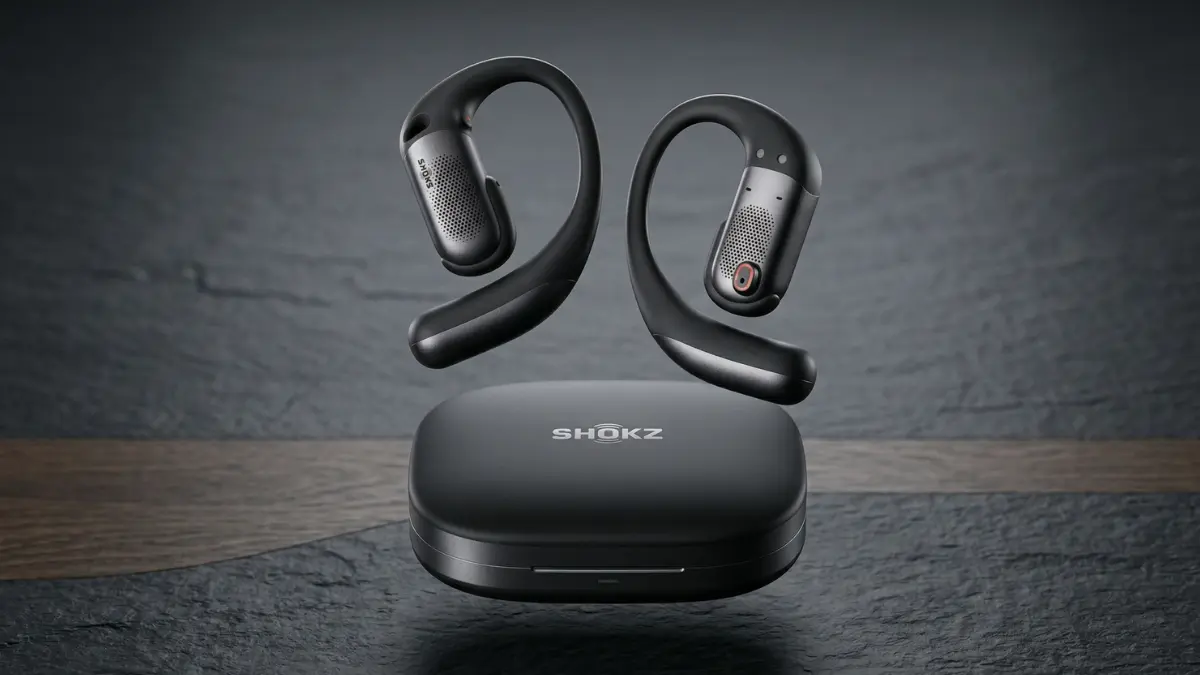
Open-ear earbuds have always asked you to make a trade: stay aware of your surroundings, but accept worse sound quality. The Shokz OpenFit Pro, launched at CES 2026, is the first open-ear earbud that genuinely challenges that trade-off. With dual SuperBoost drivers, Dolby Atmos processing, and a proprietary open-ear noise reduction system, it arrives at a $249 price tag with a serious claim: you don’t have to choose between audio quality and situational awareness anymore.
After two weeks of daily testing — morning runs, commutes, gym sessions, long work-from-home stretches, and weekend hikes — here’s what we found.
The OpenFit Pro is the most capable open-ear earbud ever made. Dual drivers and Dolby Atmos deliver genuinely impressive audio for an open design, the open-ear noise reduction works meaningfully in moderate environments, and the 50-hour total battery is class-leading. At $249 it’s expensive, and the 12.3g per earbud is heavier than competitors. But for runners, commuters, and outdoor athletes who’ve been waiting for open-ear audio to grow up — this is the arrival.
Pros
- Dual 11×20mm SuperBoost drivers — best sound in open-ear category
- Dolby Atmos support — spatial audio on open ears
- Bluetooth 6.1 — lowest latency, most stable connection
- Open-ear noise reduction actually works in moderate environments
- 50 hours total battery (12h per charge, NR off)
- 10-min quick charge → 4 hours playback
- Wireless charging case
- IP55 — sweat and rain rated
- Secure ear hook — never falls off at any pace
Cons
- $249 — premium price, not everyone needs this level
- 12.3g per earbud — heavier than most open-ear competitors
- Noise reduction drops battery to 6h (vs 12h without)
- Mic still struggles in heavy wind outdoors
- Open design = no passive noise isolation at all
- Overkill for casual home / desk use
Check the latest price and availability for the Shokz OpenFit Pro on Amazon.
Check Price on AmazonThis is an affiliate link. We may earn a commission at no extra cost to you.
Full Specs at a Glance
| Specification | Shokz OpenFit Pro |
|---|---|
| Driver | Dual 11×20mm SuperBoost™ (synchronized dual-diaphragm) |
| Frequency response | 20Hz – 40kHz |
| Bluetooth version | 6.1 |
| Codecs | SBC, AAC, LC3 (Bluetooth LE Audio) |
| Spatial audio | Dolby Atmos |
| Noise reduction | Open-ear noise reduction (proprietary, not ANC) |
| Battery — earbuds (NR off) | Up to 12 hours |
| Battery — earbuds (NR on) | Up to 6 hours |
| Total with case (NR off) | Up to 50 hours |
| Total with case (NR on) | Up to 24 hours |
| Quick charge | 10 min → 4 hours |
| Case charging | USB-C + Wireless (Qi) |
| Water resistance | IP55 |
| Weight per earbud | 12.3g |
| Design type | Open-ear, over-ear hook |
| Microphone | AI-enhanced multi-microphone array |
| Colors | Black, White |
| Price | ~$249 / ~€249 |
Design & Build Quality
The OpenFit Pro looks premium without trying too hard. The matte finish resists fingerprints well, the speaker housing is compact given the dual-driver setup inside, and the revised ear hook is notably more flexible than previous Shokz generations — it bends to accommodate a wider range of ear shapes without cracking or fatigue over time.
The charging case has a solid hinge, magnetic lid closure, and a subtle LED battery indicator. Wireless charging is a meaningful addition at this tier — drop it on any Qi pad overnight and both earbuds are ready at full charge by morning. The USB-C port remains for wired charging when needed.
Build quality throughout feels proportionate to the $249 price: this doesn’t feel like a $30 earbud, and it doesn’t need to look flashy to justify that. Everything from the button tactility to the hinge dampening feels considered.
Fit & Comfort — The Ear Hook System
Open-ear earbuds live or die on their ear hook. The OpenFit Pro uses a C-shaped flexible hook that wraps around the upper ear cartilage — no insertion into the ear canal, no pressure against the tragus. The speaker rests just outside the ear opening, held in place entirely by the hook’s grip on the antihelix.
In two weeks of testing, including 10K runs and hour-long cycling sessions, they never fell off once. The hook grip is firm enough to stay put during high-impact movement but flexible enough that you don’t feel it during multi-hour listening sessions.
Because nothing enters the ear canal, there’s no pressure buildup, no moisture occlusion, and no tip degradation over time. Users who experience pain with in-ear designs after 30–60 minutes consistently report zero discomfort with open-ear hook designs across 4–6 hour sessions.
At 12.3g per earbud, the OpenFit Pro is heavier than competitors like the Anker Soundcore AeroFit Pro (~8g) or the original OpenFit 2 (~8.7g). In practice this is noticeable when you pick them up, but less so once the hook is seated — the weight distribution along the hook means the speaker doesn’t pull downward during use.
We ran in 12 open-ear earbuds across road, trail, and track to find which ones stay in, sound best, and keep you genuinely aware of your surroundings.
Sound Quality: Dual Drivers + Dolby Atmos
This is where the OpenFit Pro separates itself from every open-ear earbud that came before it. Previous Shokz models — and most open-ear competitors — use a single driver and deliver sound that’s adequate for podcasts and casual music but noticeably lacking in bass weight and dynamic range. The OpenFit Pro’s dual 11×20mm synchronized diaphragm system changes this fundamentally.
Bass
For an open-ear design, the bass is genuinely surprising. It won’t match a sealed in-ear earbud — physics prevents that — but kick drums have real impact, bass guitars are present and defined, and EDM drops register as more than a suggestion. The extended 40kHz frequency response adds texture to the top end that older Shokz models completely lacked.
Dolby Atmos
Dolby Atmos on an open-ear earbud is a strange concept that works better than expected. The spatial processing widens the perceived soundstage significantly for stereo music — instruments feel positioned outside your head rather than inside it. For Atmos-encoded content (Apple Music Spatial Audio, Amazon Music HD), the effect is more pronounced. It won’t replace a proper surround setup, but it’s meaningfully different from standard stereo on this hardware.
Practical listening
Pop, hip-hop, podcasts, and electronic music all sound excellent. Classical and acoustic recordings benefit from the extended treble and the open soundstage. The main remaining limitation versus in-ear earbuds is isolation — any ambient sound in your environment blends with your music, which is both the point of open-ear design and its inherent limit.
Open-Ear Noise Reduction: Does It Actually Work?
This is the feature that makes the OpenFit Pro genuinely new — not just an incremental upgrade. Traditional ANC works by creating an inverted soundwave inside a sealed ear canal. The OpenFit Pro’s noise reduction does something different: it uses the multi-microphone array to identify and digitally suppress repetitive background noise (HVAC hum, train noise, office chatter) before it reaches the driver, while leaving irregular and directional sounds (traffic, voices calling your name) largely intact.
The result is not equivalent to a good sealed ANC earbud — let’s be clear about that. In a very loud subway car or a loud open office, in-ear ANC from Sony or Bose will outperform the OpenFit Pro’s noise reduction significantly. But in most real-world scenarios — running near traffic, working in a moderately noisy cafe, commuting on a train — the noise reduction meaningfully reduces listening fatigue without removing your awareness of the world around you.
Enabling noise reduction cuts battery from 12 hours to 6 hours per charge (case total: 50h → 24h). For most users, we recommend leaving NR off during outdoor activities where situational awareness matters most, and enabling it during commutes or desk work where it’s most effective.
A full breakdown of the trade-offs between both designs — sound isolation, audio quality, comfort, safety, and which use cases genuinely favor each type.
Battery Life
The OpenFit Pro’s battery headline is 12 hours per charge with noise reduction off, and 50 hours total with the case. Our real-world testing at 70% volume with NR off returned 11.4 hours — extremely close to the claim. With NR enabled, we got 5.8 hours, also nearly matching Shokz’s 6-hour stated figure. These are honest numbers.
The 10-minute quick charge delivering 4 hours is genuinely useful for runners who forget to charge before heading out. The wireless charging case means the overnight charge loop is frictionless — just set it on the pad and it’s ready.
10 minutes on USB-C = 4 hours of playback. That covers a half marathon or a full work commute. Useful enough that we’d rank it as one of the OpenFit Pro’s best practical features — not just a spec.
Microphone & Call Quality
Shokz’s AI-enhanced multi-microphone array handles indoor calls well. In quiet office and home environments, call recipients consistently reported clear voice quality with minimal background noise pickup — the array does a real job of separating voice from ambient sound in controlled environments.
Outdoors in wind, the story is familiar: gusts above 15 km/h degrade call audio significantly. This isn’t unique to the OpenFit Pro — it’s a fundamental challenge for open-design earbuds where no housing blocks wind from the microphone apertures directly. If outdoor calls in wind are frequent, a headset or in-ear design remains the better tool for that job.
Indoor calls: excellent. Outdoor calls in calm conditions: good. Outdoor calls with any meaningful wind: noticeably degraded. This applies to all open-ear earbuds — not a unique OpenFit Pro weakness, but worth knowing if calls are a core use case.
OpenFit Pro vs. Competitors
| Feature | Shokz OpenFit Pro | Shokz OpenFit 2 | Anker AeroFit Pro | Winner |
|---|---|---|---|---|
| Driver | Dual 11×20mm | Single driver | Single 16.2mm | OpenFit Pro |
| Noise reduction | Open-ear NR ✓ | None | None | OpenFit Pro |
| Bluetooth | 6.1 | 5.3 | 5.3 | OpenFit Pro |
| Battery (buds) | 12h | 10h | 11h | OpenFit Pro |
| Total battery | 50h | 30h | 42h | OpenFit Pro |
| Wireless charging | Yes | No | No | OpenFit Pro |
| Weight per bud | 12.3g | 8.7g | ~8g | Competitors |
| Price | ~$249 | ~$130 | ~$100 | Competitors |
If $249 is more than you need to spend, the OpenFit 2 still delivers the core Shokz open-ear experience at ~$130 — we broke down exactly where it wins and where it falls behind the Pro.
Who Should Buy the Shokz OpenFit Pro
✔ Buy the OpenFit Pro if you…
- Run, cycle, or train outdoors regularly
- Need situational awareness for safety
- Want the best open-ear audio available
- Suffer discomfort from in-ear designs
- Want long battery without daily charging
- Use Dolby Atmos content (Apple/Amazon Music)
- Take calls in moderate environments
- Want wireless charging convenience
✖ Skip the OpenFit Pro if you…
- Need strong noise cancellation (commute, plane)
- Primarily listen at a desk indoors
- Take frequent outdoor calls in wind
- Have a tight budget — OpenFit 2 at $130 covers the basics
- Prefer very lightweight earbuds (under 8g)
- Need in-ear passive isolation for focus/sleep
Frequently Asked Questions
For serious runners, cyclists, and outdoor athletes who need situational awareness alongside genuine audio quality — yes. The OpenFit Pro offers features (dual drivers, Dolby Atmos, Bluetooth 6.1, open-ear noise reduction, 50h battery, wireless charging) that no competitor matches in the open-ear category. Casual listeners who primarily use earbuds at home or at a desk will find the OpenFit 2 at $130 more appropriate for their needs.
Not traditional ANC. The OpenFit Pro features proprietary open-ear noise reduction — it uses the microphone array to digitally reduce repetitive background noise in your music and calls without physically sealing your ear canal. It meaningfully reduces listening fatigue in moderate environments but does not match the isolation depth of a sealed in-ear ANC earbud like the Sony WF-1000XM5 in very loud settings.
12 hours per charge with noise reduction off (our real-world test: 11.4h). 6 hours with noise reduction on. The case adds approximately three more full charges, giving 50 hours total (NR off) or 24 hours (NR on). Quick charge delivers 4 hours of playback from just 10 minutes on USB-C. The case charges via both USB-C and wireless Qi.
Yes — it’s specifically designed for it. The ear hook design stays secure at any pace (we tested up to 5:30 min/km intervals with zero shifting). IP55 handles heavy sweat and rain. The open design keeps you aware of traffic, other runners, and trail hazards. And the 12-hour battery covers everything from a 5K to an ultramarathon without needing the case.
The OpenFit Pro adds: dual drivers (vs single), Dolby Atmos, Bluetooth 6.1 (vs 5.3), open-ear noise reduction, wireless charging, 50h total battery (vs 30h), and quick charge. The OpenFit 2 costs approximately $120 less and is an excellent earbud for users who don’t specifically need noise reduction or premium audio processing. Both share the same fit system and IP55 rating.