
Best AI Translation Earbuds for Real-Time Translation (2026)
We tested the leading AI translation earbuds to find out which ones actually hold up in real conversations—across airports, restaurants, and foreign streets where getting it wrong matters.
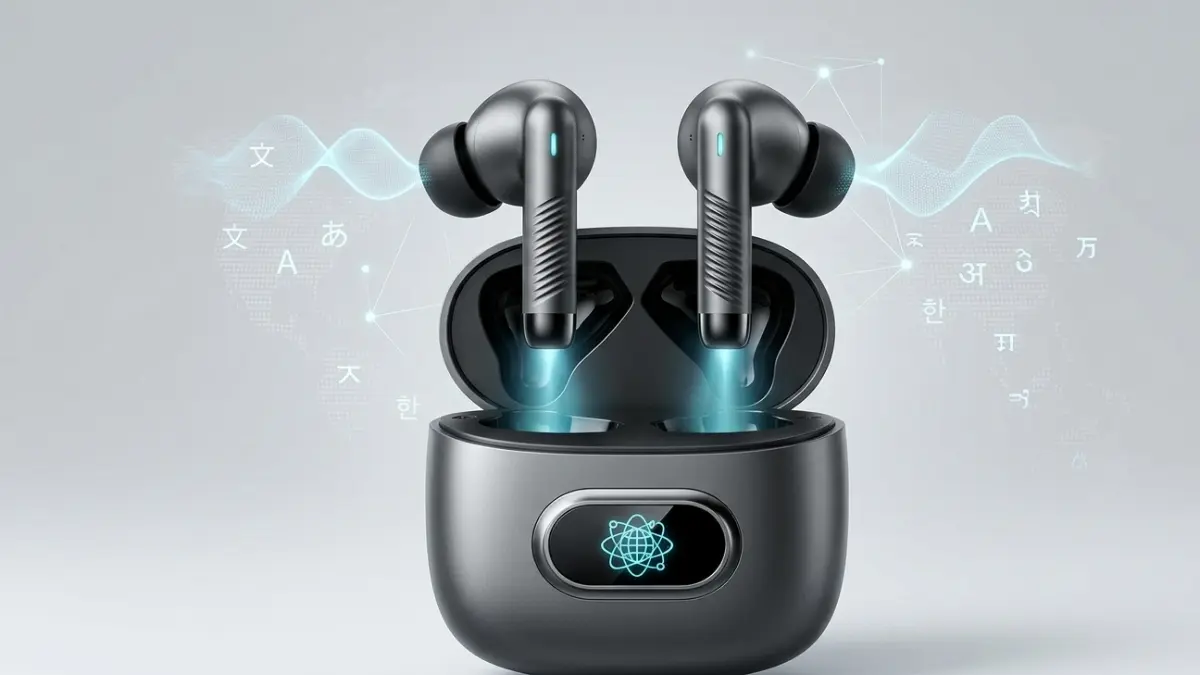
Real-time translation earbuds have moved well past the novelty stage. In 2026, the best models are genuinely useful—capable of handling fluid conversations in dozens of languages with latency that no longer interrupts the rhythm of a normal exchange. That said, not every pair marketed as an “AI translation earbud” is worth your money, and the gap between strong and weak performers is still significant.
We spent time with six of the most talked-about models this year, testing them in quiet rooms, noisy environments, and across multiple language pairs. The criteria we cared about most: translation accuracy, response speed, offline capability, comfort during extended wear, and whether the companion app actually makes things easier or just adds friction.
This guide is for travelers, people who work across language barriers regularly, and anyone curious about whether AI-powered earbuds have reached the point where they can replace reaching for your phone mid-conversation. The short answer: for most everyday situations, yes—if you choose the right pair.
Best AI Translation Earbuds (2026): Our Top Picks
After testing six models across real-world conditions, these are the earbuds that earned a recommendation. Each one was evaluated across translation accuracy, latency, offline functionality, app quality, comfort, and—where relevant—general audio performance.
⭐ Best Overall — Timekettle W4 ProThe Timekettle W4 Pro is the most complete AI translation earbud we tested this year. It covers 40 languages and 93 accents, handles simultaneous dual-ear translation smoothly, and pairs with an app that’s genuinely well-built. Translation latency sits around 1.5–2 seconds for major language pairs—fast enough that conversations don’t feel awkward. If your primary reason for buying translation earbuds is that you actually need to communicate across language barriers, this is where we’d start.
- 40 languages, 93 accents supported
- Dual-ear simultaneous translation mode
- Offline language packs available
- Consistent 1.5–2 second latency
- Clean, functional companion app
- Audio quality for music is average
- No active noise cancellation
- Requires app for most features
- Battery shorter than general-use earbuds
Check the latest price and availability for the Timekettle W4 Pro on Amazon.
This is an affiliate link. We may earn a commission at no extra cost to you.
Best Picks at a Glance
Here’s a quick summary of every model we recommend, what it does best, and where it fits in the market.
| Pick | Model | Languages | Offline | Battery | Best For |
|---|---|---|---|---|---|
| 🥇 Best OverallTop Pick | Timekettle W4 Pro | 40 | Yes | 6h + case | Most users |
| ✈️ Best for Travel | Timekettle M3 | 40 | Yes | 8h + case | Frequent travelers |
| 💬 Best for Conversations | Google Pixel Buds Pro 2 | 40+ | Partial | 8h + case | Android users |
| 💰 Best Budget | Timekettle Zero | 36 | Partial | 5h + case | Budget buyers |
| 👑 Best Premium | Ainut AI Translator | 144 | Yes | 7h + case | Power users |
| ⚖️ Mid-Range | ANFIER Translator | 71 | Yes | 10h + case | Extended use |
Best Overall AI Translation Earbuds: Timekettle W4 Pro
🥇 Best OverallThe W4 Pro is the most refined translation earbud available right now. It handles 40 languages and 93 accent variants, offers three distinct translation modes—simultaneous, touch, and speaker mode for group settings—and its latency in online mode is consistently fast enough that you’re not sitting through awkward pauses waiting for the translation to arrive. The dual-ear simultaneous mode, where both speakers receive a translated version in their own language in real time, is its standout feature, and it works as well as the marketing suggests.
Build quality is solid, the eartips seal well, and the companion app is logically laid out without unnecessary bloat. The battery gives about six hours of translation use, which is shorter than general-purpose earbuds but reasonable for dedicated translation hardware. Music playback is acceptable but clearly secondary—if audio fidelity matters to you, this isn’t built for that.
Who it’s for: Anyone buying their first serious AI translation earbud, frequent international travelers, and professionals who regularly communicate across language barriers.
Best for Travel: Timekettle M3
✈️ Best for TravelWhere the W4 Pro is the fuller-featured option, the M3 is the one you’ll actually want in your bag every day. It’s lighter, smaller, and its eight-hour battery makes it more practical for long travel days. The translation performance is slightly behind the W4 Pro on less common language pairs, but for the core European and Asian language pairings most travelers actually need, the gap is negligible.
Offline language packs are available here too, which matters when you’re on a data roaming plan or in areas where your connection is inconsistent. The M3 doesn’t have the dual-ear simultaneous mode of the W4 Pro, but for most travel scenarios—asking for directions, ordering food, checking into a hotel—it covers everything you need without the extra complexity.
Who it’s for: Travelers who want reliable translation without carrying a bulkier device, and those who prefer simplicity over feature depth.
Travel tip: Download offline language packs over Wi-Fi before any trip. Data coverage abroad is unpredictable, and having offline fallback for your destination’s primary language takes that variable off the table completely.
Best for Conversations: Google Pixel Buds Pro 2
💬 Best for ConversationsThe Pixel Buds Pro 2 aren’t marketed as a translation device first, but their integration with Pixel Translate and Gemini-powered live translation makes them one of the most natural-feeling conversation tools in the category. If you’re already in the Google and Android ecosystem, the experience is seamless in a way that dedicated translation earbuds rarely match—translated text appears on your phone display while audio plays through the earbuds, and the Gemini-backed engine is notably strong on conversational context rather than literal word-for-word output.
The bonus here is that these are also genuinely excellent earbuds for everything else. Strong ANC, good sound quality, comfortable fit, and a companion app that covers more ground. The trade-off is that offline translation is limited compared to dedicated hardware, and the experience is meaningfully better on Pixel phones than on other Android devices.
Who it’s for: Android users, especially Pixel owners, who want a single pair of earbuds that handles both translation and everyday listening at a high level.
Best Budget Pick: Timekettle Zero
💰 Best BudgetThe Timekettle Zero proves that you don’t need to spend at the top of the market to get translation that’s actually useful. It covers 36 languages, which handles the vast majority of travel and communication scenarios, and its accuracy on English, Spanish, French, German, Japanese, and Mandarin is solid. Offline mode requires a connected phone for most functions, and latency ticks up slightly compared to the W4 Pro, but for casual travelers or anyone buying their first AI translation earbud, it’s a sensible starting point.
Who it’s for: Budget-conscious buyers, first-time translation earbud users, and occasional travelers who don’t need the full feature set of premium models.
Best Premium Pick: Ainut AI Translator Earbuds
👑 Best PremiumThe Ainut AI Translator earbuds are the choice for anyone who genuinely needs broad language coverage. At 144 supported languages, it’s the widest of any device we tested—relevant if your work takes you into less commonly served language markets where other hardware struggles. Simultaneous bilateral translation means both conversation partners hear a translated version in real time, and the accuracy on the core language pairs is genuinely strong. Build quality is premium, and offline packs cover more ground than most competitors.
The price is the honest barrier here. For most travelers, the Timekettle W4 Pro gets to the same destination at a lower cost. But for business users, diplomats, NGO workers, or anyone regularly operating in linguistically diverse environments, the Ainut justifies its asking price.
Who it’s for: Business travelers, professionals who work across multiple language regions, and power users who want the widest possible language coverage.
Worth noting: No AI translation earbud currently on the market is suitable for professional interpretation in medical, legal, or diplomatic contexts where accuracy and nuance are critical. These are tools for everyday communication, not certified interpreting.
How AI Translation Earbuds Actually Work
The mechanics behind real-time translation earbuds have matured considerably. Most current-generation devices follow a similar pipeline: the earbuds capture spoken audio via onboard microphones, compress and transmit that audio to a companion app running on your phone, which routes it to a cloud-based AI translation engine. The translated output is returned as audio through your earbuds in near real time. For offline modes, a locally stored language model handles the processing, which trades some accuracy for independence from a data connection.
Rather than processing word-by-word, modern engines analyze sentence-level context and syntax, which is why conversational translations sound more natural than the stilted output that characterized early versions. Accent recognition is now a distinct capability in higher-end devices—the Timekettle W4 Pro’s 93-accent support specifically improves recognition of regional pronunciation patterns that would otherwise cause word-level errors.
Latency is still the core user experience variable. Sub-2-second translation feels genuinely fluid in conversation. Above 3 seconds, the rhythm of dialogue starts to feel interrupted. Wind noise, background music, and multiple simultaneous voices remain the conditions where most devices struggle most visibly.
Are They Better Than Translation Apps?
Honest answer: it depends on what you’re trying to do. For quick, one-off queries—reading a menu, translating a sign, asking a single question—Google Translate and similar apps remain hard to beat on pure accessibility. They’re free, they’re on the phone already, and they don’t require purchasing additional hardware.
Where dedicated translation earbuds pull ahead is in sustained, back-and-forth conversation. Holding up a phone and waiting for each person to speak into it creates an obvious awkwardness that breaks the natural flow of interaction. Earbuds remove that friction. Both speakers can talk more naturally, the translated audio comes directly to your ear, and the exchange feels closer to a real conversation.
There’s also the hands-free element. On a busy street, negotiating at a market, or navigating transport, not being anchored to your phone screen is a genuine practical advantage.
Bottom line: Use a translation app for quick lookups and static text. Use translation earbuds when you need to hold a real conversation—that’s the scenario they’re actually built for.
What to Look for Before You Buy
Language and Accent Coverage
The headline language count matters less than depth of coverage for the specific languages you actually need. A device that supports 144 languages at mediocre accuracy is less useful than one supporting 40 languages with strong performance in each. Check which specific language pairs the device has been optimized for, and whether it supports regional accents or dialects relevant to your situation.
Offline Functionality
Critical for travelers. Cloud-based translation is typically more accurate, but you can’t always count on a reliable internet connection. Offline packs for your key language pairs should be treated as a non-negotiable for any device marketed as a travel tool.
Translation Mode Flexibility
The best devices offer multiple modes: a standard one-direction mode, a two-way simultaneous mode, and often a speaker or broadcast mode for group settings. Consider which scenarios you’ll actually be in and whether the device’s available modes match those use cases.
Latency
Manufacturers often quote best-case latency figures. In practice, expect the published number to reflect optimal conditions. For a more realistic feel, look at third-party testing across varied conditions rather than spec sheet claims alone.
General Audio Capability
If you want one device for both translation and everyday listening, look at models like the Google Pixel Buds Pro 2 that balance both functions. Pure translation earbuds like the Timekettle line are optimized for translation first—their music and call quality is adequate but secondary.
Side-by-Side Comparison
| Model | Languages | Offline | Latency | Dual-Ear | ANC | Battery |
|---|---|---|---|---|---|---|
| Timekettle W4 ProTop Pick | 40 | Yes (21 pairs) | ~1.5–2s | ✓ | ✗ | 6h |
| Timekettle M3 | 40 | Yes | ~2s | ✗ | ✗ | 8h |
| Pixel Buds Pro 2 | 40+ | Partial | ~1.5–2s | Partial | ✓ | 8h |
| Timekettle Zero | 36 | Partial | ~2.5s | ✗ | ✗ | 5h |
| Ainut AI Translator | 144 | Yes | ~2s | ✓ | ✗ | 7h |
| ANFIER Translator | 71 | Yes | ~2.5s | ✗ | ✗ | 10h |
Who Should Buy AI Translation Earbuds
- Travel internationally multiple times per year
- Regularly communicate with people who speak a different language
- Work in multilingual business environments
- Want a hands-free translation experience
- Need sustained conversation translation, not just quick lookups
- Require offline fallback when abroad
- Only need translation for occasional single phrases
- Work in medical, legal, or diplomatic settings
- Primarily want earbuds for music or calls
- Are happy using a phone app for your translation needs
- Need to translate written text more than spoken conversation
Final Verdict
AI translation earbuds have reached genuine utility in 2026. The best models are no longer a curiosity—they’re tools that hold up in real conversations, and the improvement in natural language handling over the past two years has been substantial. The Timekettle W4 Pro remains our overall recommendation because it gets the balance right across accuracy, feature depth, offline capability, and real-world performance.
If travel portability and battery are the priority, the Timekettle M3 is the more sensible choice. If you’re already invested in Android and want one pair that handles both translation and high-quality daily listening, the Google Pixel Buds Pro 2 with Gemini integration is hard to argue against. Budget-conscious buyers can get real value from the Timekettle Zero, and those who need genuinely broad language coverage for professional use should look seriously at the Ainut AI Translator.
The space will continue to improve quickly. Language model updates are happening continuously, and the hardware already in market today will improve in accuracy over time through software. Buying the best hardware now means you’re positioned to benefit from those improvements as they roll out.
Frequently Asked Questions
