
Bang & Olufsen Beoplay H95 Review: Does Luxury Justify the Price?
B&O’s flagship wireless headphones make a bold argument: that premium audio is about more than specs. After extended testing across long flights, studio sessions, and daily commutes, here is our complete assessment.
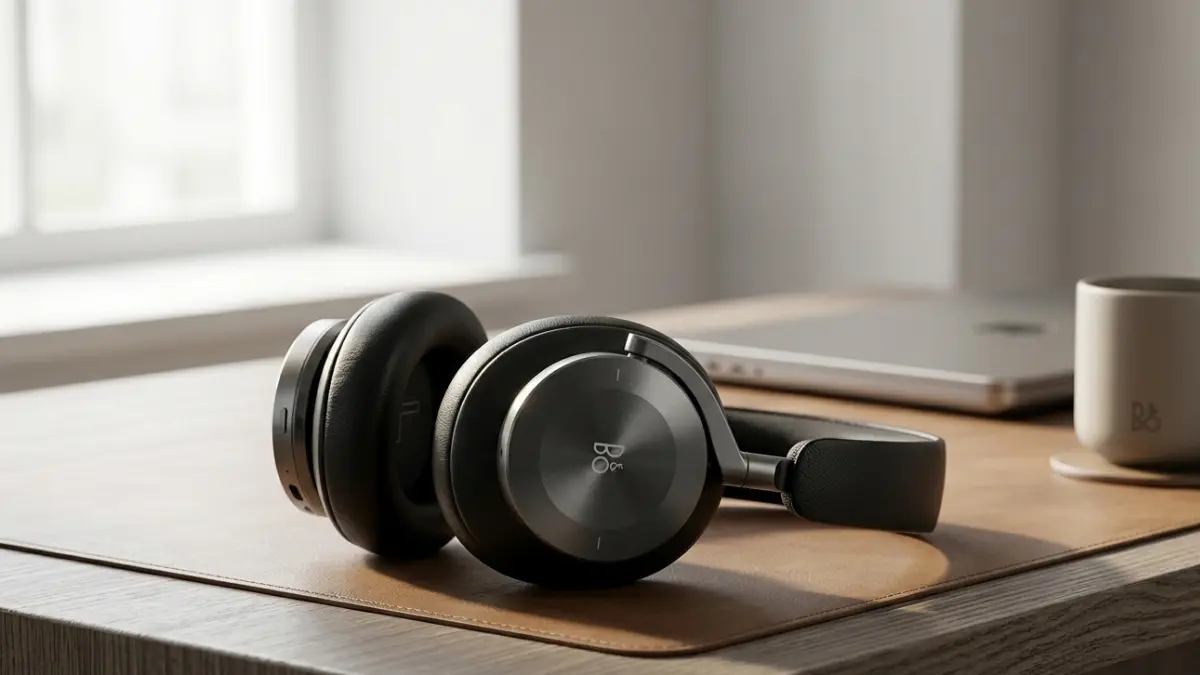
There are very few consumer electronics products that you pick up and immediately understand cost what they cost. The Bang & Olufsen Beoplay H95 is one of them. The moment the CNC-milled aluminum earcups rotate in your hands, the moment the lambskin leather presses against your ears, the moment the headband adjusts with the kind of mechanical precision you associate with Swiss watchmaking — the materials tell you something before a single note has played. Whether that something justifies one of the highest price tags in the wireless headphone category is the question this review is here to answer, without sentiment and without hype.
The Beoplay H95 is Bang & Olufsen’s benchmark — the headphone that represents the brand’s fullest expression of what a personal listening device can be. It ships with a 50-hour battery, six microphones for adaptive ANC, custom-tuned 40mm drivers developed specifically for this model, and a travel case that is itself a minor object of design. The competition it faces is formidable: the Sony WH-1000XM6, the Bose QuietComfort Ultra, and Apple’s AirPods Max all occupy overlapping territory, several of them at meaningfully lower price points. The H95 has to earn its position with every aspect of the experience — and for a specific kind of listener, it does.
Quick Verdict
The Bang & Olufsen Beoplay H95 is the most complete expression of what a luxury wireless headphone can be in 2026. It delivers an acoustic performance that rewards critical listening, a build quality that makes every rival feel like a prototype, and a 50-hour battery that removes recharging from the conversation entirely. It is not the right headphone for every listener — and honestly, it shouldn’t be. But for the buyer who will keep these for five or more years, who values the physical experience of wearing them as much as the audio they produce, and who wants a sound signature tuned for accuracy rather than excitement, the H95 earns every uncomfortable dollar of its asking price.
Buy it if you are a serious, long-session listener who values acoustic precision, exceptional build quality, and endurance above all else — and who treats headphones as a long-term investment rather than a consumable. Skip it if your primary criteria are maximum ANC suppression per dollar, feature density, or price-to-performance ratio on any conventional metric.
Check the latest price and availability for the Bang & Olufsen Beoplay H95 on Amazon.
Check Price on AmazonThis is an affiliate link. We may earn a commission at no extra cost to you.
Design & Build Quality
There is no diplomatic way to say this: the Beoplay H95 is in a different physical category from every other wireless headphone currently shipping. The earcups are CNC-machined from a single block of aluminum — not plastic with a metallic coating, not cast metal with surface treatment, but milled aluminum with the kind of dimensional tolerance that is genuinely unusual in consumer electronics. They rotate smoothly through a range of angles and lock into position with a mechanical firmness that communicates precision without drama. The headband is wrapped in genuine leather, the inner cushion uses lambskin, and the stitching is the kind that you only notice because it’s flawless.
B&O offers the H95 in a restrained palette — primarily black and a natural sand-tone — that suits the headphone’s character. These are not headphones that announce themselves. The design language is architectural: geometric, deliberate, built around the geometry of the earcup rather than surface decoration. Side by side with a Sony WH-1000XM6 or a Bose QuietComfort Ultra, the material gap is immediately apparent. Both of those are well-built headphones by any mainstream standard. The H95 makes them look like they came from a different industry.
The included travel case reinforces the premium positioning. It’s a semi-rigid clamshell in matching materials with a magnetic closure and a dedicated cable pouch — not an afterthought, but an object you’d keep. The USB-C cable is braided and terminates in metal connectors. These details accumulate into an unboxing and ownership experience that B&O has clearly thought about as carefully as the headphone itself.
What the H95 is not is light. At 317g, it is noticeably heavier than the Sony at 250g or the Bose at 254g. Aluminum costs weight, and the H95 makes no apology for that trade-off. For most listening sessions the weight is unnoticeable, but it is a real variable in extended wear for physically sensitive users.
Comfort & Fit
Weight figures in spec sheets can be misleading because they say nothing about weight distribution or the quality of the cushioning that mediates between headphone and skull. The H95 is a case study in how well-engineered physical design can make a heavy product feel lighter than the numbers suggest. The lambskin earcups are soft, warm, and deep enough to fully enclose most ears without contact pressure. The memory foam layer beneath the lambskin compresses slowly and returns gently, maintaining a consistent seal without the progressive pressure buildup that makes many competing headphones uncomfortable after hour two.
The clamping force is calibrated deliberately low — firm enough to maintain the seal and isolation, not so firm that it creates temporal pressure during long sessions. During testing sessions that ran between four and seven hours — the kind of listening that happens on intercontinental flights or long studio days — the H95 produced no meaningful discomfort. Competing headphones in this weight class typically begin to register on the skull somewhere around the three-hour mark.
The headband adjustment mechanism is infinitely smooth and holds its position without ratchet clicks, which means micro-adjustments during wear are effortless. Users with larger heads will find the H95 accommodating; the extension range is generous. The overall ergonomic package makes these among the most comfortable long-session headphones currently available.
Sound Quality
The H95 uses 40mm custom drivers developed specifically for this model — not off-the-shelf transducers sourced from a component manufacturer, but drivers whose frequency response target was determined by B&O’s acoustic engineers working from their house sound signature. B&O tunes for accuracy and naturalism rather than for the boosted bass and elevated treble that produces immediate excitement in a brief demo. The H95 is a headphone that rewards prolonged attention, not one that wins the ten-second audition.
The bass is present, controlled, and honest. It extends well into the sub-bass range and produces the tactile weight that low-frequency music requires, but it does not bloom or exaggerate. On electronic music with precisely mixed kick drums, each transient is tight and distinct. On orchestral recordings, the low string section sits correctly in the soundstage — grounded, substantial, but never overwhelming the midrange.
The midrange is the H95’s most distinguished frequency region. Vocals — male and female, chest resonance and falsetto alike — are reproduced with a clarity and presence that is genuinely rare in wireless headphones. The texture of a pianist’s touch, the breath before a sustained note, the micro-dynamics in acoustic guitar fingerpicking — the H95 resolves all of this without smearing or compression.
Treble extension is clean, detailed, and free from the artificial brightness that budget tuning uses to simulate resolution. Cymbal decay trails naturally into the noise floor. High-frequency fatigue is essentially absent.
Soundstage, for a closed-back design, is wider than expected and well-positioned. Against the Sony WH-1000XM6 — which has a slightly warmer, more consumer-friendly tuning — the H95 feels more transparent and more honest. Against the Bose QuietComfort Ultra, the B&O has more low-end precision and significantly better midrange texture.
Active Noise Cancellation (ANC)
The H95’s ANC system uses six microphones — four feed-forward external and two feedback internal — to construct a cancellation signal that adapts to the acoustic environment in real time. The result is strong, consistent, and notably free from the pressure artifact that cheaper ANC systems impose. B&O’s implementation produces a clean silence rather than a pressurized one.
On an aircraft, the H95 handles the 80–100 Hz engine drone that defines cabin acoustics with genuine effectiveness. The low-frequency constant disappears; what remains is a quiet that is comfortable rather than sterile. In a busy open-plan office, HVAC systems and general ambient hum are cleanly suppressed.
The Sony WH-1000XM6 and Bose QuietComfort Ultra are the current ANC ceiling in the consumer headphone market, and both edge the H95 on raw suppression depth. The gap is real but not dramatic. For most travel and focus use cases, the H95’s ANC is entirely sufficient. What the H95 does differently is combine strong ANC with acoustic purity that makes the music playing through it sound noticeably better than either Sony or Bose.
The Transparency mode — B&O calls it Hear-Through — is natural-sounding and usable. External audio passes through without obvious electronic coloration, making it practical for conversations and airport announcements without removing the headphones.
Battery Life & Charging
After systematic testing at moderate volume with ANC active across multiple full-cycle discharges, the H95 consistently returned figures between 46 and 52 hours depending on ANC intensity and Bluetooth codec. At typical listening volumes and with the default ANC setting, 48–50 hours is a realistic daily expectation.
To put this in practical terms: a traveler flying from New York to Singapore — roughly 18.5 hours — could make the journey twice without recharging. A commuter listening for ninety minutes daily would recharge approximately once a month.
Charging is via USB-C at a 1.5-hour full charge rate. A 20-minute quick charge provides approximately 5 hours of playback. The headphone also supports passive wired listening via the included 3.5mm cable.
Call Quality & Connectivity
Call performance on the H95 is competent and consistently above average. The six-microphone array uses beamforming to isolate the speaker’s voice from ambient noise. In quiet environments, call recipients consistently report clear, natural voice reproduction. In moderately loud environments — airport departure halls, cafés — the H95 maintains intelligibility well.
Bluetooth 5.1 provides stable, consistent connectivity. Reconnection when the headphone wakes from sleep is fast — under two seconds in testing — and multi-point pairing allows simultaneous connection to two devices. The H95 supports AAC, SBC, and aptX Adaptive. It does not support Sony’s LDAC codec.
App & Features
The Beoplay companion app is clean, well-designed, and honest about its limitations. It provides ANC intensity adjustment across a sliding scale, Hear-Through level control, a basic equalizer with preset profiles, and device management. For users who want to set a preferred sound profile and leave it alone, the app works well.
What it does not offer is the granular control that Sony’s Headphones Connect app provides. There is no parametric equalizer with per-band adjustment, no auto-optimizing ANC that reads atmospheric pressure, no voice detection feature equivalent to Speak-to-Chat. For users who rely on fine-grained EQ customization, the app’s relative simplicity will be a genuine limitation.
Touch controls are implemented via a capacitive zone on the right earcup: swipe up/down for volume, forward/back for track, tap to play/pause, hold for ANC toggle. Gesture registration is accurate and responsive.
Beoplay H95 vs Competitors
The H95 competes at the intersection of audiophile-grade wireless performance and luxury goods. Its three main rivals — the Sony WH-1000XM6, Bose QuietComfort Ultra, and Apple AirPods Max — each approach this intersection from a different angle.
| Feature | B&O Beoplay H95 | Sony WH-1000XM6 | Bose QC Ultra | Apple AirPods Max |
|---|---|---|---|---|
| Build Quality | ★★★★★ Exceptional | ★★★☆☆ Good | ★★★☆☆ Good | ★★★★☆ Very Good |
| Battery (ANC on) | 50 hours | 40 hours | 24 hours | 20 hours |
| ANC Strength | Strong | Best-in-class | Best-in-class | Excellent |
| Sound Accuracy | Reference-grade | Warm / consumer | Balanced | Refined |
| Weight | 317g | 250g | 254g | 385g |
| App Quality | Good, basic EQ | Best-in-class | Good | iOS only |
| Ecosystem | All platforms | All platforms | All platforms | Apple only |
| Price Tier | Ultra-Premium | Premium | Ultra-Premium | Ultra-Premium |
The Sony WH-1000XM6 is the H95’s most practical rival. At a significantly lower price, it delivers stronger ANC, a more comprehensive app, and lighter weight. What it cannot match is the build quality, battery endurance, or acoustic precision of the B&O. Our full Sony WH-1000XM6 review covers its full capability in detail.
The Bose QuietComfort Ultra is the ANC benchmark, full stop. Its battery (24 hours) is less than half the H95’s, its build feels more utilitarian, and its sound signature lacks the H95’s midrange transparency.
The AirPods Max occupies the same luxury tier as the H95 but is designed primarily as an Apple ecosystem product. The 20-hour battery is the weakest in this comparison. For non-Apple users, the AirPods Max has almost nothing to offer over the H95.
Pros & Cons
Pros
- CNC aluminum and lambskin leather — materials class is genuinely unmatched
- 50-hour battery is the longest in the premium wireless category
- Reference-grade sound tuning rewards serious listening
- Exceptional long-session comfort with low clamping force
- Premium travel case and accessories included as standard
- Clean, effective ANC with no pressure artifact
- Multi-point Bluetooth pairing for phone + laptop simultaneously
- Wired 3.5mm passive listening as backup
Cons
- Price is among the highest in the wireless headphone category
- ANC strong but does not lead the category vs Sony or Bose
- 317g — heavier than most rivals, noticeable for sensitive users
- Beoplay app lacks parametric EQ and advanced features
- No LDAC codec support for Android hi-res streaming
- Sound signature may be too neutral for listeners who prefer boosted bass
Who Should Buy It?
The Beoplay H95 is built for a specific kind of listener. They listen critically — not necessarily with audiophile hardware at home, but with attention. They notice when instruments sound natural versus processed. They find V-shaped consumer tuning unsatisfying over long sessions. They travel frequently and on long routes. They will keep these headphones for five years, possibly longer, and they factor material longevity into what they’re willing to pay.
Who Should Skip It?
If maximum ANC performance is your primary criterion, the Bose QuietComfort Ultra and Sony WH-1000XM6 both suppress low-frequency noise more deeply than the H95. If you rely on your headphone’s companion app for fine-grained sound customization — parametric EQ, per-band adjustment, advanced presets — the Beoplay app will disappoint you. If bass impact and low-frequency excitement define your listening preference, the H95’s honest tuning will feel underwhelming. And if the price is a stretch, or if you will replace these in two years regardless, the Sony WH-1000XM6 delivers an objectively excellent wireless experience at a fraction of the cost.
Final Verdict
The Bang & Olufsen Beoplay H95 review invariably returns to the same question: is this a headphone that justifies its price, or a luxury product that uses audio as its pretext? After extended testing, the answer is that it is genuinely both — and that both are defensible depending on who is asking.
The acoustic performance is not a luxury add-on applied to an average product. The 40mm custom drivers, the reference-grade tuning, the midrange transparency that makes familiar recordings sound newly detailed — these are the outputs of serious acoustic engineering. The 50-hour battery is a real-world number that changes how you travel with headphones. The CNC aluminum construction will outlast the plastic bodies of every cheaper competitor by years, probably decades.
What B&O asks you to accept is that ANC, while strong, is not the best available — and that the app, while functional, is not the most feature-rich. If either of those are disqualifying criteria for your specific use case, the Sony WH-1000XM6 or Bose QuietComfort Ultra are more complete value propositions. The H95 asks a different question, and it answers it definitively.
Score: 9.2 / 10 — Essential for the right listener. Not the right headphone for everyone. Exactly as it should be.
Check the latest price and availability for the Bang & Olufsen Beoplay H95 on Amazon.
Check Price on AmazonThis is an affiliate link. We may earn a commission at no extra cost to you.
Frequently Asked Questions
