
Cheap earbuds often sound exciting on day one. A few weeks later, that energy fades — and the sound can become flatter, duller, and less satisfying. Here’s why that happens, both in your ears and inside the hardware.
Why Cheap Earbuds Sound Good at First (Then Get Worse Fast)
Budget earbuds can sound genuinely impressive out of the box. Then, weeks later, they don’t. Here is the full explanation — from psychoacoustics and deliberate tuning tricks to physical hardware decay — for why this keeps happening.
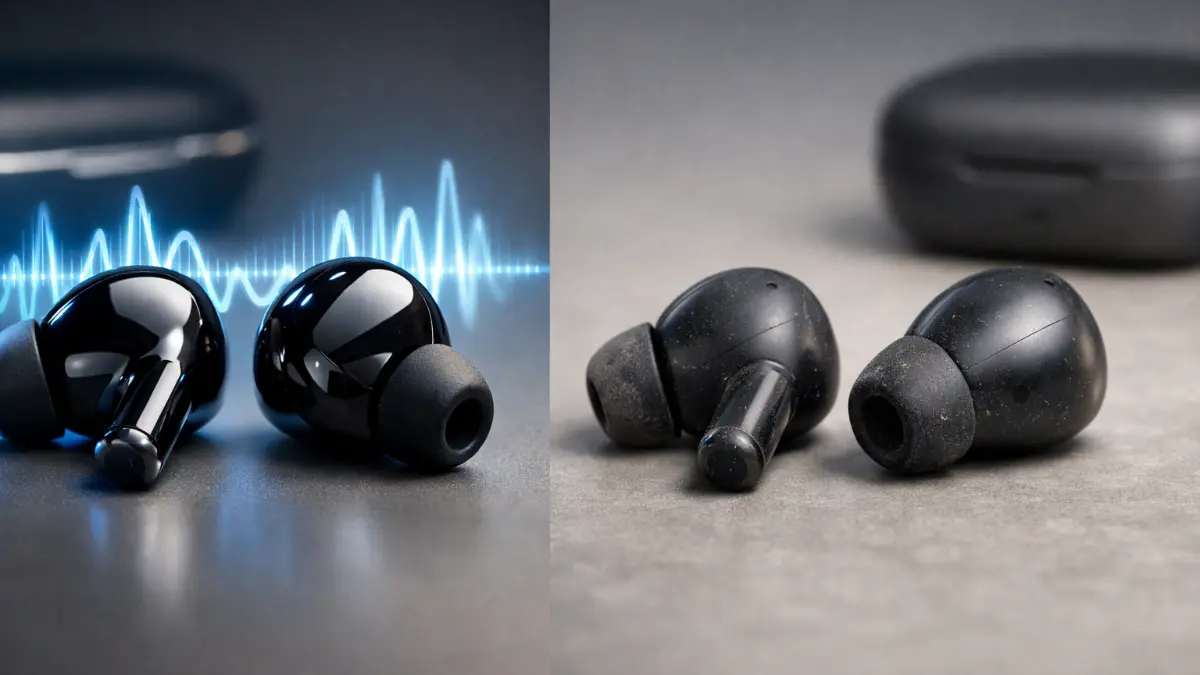
You open a new pair of earbuds, press them into your ears, and something happens that feels almost too good for the price. The bass hits harder than you expected. There’s a brightness and energy to the sound that makes your music feel alive. You think: these are actually great. Maybe you got lucky. Maybe you found a hidden gem.
Then, a few weeks later, something is different. The sound feels thinner. The bass that impressed you seems to have softened. The whole experience feels flatter, slightly muffled — like a room with the windows closed. You check if they’re broken, find no obvious fault, and eventually just accept that they’ve “worn in.” Or you start wondering if you were imagining things from the start.
You weren’t imagining it. And they probably aren’t broken. What’s actually happening is more interesting — and more deliberate — than most people realize.
In This Article
- Why Cheap Earbuds Sound So Good at First
- The Budget Tuning Trick Most People Don’t Notice
- Your Brain Is Being Tricked (And Then It Adapts)
- Why Cheap Earbuds Degrade Faster
- The Hidden Difference Between Cheap and Premium Sound
- Can You Fix It or Slow It Down?
- When It’s Time to Replace Your Earbuds
- Final Verdict
- Frequently Asked Questions
Why Cheap Earbuds Sound So Good at First
The answer begins with how human hearing actually works. The auditory system doesn’t respond to all frequencies equally. Humans are naturally more sensitive to sounds in the 2–5 kHz range — the frequency band where speech clarity, vocal presence, and many musical details live. Below that range, bass frequencies require significantly more energy to be perceived at the same apparent loudness. Above that range, treble frequencies that add shimmer and definition also need a push to compete perceptually with the midrange.
This relationship between frequency and perceived loudness is captured by the equal-loudness contours — curves originally mapped by Fletcher and Munson in the 1930s and refined over decades since. What these contours show, in practical terms, is that flat, accurate sound reproduction doesn’t actually sound impressive to most listeners out of the box. It can sound balanced, detailed, and natural — but natural isn’t exciting. It takes familiarity and trained ears to appreciate neutrality.
Budget earbud manufacturers know this. What they optimize for isn’t accuracy. It’s the first impression — the moment a consumer puts the earbuds in at a store or takes them out of the box for the first time. The tuning approach they almost universally reach for is the V-shaped frequency response: bass and treble are both boosted significantly, while the midrange — which contains much of the texture and information in music — is recessed. The result is a sound that immediately seems powerful, bright, and full. There’s a thumping low end and a crispness to cymbals and high-frequency details that feels like premium audio.
It isn’t. But for those first few listens, it is genuinely convincing. The cheap earbuds sound good at first precisely because they’ve been tuned to exploit the psychoacoustic reflexes of an unacclimated listener.
The “Budget Tuning Trick” Most People Don’t Notice
The V-shape tuning strategy is well-known among audiophiles, but most people encountering budget earbuds for the first time have no reference for it. What they experience is a vague sense of quality — more bass than expected, more sparkle — without the vocabulary to identify why it sounds that way, or what it’s missing.
What’s missing is the midrange. Vocals sit in the midrange. The body of acoustic instruments lives there. The warmth of a piano, the chest resonance of a voice, the natural timbre of a guitar — all of it occupies the frequency band that V-shaped tuning pushes back. Budget earbuds with this tuning sound impressive on bass-heavy electronic music and pop, where the boosted frequencies align with the genre’s intentional emphasis. They sound surprisingly poor on jazz, classical, or spoken word — anything where natural tonality matters — though most listeners don’t realize this until they’ve used them long enough to start noticing the flatness in instruments they know well.
Beyond the V-shape, some budget brands apply an additional trick: an elevated upper treble boost in the 8–12 kHz range. This adds a sense of “air” and perceived detail that sounds like resolution but isn’t. It’s an illusion of clarity — an energetic shimmer that makes the listener feel like they’re hearing more information than they actually are. The effect is particularly convincing during the first listen because the ear hasn’t yet learned to interpret this frequency boost as artificial.
Your Brain Is Being Tricked (And Then It Adapts)
The perception shift that follows those first impressive listens is a well-documented phenomenon in auditory science. The brain maintains something like a running average of the sonic environment it regularly encounters. When exposed repeatedly to any consistent stimulus — including a specific frequency response — the auditory cortex recalibrates its expectations. The exaggerated bass and treble that sounded dramatic on day one begins to sound normal by day ten. And once it sounds normal, it no longer sounds impressive. It just sounds like your earbuds.
This process is called auditory adaptation, and it operates in both directions. People who switch from bass-heavy earbuds to a neutral-sounding pair often initially find the neutral pair thin and underwhelming, even if those earbuds are objectively more accurate. Their baseline has been shifted. The reverse is equally true: after extended use of neutral earbuds, returning to a bass-heavy pair feels exaggerated and muddy rather than punchy and exciting.
This matters enormously for understanding the cheap earbuds experience. What many users interpret as the earbuds getting worse is often, at least initially, the brain getting used to them. The excitement fades not because the hardware has changed but because the novelty has worn off and the auditory system has recalibrated around the new normal. The earbuds haven’t moved. Your perception has.
This perceptual shift then exposes a second problem that was always present but masked by novelty: the recessed midrange. Once the bass and treble cease to impress, there’s nothing left to carry the sound. Premium earbuds tuned with more care for midrange presence and tonal accuracy tend to sound better the longer you use them, not worse — because accuracy becomes more apparent as the brain settles in. For a deeper look at this mechanism, this analysis of why earbuds sound worse over time covers the neuroscience side in considerably more depth.
Why Cheap Earbuds Degrade Faster
Perception isn’t the whole story. Budget earbuds also undergo genuine physical changes over weeks and months of regular use, and these changes are measurable. The speed and severity of physical degradation is where the gap between cheap and premium hardware becomes most concrete.
Driver Membrane Fatigue
The driver is the component that converts electrical signal into sound — the engine of the earbud. Budget drivers are typically made from mylar or basic PET film membranes. These materials are lightweight and cheap to produce at scale, but they have limited elasticity and poor resistance to deformation under sustained use. A driver membrane that is repeatedly pushed to its limits by over-boosted bass frequencies — exactly the kind of use pattern that V-shaped tuning encourages — begins to lose its original tension. The membrane stiffens, loses its precise excursion control, and the low-frequency response changes. This is a measurable shift in the physical properties of the component that was producing the bass you liked.
Mesh Clogging
The protective mesh grille covering each driver accumulates earwax, skin oils, and environmental debris continuously during use. In many budget designs, this mesh is either non-removable or too fragile to clean effectively. As debris accumulates, it acts as a partial acoustic barrier — attenuating high frequencies first, since their shorter wavelengths are more easily blocked by small obstructions. The user experiences this as a gradual dulling of the sound, particularly in the upper midrange and treble. What often reads as the earbuds “going flat” is partially just biological debris sitting between the driver and the ear canal.
Battery Voltage Drop (Wireless Models)
In wireless earbuds at any price point, battery voltage drop is an additional variable that budget models handle particularly poorly. Lithium-ion batteries don’t deplete linearly. As a cell ages and its internal resistance increases, voltage output becomes less stable under load. Audio amplifier circuits are sensitive to supply voltage variation. Budget wireless earbuds typically use simpler amplifier designs with less voltage regulation, which means that as the battery degrades, the audio output quality degrades with it — a slight loss of dynamics, a compression of the sound’s range that compounds over hundreds of charge cycles.
Seal Deterioration
Eartip seal deterioration affects both passive isolation and bass response in ways that are consistently underappreciated. The eartips on budget earbuds are almost always made from lower-grade silicone that hardens, deforms, and loses its original fit geometry faster than premium alternatives. A degraded seal allows bass frequencies to leak, which directly reduces low-end impact. The user perceives this as the earbuds losing their bass — and they’re right — but the driver itself may be functioning identically. The seal is doing less work, and physics is simply following through.
The Hidden Difference Between Cheap and Premium Sound
The standard framing of cheap versus premium audio focuses on resolution — detail retrieval, soundstage width, imaging precision. These differences are real, but they’re not actually the most important distinction for most listeners. The more meaningful difference is consistency.
Premium earbuds from manufacturers with serious acoustic engineering are designed with long-term stability as a core requirement. Driver materials are chosen not just for their acoustic properties on a test bench but for their resistance to deformation under sustained real-world use. Tuning is calibrated toward a target that sounds good not just immediately but after weeks of adaptation, when novelty has worn off and only the actual frequency response remains.
This is why premium earbuds tend to improve with familiarity rather than disappoint with it. A well-tuned midrange that initially seems less exciting than a V-shaped budget alternative becomes more rewarding as the listener’s brain settles in — because it accurately represents music rather than caricaturing it. The stability of the sound signature over months of use reflects both the physical durability of the components and the intentionality of the tuning decisions made during development.
There’s also a driver technology gap that matters at the extremes. Budget earbuds almost exclusively use basic dynamic drivers. Premium earbuds increasingly use balanced armature configurations, planar magnetic designs, or hybrid implementations that offer fundamentally different mechanical properties — lower distortion at higher volumes, more precise transient response, and materials that maintain their characteristics under long-term use more reliably. If you’re weighing options in that space, our guide to the best wireless earbuds in 2026 covers how these driver differences translate to real listening experience across price tiers.
Can You Fix It or Slow It Down?
The degradation trajectory of budget earbuds isn’t entirely unavoidable. Several practical interventions can meaningfully extend their useful life or partially recover lost performance.
Clean the Mesh Grilles
This is the highest-return maintenance task and the most neglected. A dry, soft-bristled brush applied gently to the mesh surface after every few uses prevents the gradual accumulation of debris that dulls treble response over time. For heavier buildup, a small amount of isopropyl alcohol on a cotton swab — applied carefully without allowing liquid to penetrate the driver housing — can dissolve oils and wax that brushing alone won’t remove. This takes thirty seconds and most people never do it.
Replace the Eartips
Budget silicone tips are among the most replaceable components on an earbud. Aftermarket foam tips — particularly memory foam alternatives like those from Comply — create a substantially better seal than most stock silicone tips. A better seal directly improves bass response by reducing acoustic leakage, which partially compensates for driver membrane fatigue. The difference is often noticeable enough to feel like a genuine upgrade.
Apply Parametric EQ
Parametric EQ, available through apps like Wavelet on Android or system-level audio tools on some platforms, allows direct correction of a frequency response. For earbuds that have shifted toward muddiness or excessive brightness over time, gentle EQ adjustments can restore some balance. The limitation is that EQ can shape the frequency response but cannot repair a physically degraded driver — you can redirect signal, but you cannot make a deformed membrane behave as it did when new.
Improve Storage Habits
Storing earbuds loose in a pocket or bag — where they’re compressed, twisted, and exposed to debris — accelerates every form of physical degradation. A case, even a basic one, extends component life meaningfully. Avoiding maximum volume consistently also reduces driver membrane fatigue, particularly in the bass frequencies where budget drivers are already working at the edge of their design tolerances.
When It’s Time to Replace Your Earbuds
There’s a point beyond which maintenance becomes performance theater — effort that produces diminishing returns on hardware that has simply reached the end of its useful life. Recognizing that point honestly saves time, frustration, and the subtle daily irritation of listening through gear that no longer serves you.
The clearest physical sign is a driver producing distortion at moderate volumes — a buzzing, rattling, or crackling quality that appears during bass notes or loud passages. This typically indicates membrane deformation or a loose internal component, neither of which is practically repairable in consumer earbuds. Similarly, if one earbud sounds noticeably different from the other — a channel imbalance that wasn’t present initially — the driver in the affected unit has likely changed its physical properties in a way that cannot be equalized back into symmetry.
If you’ve cleaned the mesh, replaced the tips, adjusted the EQ, and the sound still doesn’t satisfy — that’s not a fixable situation. It’s information. The earbuds have completed their cycle, and the honest response is replacement rather than continued troubleshooting.
Final Verdict
The experience of cheap earbuds sounding impressive and then disappointing isn’t random, and it isn’t bad luck. It is, in a very real sense, the intended outcome of a set of deliberate engineering and tuning decisions made to optimize for a specific, narrow window: the first impression.
V-shaped tuning exploits psychoacoustic reflexes to produce immediate excitement. Boosted bass and artificial treble air register as quality to an unacclimated listener. The brain adapts, the novelty fades, and what’s left is often a midrange-recessed, perceptually flat sound signature with no particularly compelling qualities. Meanwhile, the hardware itself — low-grade driver membranes, basic silicone tips, simple battery management — degrades faster than premium alternatives under normal use conditions, accelerating the decline.
Understanding this process doesn’t make budget earbuds useless. They have a legitimate place: backup pairs, gym use, situations where loss or damage is likely, children’s devices. But using them with the expectation that the initial sound quality will hold is a setup for disappointment, because that initial quality was partly an illusion constructed for the evaluation moment. What distinguishes better earbuds isn’t primarily how impressive they sound on first listen. It’s how accurately and consistently they perform on the thousandth one.
Frequently Asked Questions