
The best earbuds are not always the ones that seal the world out. Sometimes the ones worth talking about are the ones that let the world in — beautifully.
ReviewBaseus Inspire XC1 Review (2026): Surprisingly Premium Open-Ear Sound — But Who Is It Really For?
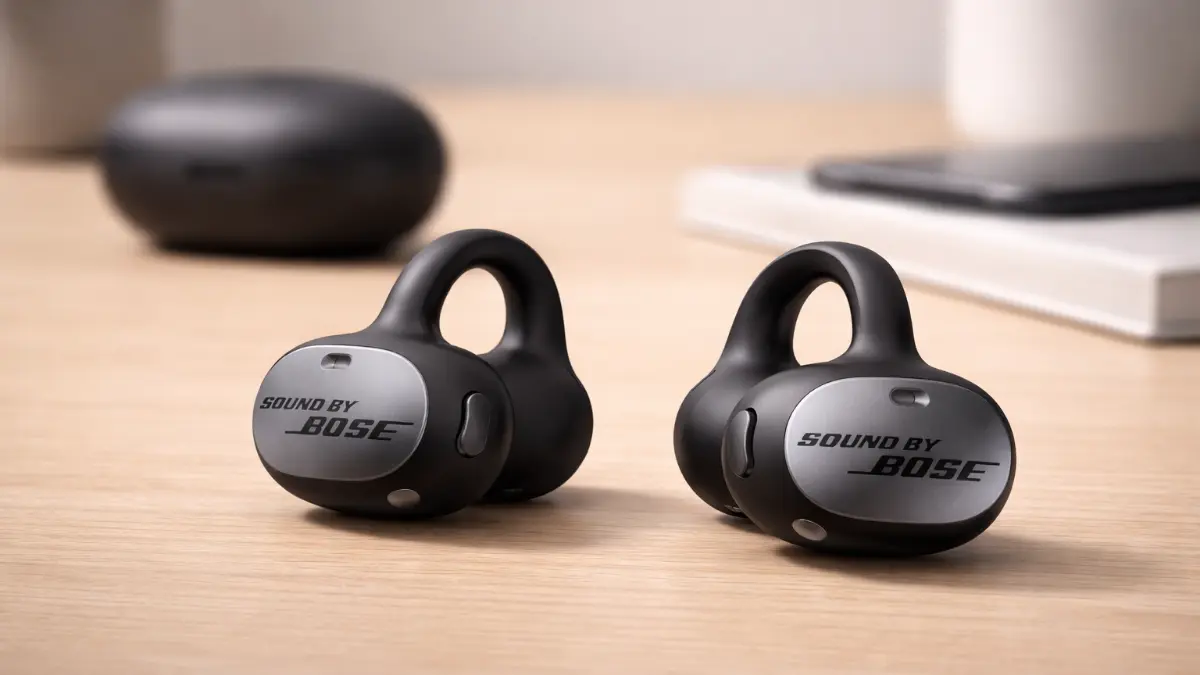
Sound by Bose tuning, LDAC, a Knowles balanced armature tweeter, and IP66 durability — all in an open-ear clip design under €110. We tested it across office sessions, commutes, and long daily wear to find out what it actually delivers.
Open-ear earbuds occupy a peculiar space in the audio market. They are not trying to be the loudest, the most isolated, or the most technically impressive. They are trying to be the most liveable — earbuds you can wear for eight hours straight without ear fatigue, without missing a bus announcement, without feeling cut off from the office conversation that actually matters. That is their pitch, and for a growing number of people in 2026, it is a compelling one.
The Baseus Inspire XC1 enters this category with credentials that no open-ear earbud at its price tier has previously assembled in one device. Sound tuning developed in collaboration with Bose. Dolby Audio and Hi-Res Audio certification. LDAC support. A hybrid 2-way driver system pairing a dynamic woofer with a Knowles balanced armature tweeter. Bluetooth 6.1 with multipoint. IP66 weather resistance. And a 4-microphone AI call system. All sitting in a clip-style open-ear design priced around €109.99.
After extended daily use across office work, pedestrian commuting, and long casual listening sessions, this is the clearest way to describe the XC1: it is the most serious audio engineering effort we have seen in an open-ear earbud at anywhere near this price. Whether that engineering fully translates into a better experience than simpler, cheaper alternatives depends almost entirely on who is listening — and what they are listening for.
Check the latest price and availability for the Baseus Inspire XC1 on Amazon.
Affiliate link — we may earn a commission at no extra cost to you.
Full Specs at a Glance
| Specification | Baseus Inspire XC1 |
|---|---|
| Wearing style | Open-ear clip-on (no ear canal insertion) |
| Driver setup | Hybrid 2-way: dynamic woofer + Knowles balanced armature tweeter |
| Audio certifications | Hi-Res Audio, Dolby Audio |
| Tuning | Sound by Bose technology |
| Bluetooth version | 6.1 |
| Codecs | LDAC, AAC, SBC |
| Multipoint | Yes — two devices simultaneously |
| Battery — earbuds | Up to 8 hours per charge |
| Battery — total with case | Up to 40 hours |
| Water resistance | IP66 (dust-tight + powerful water jet resistant) |
| Call microphones | 4-mic system with AI call clarity processing |
| Charging | USB-C (case) |
| Colors | Cosmic Black, Starlight Off-White |
| Price | Approx. €109.99 (EU sale pricing) |
Design & Fit: The Open-Ear Case, Made Properly
The Inspire XC1 uses a clip-on form factor that rests against the outer ear rather than inserting into the ear canal. This is the defining design decision — and it shapes everything: comfort, isolation, awareness, how long you can actually wear these before your ears protest.
The hours-long fatigue that comes from pressing a silicone tip into your ear canal all day is real, and the XC1 sidesteps it entirely. There is no pressure, no seal, and no gradual discomfort. For office workers who wear earbuds through back-to-back meetings and a long focus session, that absence of in-ear pressure is not a minor benefit — it is the reason to buy the product over a conventional sealed pair.
The clip design also keeps you connected to your environment in a way that no passive transparency mode fully replicates. If a colleague calls your name across the room, you hear it. If a car horn sounds while you are crossing a road, you hear it without fumbling with controls. For users who need situational awareness, this is not a compromise — it is the intended experience.
Baseus offers the XC1 in Cosmic Black and Starlight Off-White, both finished in a restrained, modern aesthetic. The case is compact and pocketable. Stability for light activity — walking, casual office movement, commuting on foot — should be solid based on the clip mechanism. For very high-intensity running or sport, a more structural over-ear hook design may offer greater security. For the everyday active use case this product targets, the XC1’s form factor is well-matched.
The biggest practical advantage of the XC1’s form factor is how long you can actually wear it. No ear canal insertion means no seal pressure, no gradual soreness, and no reason to take them out between sessions.
A practical guide to fit geometry, pressure points, and which earbuds work best if most in-ear models feel too big or uncomfortable.
Sound Quality: The Best Reason to Take the XC1 Seriously
This is the most important section of this review, because it is where the Inspire XC1 most clearly separates itself from the rest of the open-ear category. And it is also where honest expectations most need calibrating.
The hybrid 2-way driver system combines a dynamic driver handling bass and midrange frequencies with a Knowles balanced armature tweeter responsible for high-frequency resolution. Knowles is not a budget components supplier — its BA drivers appear in professional in-ear monitors and premium consumer earbuds across the market. Seeing it in an open-ear earbud at this price is genuinely unusual, and it signals that Baseus is not treating the audio here as an afterthought.
The tuning partnership with Bose is equally significant. Sound by Bose is a licensing and collaboration arrangement that brings Bose’s acoustic engineering methodology into third-party products. Bose’s characteristic sound profile tends toward a balanced, refined presentation — warm without being muddy, detailed without being harsh, with clear attention to vocal intelligibility. For open-ear earbuds, which structurally cannot deliver the low-end weight that sealed designs achieve, a tuning philosophy focused on midrange balance and vocal clarity is precisely the right approach.
LDAC support adds a meaningful dimension for Android users. Sony’s high-resolution wireless codec transmits up to 990 kbps — roughly three times the bandwidth of standard AAC — and the difference is audible in cleaner transients, more resolved high-frequency detail, and a generally more defined presentation. Whether an open acoustic design can fully exploit LDAC’s theoretical ceiling is a reasonable question. What matters practically is that signal quality is not the bottleneck.
Based on the driver configuration, Bose tuning philosophy, and the inherent acoustic physics of open-ear designs, the XC1 most likely delivers a sound that is airy, clean, and consistently pleasant across the midrange. Vocals, acoustic instruments, podcasts, jazz, classical, and lighter electronic music will suit it well. The soundstage will feel notably wide by earbud standards — a natural consequence of not sealing sound inside a closed cavity. The genuine limitation is deep bass. Without a seal, the sub-bass punch that closed in-ear earbuds achieve is not possible. For the use cases the XC1 is built for — office listening, casual daily audio, commuting, podcasts — this is a reasonable trade.
Bass rating reflects the inherent acoustic constraints of all open-ear designs. All other ratings are benchmarked against the open-ear category at this price.
Most open-ear earbuds use a single dynamic driver and minimal tuning effort. The XC1 uses a Knowles BA tweeter, a dedicated woofer, and Bose acoustic engineering. That combination produces a more coherent, more resolved midrange and treble than the category typically delivers.
LDAC, multipoint, and codec support explained — and which earbuds currently make the most of Android’s audio stack.
Call Quality: Designed for the Modern Workday
The Inspire XC1 ships with a 4-microphone AI call system — a specification that places it well above the baseline for this category. Four microphones allow for directional noise filtering and beamforming, with AI processing working to isolate the caller’s voice from the ambient environment.
For office calls, video meetings, remote work voice notes, and everyday phone conversations, the 4-mic setup should handle the job reliably. The open-ear format also works in the caller’s favour in one specific respect: without an in-ear seal, the listener’s own voice sounds more natural during calls. The hollow self-feedback that many sealed earbuds produce — sometimes called the occlusion effect — does not exist here. That is a subtle but real quality-of-life improvement for anyone on frequent calls.
In highly noisy environments — a busy street, strong wind, loud café — the open-ear design means ambient noise is not physically blocked before reaching the microphones. AI processing will reduce this to a degree, but callers may notice more background ambient noise than they would with a closed ANC earbud. For the office and pedestrian commute environments the XC1 is built for, this is rarely a meaningful limitation.
Open-ear earbuds eliminate the occlusion effect that makes sealed earbuds sound odd during calls. Your own voice sounds normal, not muffled or boomy. For frequent callers, this is one of the underappreciated advantages of the form factor.
Battery Life: 40 Hours Is a Serious Number
Baseus rates the Inspire XC1 at approximately 8 hours of playback per charge from the earbuds, with the charging case delivering a total of around 40 hours. That combined figure is competitive with the best open-ear earbuds on the market and generously ahead of many sealed alternatives at a higher price.
Eight hours per session is comfortably enough for a full workday of moderate listening — covering a morning commute, several hours of focus audio, and multiple calls before reaching for the case. The 40-hour total translates to roughly five full charges from the case, making the XC1 a strong multi-day option even when charging access is limited.
USB-C charging on the case ensures broad cable compatibility. For the price and category, a 40-hour total is a genuine competitive advantage — not a marketing headline.
Many open-ear earbuds manage 6–8 hours from the buds and 20–30 hours total. The XC1’s 40-hour combined rating puts it near the top of its category for real-world all-day and multi-day use.
Water Resistance & Daily Durability: IP66 Is Not a Footnote
IP66 is a meaningfully strong weather resistance rating. It is dust-tight and rated to resist powerful water jets from any direction — significantly above the IPX4 splash resistance that many competing earbuds in this price range offer. Heavy rain, strong sweat during exercise, and accidental liquid exposure are all handled comfortably by IP66. This is not cautious handling territory.
For the everyday user profile the XC1 targets — someone wearing these through a morning walk in unpredictable weather, a lunch jog, or a commute caught in rain — IP66 provides genuine peace of mind. At €109.99, IP66 reinforces the value proposition rather than merely ticking a box.
The Soundcore AeroClip — one of the XC1’s main rivals — is rated IP54. The XC1’s IP66 is genuinely more capable in rain and sweat conditions, and is closer to dedicated workout earbuds in its weather durability.
Open-Ear Reality Check: What This Design Cannot Do
Honest reviews serve readers better than optimistic ones. The Baseus Inspire XC1 is an impressive product within its category — but its category has real, inherent limitations that need to be understood before purchase.
Open-ear earbuds do not reduce external noise. They are designed to let it in. If you board a transatlantic flight and put these on, engine roar will be present throughout your listening session. If you commute on a busy underground line, carriage noise will mix directly with your audio. If you work in a genuinely loud open-plan office, the XC1 will not create the focused quiet that a sealed ANC earbud can.
There is also the sound leakage question. Because open-ear earbuds do not seal, audio leaks outward at moderate-to-high volumes. In a quiet meeting room or library, nearby people can hear your audio. This is not a defect — it is simply how open acoustic systems work — but it is worth knowing before purchase.
The XC1 excels for: office workers in reasonably quiet environments, pedestrian commuters who need street awareness for safety, cyclists or joggers who benefit from hearing traffic, people who find in-ear earbuds uncomfortable after extended wear, and listeners who prioritise situational awareness over immersive sound isolation. For those profiles, the open-ear design is not a compromise — it is the correct choice.
If your primary use cases include flights, loud public transit, shared quiet spaces, or any situation requiring consistent sound isolation, a closed in-ear earbud with active noise cancellation will serve you better. The Inspire XC1 is not designed to compete in that space — and that is not a criticism. It is a clarification that protects you from a mismatched purchase.
A full breakdown of the trade-offs between open-ear and sealed in-ear designs — comfort, isolation, sound, and daily use scenarios compared.
Baseus Inspire XC1 vs. Soundcore AeroClip
The Soundcore AeroClip (by Anker) is one of the most visible competitors in the affordable open-ear segment. The comparison below draws on confirmed specifications and category knowledge for both products.
| Feature | Baseus Inspire XC1 | Soundcore AeroClip | Winner |
|---|---|---|---|
| Price | ~€109.99 | ~€79–€99 | AeroClip |
| Driver type | Hybrid 2-way + Knowles BA | Single dynamic driver | XC1 |
| Audio tuning | Sound by Bose | Soundcore tuning | XC1 |
| Wireless codec | LDAC, AAC, SBC | AAC, SBC | XC1 |
| Bluetooth | 6.1 | 5.3 | XC1 |
| Battery total | ~40 hours | ~36 hours | XC1 |
| Water resistance | IP66 | IP54 | XC1 |
| Call mics | 4-mic AI system | 2-mic system | XC1 |
| Hi-Res Audio | Yes | No | XC1 |
| App ecosystem | Baseus app (developing) | Soundcore app (established) | AeroClip |
The XC1 commands a modest price premium over the AeroClip, but the specification advantage is substantial across nearly every hardware dimension. The Soundcore AeroClip wins on price and benefits from Anker’s more mature app ecosystem. For listeners who prioritise raw audio capability, codec support, and hardware specification, the XC1 makes a compelling case at the price difference.
Who Should Buy the Baseus Inspire XC1
✔ Buy the XC1 if you…
- ✔Wear earbuds all day and want zero in-ear pressure fatigue
- ✔Need to stay aware of your environment while listening
- ✔Use Android and want LDAC-level audio quality
- ✔Take frequent calls and want a multi-mic awareness-friendly solution
- ✔Work out regularly and need IP66-rated durability
- ✔Want premium audio engineering without flagship pricing
- ✔Frequently switch between two connected devices
✖ Skip the XC1 if you…
- ✖Fly frequently and depend on active noise cancellation
- ✖Commute on loud trains or underground lines
- ✖Prioritise deep, powerful bass above all else
- ✖Work in quiet shared spaces where sound leakage is disruptive
- ✖Want a mature companion app with deep EQ customisation
- ✖Need IP68 submersion protection for swimming
Frequently Asked Questions
The Topivo team covers wireless audio, consumer electronics, and emerging technology. The Baseus Inspire XC1 was evaluated across office sessions, daily commuting, light fitness use, and extended listening to assess its real-world performance and value within the open-ear category.