
Trying to choose between bone conduction and open-ear air conduction headphones? Both keep your ears open to the world around you, but they solve very different problems in daily life.
In this guide, we compare both technologies in real-world 2026 scenarios like running, commuting, and office use. If you want more context, see our open-ear vs in-ear earbuds guide and our best open-ear headphones for running.
Bone Conduction vs Open-Ear Air Conduction (Real Life Test 2026)
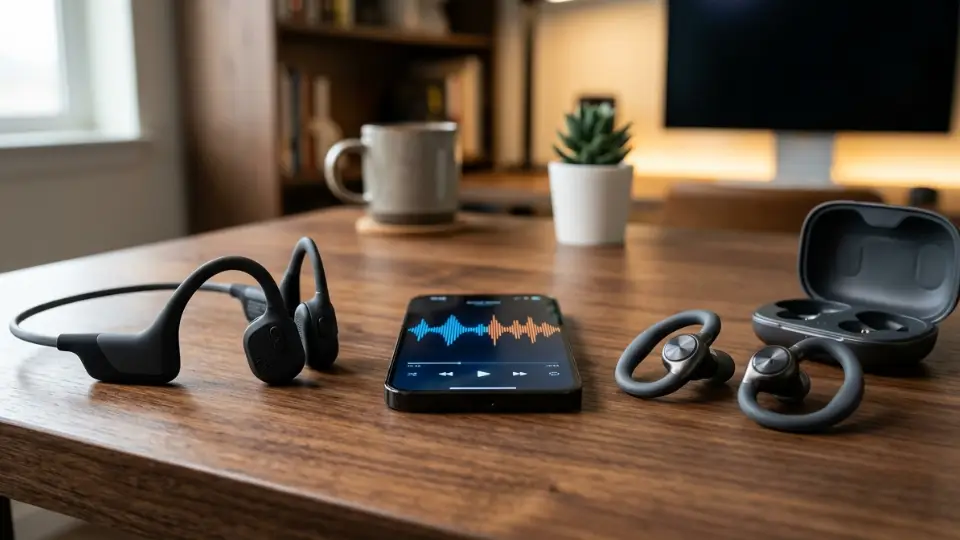
The Science Behind the Sound: How They Actually Work
Before we dive into our real-world testing results, it is essential to understand that these two technologies deliver audio to your brain in fundamentally different ways. While both designs leave your ear canal completely unblocked, the mechanical engineering behind them is completely different. When comparing open-ear vs in-ear earbuds, the lack of a physical seal is the main draw, but how the sound travels makes all the difference.
Bone Conduction: The Vibration Method
Bone conduction headphones bypass your eardrums entirely. Instead of pushing air, they rely on small transducers that rest directly on your cheekbones, just in front of your ears. These transducers send micro-vibrations through your facial bones directly into your inner ear (the cochlea). Because your eardrum is left completely completely open, your natural hearing is 100% unimpeded. This is the exact same technology utilized by tactical military teams, scuba divers, and specialized medical hearing devices.
Open-Ear Air Conduction: The Directional Speaker Method
Air conduction, on the other hand, is much closer to traditional audio, but heavily redesigned for the modern era. Devices in this category feature tiny, highly directional speakers that hover just above or sit slightly inside the outer ridge of your ear. They blast a concentrated beam of sound directly into your ear canal without physically plugging it. To prevent everyone around you from hearing your music, advanced 2026 algorithms cancel out the reverse sound waves, minimizing audio leakage.
The Real-World Scenario: The Commute and The Cubicle
To truly understand the difference between these two technologies, we need to step out of the sound-treated testing lab and into the messy reality of daily life. Let us walk through a typical Tuesday morning using both devices.
Imagine you start your day with a brisk 5-mile run through a busy suburban neighborhood. With bone conduction headphones, the experience is incredibly secure. The titanium band wraps tightly around your head, meaning no amount of sweat or sprinting will dislodge them. As a car approaches from a blind intersection, you hear the tire friction on the asphalt perfectly because your ears are entirely bare. However, when a massive diesel truck drives past, the roar of its engine completely drowns out the podcast you are listening to. Because bone conduction relies on vibrations, it simply cannot compete with loud environmental noise.
Now, imagine transitioning into the office. You swap to a pair of open-ear air conduction earbuds like the Shokz OpenFit 2. You sit down at your desk and start a heavy focused work session. The air conduction earbuds provide a much richer, fuller sound profile, allowing you to actually enjoy the bassline in your focus playlist. When a coworker walks up behind you to ask a question, you can still hear their voice clearly through your music. Furthermore, because there is no rigid band wrapping around the back of your head, you can lean back in your chair comfortably without the headset shifting out of place. This makes air conduction arguably the better choice when building a tech setup for ADHD focus, as you get excellent audio without feeling entirely cut off from reality.
Direct Comparison: Battle of the Specs
When you strip away the marketing jargon, how do these two technologies actually stack up against each other in daily use? We broke down the core pillars of the audio experience.
| Feature | Bone Conduction | Air Conduction |
|---|---|---|
| Audio Quality | Average. Weak bass, decent mids. Great for podcasts, poor for heavy music. | Excellent. Richer soundstage, noticeable bass, clear highs. |
| Fit & Stability | Extremely secure. Wraparound band ensures they never fall off. | Very good, but ear hooks can occasionally shift during extreme movement. |
| Situational Awareness | Maximum. 100% unblocked ear canal. | High. Sound is directional, but still allows ambient noise in. |
| Sound Leakage | Moderate. High volumes vibrate the chassis and create audible noise. | Minimal. Directional speakers and cancellation tech keep audio private. |
| Comfort (Long Term) | Can cause mild cheekbone fatigue or “tickling” at high volumes. | Feather-light. Often feel like you are wearing nothing at all. |
The Sound Quality Verdict
If audio fidelity is your primary concern, air conduction wins in a landslide. Because bone conduction relies on vibrating your skull, it physically struggles to reproduce low-end bass frequencies. Pushing the volume higher on a bass-heavy track with bone conduction headphones will literally cause the transducers to tickle your face annoyingly. Air conduction models like the Anker Soundcore AeroFit Pro have massive 16mm drivers that push real air, resulting in a surprisingly warm and punchy sound signature that rivals traditional earbuds.
The Comfort and Fatigue Factor
Comfort is highly subjective, but there are physical realities to both designs. Bone conduction headphones use a clamping force to ensure the transducers maintain contact with your skin. Over a six-hour workday, this pressure can cause slight tension near your temples. Conversely, open-ear air conduction earbuds use soft silicone hooks that rest gently over the top of your ears. They are incredibly comfortable, but if you wear thick-framed glasses, the real estate behind your ear can get crowded quickly.
Best For / Avoid If: Making the Right Choice
Choosing between these two technologies is not about which one is universally better; it is about which one solves your specific daily friction points.
Bone Conduction is BEST FOR:
- Outdoor Athletes: If you cycle on busy roads or run near heavy traffic, this is the safest option available. It is the undeniable champion when looking for the best open-ear headphones for running.
- People with Hearing Conditions: Because it bypasses the eardrum, individuals with conductive hearing loss or eardrum damage can often hear audio perfectly through bone conduction.
- Industrial Workers: If you are required to wear earplugs for safety, you can wear bone conduction headphones simultaneously, allowing you to hear communications while protecting your eardrums.
Bone Conduction is AVOID IF:
- You are an audiophile who demands deep bass and a wide soundstage.
- You frequently commute on loud public transit like subways or airplanes, as you will not be able to hear your audio over the engine noise.
Open-Ear Air Conduction is BEST FOR:
- Office Workers and Remote Employees: They offer excellent audio quality for Zoom calls while keeping you aware of your surroundings, making them top-tier open-ear headphones for work safety and office communication.
- Podcast and Audiobook Listeners: The vocal clarity on directional air conduction speakers is outstanding, making spoken-word content a joy to listen to.
- Long-Duration Wearers: The zero-pressure fit means you can easily wear them from 9 AM to 5 PM without any physical fatigue.
Open-Ear Air Conduction is AVOID IF:
- You do high-impact sports where violent head movements might dislodge an ear hook.
- You need absolute silence; these do not have Active Noise Cancellation (ANC) because they do not form a seal.
Mini Conclusion
The 2026 audio landscape proves that you do not need to shove a piece of silicone deep into your ear canal to get a great listening experience. If your life demands rugged stability, elemental resistance, and maximum situational awareness, bone conduction remains the undisputed king of the outdoors. However, if you want a seamless transition between life, work, and high-quality audio without the isolation of traditional earbuds, open-ear air conduction has evolved into the superior, more versatile technology. Evaluate your daily routine, consider your primary environments, and choose the technology that adapts to your life, rather than forcing you to adapt to it.
Frequently Asked Questions
Can people around me hear what I am listening to?
Both technologies have minor sound leakage, but open-ear air conduction in 2026 is vastly superior at keeping your audio private. They use phase-cancellation technology to neutralize sound waves traveling away from your ear. Bone conduction will audibly buzz and leak sound if you push the volume past 70%, especially in a quiet office environment.
Are either of these good for airplanes or loud environments?
No. Neither bone conduction nor air conduction features Active Noise Cancellation, and neither creates a passive seal to block out noise. If you try to use them on an airplane, the 85-decibel roar of the jet engines will completely overpower your music or podcast. For travel, you still need traditional ANC earbuds or over-ear headphones.
Can I wear glasses with open-ear headphones?
Yes, but it requires a bit of maneuvering. Both bone conduction bands and air conduction ear hooks sit on the same part of your ear that your glasses frames rest on. Generally, you should put your glasses on first, and then place the audio device over the frames. Thinner glasses frames will be significantly more comfortable.
Do bone conduction headphones cause headaches?
For the vast majority of users, no. However, a small percentage of people report mild headaches or dizziness when first using bone conduction, primarily due to the physical vibrations on the cheekbones or the clamping force of the titanium band. If you are prone to tension headaches, air conduction is a much safer, pressure-free alternative.