
The Bose QuietComfort Ultra and AirPods Pro 2 are both exceptional ANC earbuds — but they are built for completely different users. Choosing between them without understanding that difference is one of the most common and expensive mistakes buyers make in this category. This comparison exists to make the right choice obvious.
Bose QuietComfort Ultra vs AirPods Pro 2: Which One Should You Buy in 2026?
A direct comparison of two of the best ANC earbuds available — covering noise cancellation, sound quality, call performance, battery life, ecosystem, and the specific buyer profiles each one actually serves.
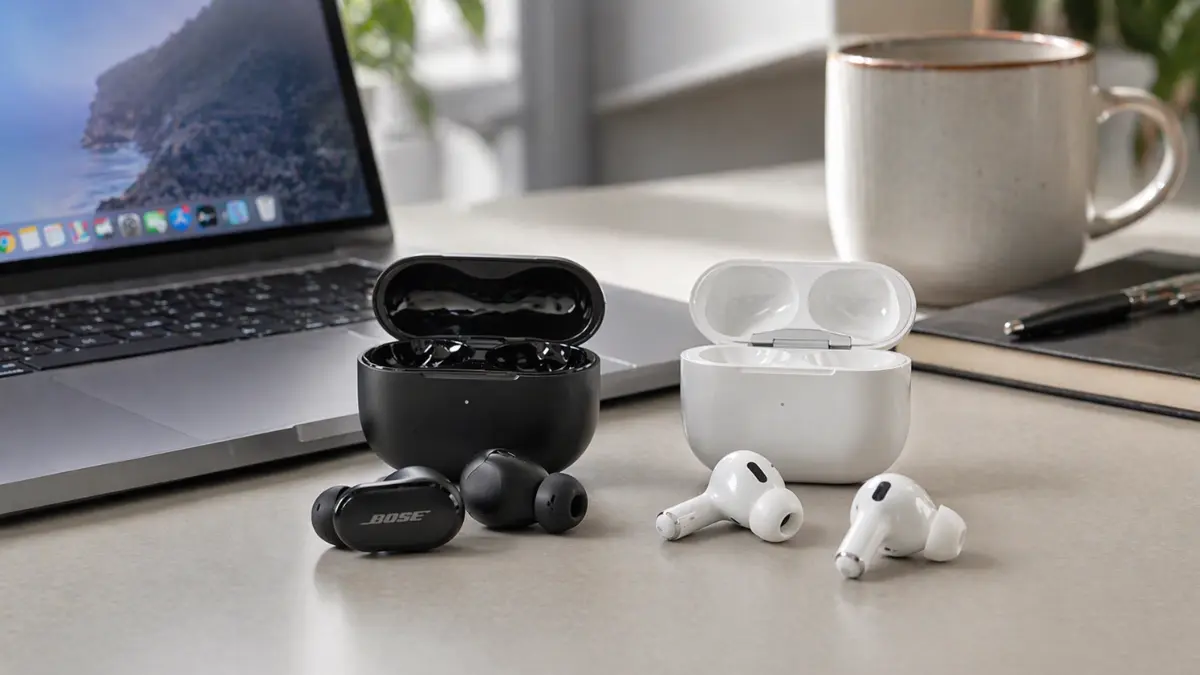
Quick Verdict
- Best ANC: Bose QuietComfort Ultra — stronger raw noise cancellation, particularly in transit
- Best for iPhone users: AirPods Pro 2 — iOS ecosystem integration is unmatched by any competitor
- Best overall balance: AirPods Pro 2 for Apple users; Bose QC Ultra for everyone else who prioritizes ANC
- Choose Bose if: You travel frequently, work in consistently loud environments, or use Android/Windows
- Choose AirPods Pro 2 if: You use iPhone and Mac, take many calls, or want the strongest all-round package on iOS
- Neither is best for: Users who prioritize audiophile-grade sound above all other factors — look at Technics EAH-AZ100 or Sennheiser MTW4 for that
Comparison Table
| Feature | Bose QC Ultra | AirPods Pro 2 (USB-C) |
|---|---|---|
| ANC Performance | Best-in-class, strongest raw cancellation | Excellent, adaptive to environment |
| Sound Quality | Immersive, wide, slightly warm | Clean, balanced, natural |
| Call Quality | Good, adequate for most environments | Very Good — Voice Isolation on Apple devices |
| Battery Life (ANC on) | ~6h earbuds / ~18h with case | ~6h earbuds / ~24h with case |
| Comfort & Fit | Secure, stable, slightly larger | Lighter, easier fit for most ears |
| Ecosystem | Universal — works well with any device | Apple only — full features on iPhone/Mac |
| Multipoint | Yes — two devices | Limited — Apple auto-switching only |
| App & Features | Bose Music app, CustomTune, Immersive Audio | No separate app — iOS Settings, spatial audio, Hearing Aid Mode |
| Price tier | Premium | Premium |
ANC Performance — The Most Important Difference
If you are comparing the Bose QC Ultra vs AirPods Pro 2 specifically because of noise cancellation, the answer is straightforward: Bose cancels more noise. This is the consensus across independent reviewers, and it is consistent rather than marginal.
The Bose QC Ultra uses CustomTune — a per-ear calibration that runs each time you put the earbuds in, adapting the ANC profile to the specific geometry of your ear canal in that session. The result is a level of low-frequency noise reduction that is difficult to match. In airplane cabin noise — the classic ANC test environment — the Bose QC Ultra reduces the engine drone more thoroughly than almost any competing earbud.
The AirPods Pro 2 use Apple’s H2 chip with adaptive ANC that continuously adjusts based on the fit and the surrounding environment. The ANC is excellent — in most everyday environments like an open office, a busy café, or a commuter train, it performs at a level that most users will find entirely satisfying. It does not reach the absolute ceiling that Bose achieves in high-noise, low-frequency environments, but the gap in typical daily use is smaller than the gap during a six-hour long-haul flight.
The practical summary: if you fly frequently and the primary reason you’re spending premium money on earbuds is to survive those flights with less noise fatigue, the Bose QC Ultra is the correct choice. If your ANC use is mostly commuting, office environments, and occasional travel, AirPods Pro 2 are more than capable — and better positioned to deliver on everything else.
Sound Quality
Both earbuds deliver sound quality that is well above the average consumer baseline. Neither is tuned for audiophile accuracy, and neither should be evaluated primarily as a music earbud — their sound profiles are shaped by their use cases and target audiences.
The Bose QC Ultra sounds wide and spacious. The Immersive Audio spatial processing mode adds a cinematic quality to music and film content that is genuinely enjoyable for passive listening. The frequency response leans slightly warm, with bass that is present and engaging without being overwhelming. It’s a sound designed to feel satisfying across a broad range of content — and it succeeds at that.
The AirPods Pro 2 sounds cleaner and more balanced. The frequency response is more neutral, which means it is more accurate to the recording but less immediately exciting than the Bose in a brief comparison. Spatial audio with head tracking works well for Apple Music content mixed in Dolby Atmos — the experience of sound appearing to come from outside your head rather than inside it is one of the more convincing spatial audio implementations in a consumer earbud.
For the majority of buyers, neither is a clear winner here — the difference is a preference for warmth and width (Bose) versus balance and accuracy (Apple). If you have a strong preference for either profile, that may inform your decision. If you don’t, this category doesn’t drive the comparison.
Call Quality
Understanding call quality requires separating two distinct things: what you hear during a call, and what the other person hears from you. ANC handles the first. Microphone quality handles the second.
On the inbound side, both earbuds are strong — you will hear calls clearly through either. The Bose advantage in raw ANC translates to a quieter backdrop during calls in loud environments, which can make it easier to concentrate on what’s being said.
On the outbound side — what your caller hears from you — AirPods Pro 2 have a clear advantage, particularly on iPhone. Apple’s Voice Isolation mode actively processes the microphone signal to identify and suppress background noise before it is transmitted. In practice, this means people on the other end of your call hear your voice more cleanly in ambient noise conditions than they do with most competing earbuds.
The Bose QC Ultra has a capable microphone system that performs adequately in typical home and office environments. In noisier conditions, the outbound noise suppression is reasonable but does not match Apple’s Voice Isolation. For anyone whose work involves frequent video calls — Zoom, Teams, Google Meet — this is a practically relevant difference, not a theoretical one.
Battery Life
On paper, the two earbuds sit at similar battery figures — both around 6 hours of earbud use with ANC active. The meaningful difference is in the charging case.
The AirPods Pro 2 case extends total battery to approximately 24 hours, while the Bose QC Ultra case provides around 18 hours. For most daily commuters and office workers, neither is a practical constraint — you’ll recharge the case overnight and have full battery available the next morning.
The difference becomes relevant during multi-day travel or situations where you cannot reliably charge the case daily. In those scenarios, the AirPods Pro 2 case’s additional capacity provides a meaningful buffer.
Both earbuds support quick charging that provides a useful amount of playback from a brief charge — a practical feature for users who forget to charge overnight. Verify current quick-charge specifications with each manufacturer, as these may be updated via firmware.
Comfort and Fit
The Bose QC Ultra is slightly larger and heavier than the AirPods Pro 2, but this trades off with a more secure, stable fit that many users find preferable for longer sessions. The eartips create a confident seal. For users who have experienced earbuds shifting or loosening during movement, the Bose provides more consistent in-ear stability.
The AirPods Pro 2 are lighter and less physically present in the ear, which many users find more comfortable for extended wear. The fit is gentler and easier for users who dislike the sealed sensation of larger earbud housings. The trade-off is that for some ear geometries, the AirPods Pro 2 feel slightly less secure than the Bose during physical activity.
Both come with multiple eartip sizes. Getting the right eartip size is the single most impactful fit decision for either earbud — a poor seal degrades both comfort and ANC performance. If an earbud feels uncomfortable or the ANC seems weaker than expected, try a different tip size before drawing conclusions about the hardware.
Ecosystem and Features
This is where the comparison becomes decisive for a large portion of buyers.
The AirPods Pro 2 are deeply integrated with Apple’s hardware and software ecosystem. Automatic switching between iPhone, iPad, and Mac happens without manual pairing. Spatial audio tracks head position in real time. Voice Isolation and Transparency mode are accessible from Control Center. Hearing Aid Mode — cleared by the FDA for mild to moderate hearing loss — is available through iOS. Find My integration locates the earbuds from the same app used for Apple devices. These are not minor conveniences. For an iPhone user who also works on a Mac, the daily experience is meaningfully smoother than any alternative.
None of these features work on Android. On Windows, basic audio functions work but the differentiating features are unavailable. AirPods Pro 2 used outside the Apple ecosystem are capable but unremarkable — you are paying a premium for features you cannot access.
The Bose QC Ultra has no ecosystem dependency. It connects to any device over Bluetooth, works with both Android and Apple apps, supports multipoint for two simultaneous device connections, and does not require any specific hardware to deliver its core value. The Bose Music app is well-built and available on both platforms. For users with a mix of devices — a Windows laptop and an Android phone, for example — Bose is simply the more practical choice.
Who Should Buy Each
Choose Bose QuietComfort Ultra if…
- You fly regularly and want the most effective noise cancellation available for long-haul cabin noise
- You work in a consistently loud environment — open office with heavy HVAC, construction nearby, loud transit — and ANC strength is the primary reason you’re spending at this tier
- You use Android or Windows and would not benefit from Apple ecosystem features
- You prefer a device-agnostic option that works equally well across any phone, laptop, or tablet
- You want standard multipoint Bluetooth connection to two devices simultaneously without ecosystem lock-in
Choose AirPods Pro 2 if…
- You use an iPhone as your primary device — the ecosystem integration alone justifies the choice
- You also use a Mac and want seamless automatic switching between your phone and laptop without any manual steps
- You take frequent video or phone calls and need strong outbound voice clarity — Voice Isolation is a practical advantage here
- You value hearing health features — Hearing Aid Mode and personalized volume are available on no competing earbud in this tier
- You want the most complete overall package for daily Apple ecosystem use rather than the maximum ANC specification
Common Mistakes Buyers Make in This Comparison
Choosing based only on ANC strength
ANC is one variable among several, and it only matters in proportion to how much ambient noise your actual daily environments produce. Many buyers who select the Bose QC Ultra primarily for its ANC superiority would have been better served by AirPods Pro 2 — because their daily ANC needs don’t extend to the conditions where the Bose advantage is most significant, and they use iPhones where AirPods Pro 2’s ecosystem benefits apply every day.
Ignoring ecosystem reality
The most common mistake in this specific comparison. AirPods Pro 2 purchased by an Android or Windows user deliver approximately half the product. The features that justify the price on an iPhone — spatial audio, Voice Isolation, automatic switching, hearing health functions — are either unavailable or significantly reduced outside Apple hardware. Ecosystem fit is not a secondary consideration; for many buyers it should be the first one.
Overvaluing marginal specification differences
Both earbuds are premium products that perform at a high level on every meaningful criterion. Spending significant time comparing 6 versus 5.9 hours of battery, or debating which sounds marginally better on a specific genre, misses the larger and more practically relevant differences — ecosystem integration, ANC depth in specific environments, and call microphone performance. Prioritize the variables that affect your daily use, not the ones that separate two products on a spec sheet.
Final Verdict
The Bose QC Ultra vs AirPods Pro 2 comparison has a clear answer for most buyers — and it is determined primarily by one question: do you use an iPhone?
If yes, buy the AirPods Pro 2. The iOS ecosystem integration delivers real daily value that the Bose cannot provide on Apple hardware. The ANC is excellent for all common environments. The call quality advantage is practical for anyone who takes calls regularly. The case battery provides more total charge. And the hearing health features are unique to this platform.
If no — if you use Android, Windows, or a mix of devices — buy the Bose QC Ultra. The stronger noise cancellation is its reason to exist, and it delivers on that without requiring any ecosystem commitment. For frequent travelers or anyone who spends significant time in loud environments, it is the most effective tool available in an earbud form factor.
The only buyer who should genuinely hesitate is an iPhone user who flies extensively and finds that the AirPods Pro 2 ANC is insufficient for long-haul flights. In that specific case, the Bose QC Ultra’s ANC ceiling may justify choosing it over the ecosystem advantages of AirPods. For everyone else, the choice follows directly from the device in your pocket.
Frequently Asked Questions
Which has better ANC — Bose QC Ultra or AirPods Pro 2?
The Bose QuietComfort Ultra Earbuds offer stronger raw noise cancellation, particularly for low-frequency continuous noise like airplane engines and HVAC systems. The AirPods Pro 2 offer excellent adaptive ANC that performs well across varied everyday environments. For maximum noise blocking in transit or on flights, Bose leads. For general daily use, AirPods Pro 2 are more than adequate.
Are AirPods Pro 2 better than Bose QuietComfort Ultra?
For iPhone and Mac users, yes — the iOS ecosystem integration, Voice Isolation on calls, spatial audio, and hearing health features make AirPods Pro 2 a more complete product on Apple hardware. For Android or Windows users who prioritize ANC strength, the Bose QC Ultra is the stronger choice. Neither is objectively better; the right answer depends on your device and priorities.
Which is better for iPhone users?
AirPods Pro 2, without reservation. Automatic device switching, spatial audio, Voice Isolation, Hearing Aid Mode, and Find My integration all depend on Apple hardware and are unavailable or heavily reduced on any third-party earbud. iPhone users pay for AirPods Pro 2 and receive all of those features. Non-Apple earbud users pay similarly and do not.
Is the Bose QC Ultra worth the price?
For frequent travelers and people who work in consistently loud environments, yes. The noise cancellation performance justifies the premium for buyers whose primary use case is noise reduction. For home-office users or casual listeners who rarely encounter extreme ambient noise, the value case is less clear — strong ANC at a lower price point may be sufficient for those needs.
Which is better for phone calls?
AirPods Pro 2 have a clear advantage for calls on iPhone. Apple’s Voice Isolation mode suppresses background noise on the outbound microphone signal before it reaches the other person. The Bose QC Ultra performs adequately on calls in quiet to moderate environments, but its outbound noise suppression does not match Voice Isolation for call clarity in noisy conditions.
Can I use AirPods Pro 2 with Android or Windows?
Yes — basic audio functions, ANC, and music playback work across platforms. However, automatic device switching, spatial audio with head tracking, Voice Isolation on calls, and Hearing Aid Mode all require Apple hardware. On Android or Windows, AirPods Pro 2 function as capable earbuds but without the features that distinguish them at their price point. For non-Apple users, the Bose QC Ultra is a better-matched choice.