
“AI earbuds” is one of the most overused — and least understood — terms in consumer audio right now. Some earbuds genuinely use neural processing to improve sound and calls in real time. Others simply relabel basic algorithms as “AI.” The difference is not small — and it directly affects what you actually hear.
Artificial intelligence has quietly become the most important hardware spec in earbuds — and most people have no idea what it actually does. The word “AI” appears on product pages between battery life claims and driver size numbers, treated as a feature in the same category as Bluetooth 5.4 or multipoint connection. It is not. AI in earbuds is a fundamentally different class of technology, and in 2026, it is reshaping what personal audio means at a level that goes far beyond noise cancellation.
The problem is that no one explains it clearly. Marketing teams use the term to describe everything from a simple algorithm that adjusts EQ to a fully adaptive neural processing system that learns your hearing profile over weeks of use. These are not the same thing, and treating them as equivalent does serious disservice to buyers trying to make an informed decision.
This guide cuts through the noise. What AI in earbuds actually does, how it works at a technical level without requiring an engineering degree, which implementations are genuinely intelligent versus which are marketing language, and where the technology is heading next — all of it, explained honestly.
AI in Earbuds: What It Actually Does (2026 Explained)
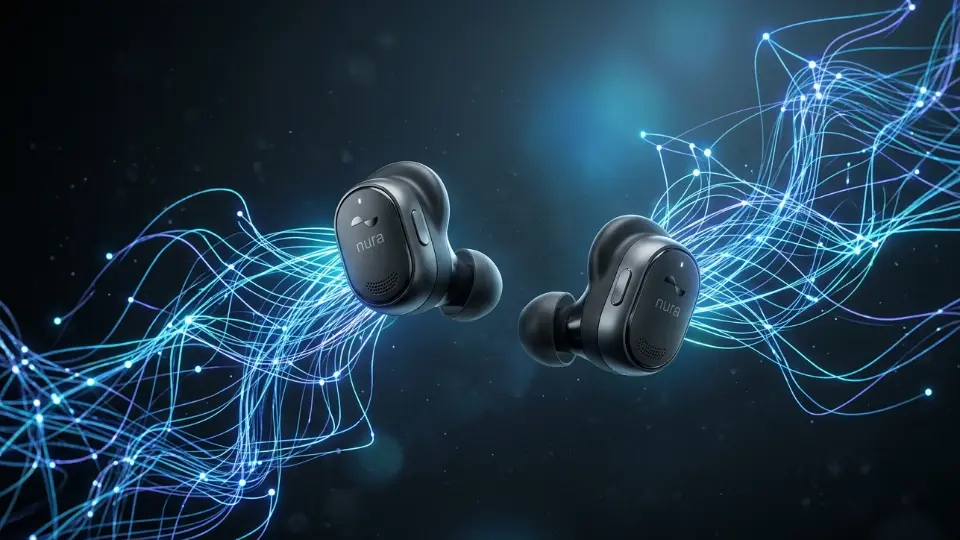
Why AI in Earbuds Is Different From AI Everywhere Else
When people talk about AI in phones or laptops, they usually mean cloud-connected models — large language systems, image generators, or recommendation engines that run on remote servers and send results back to your device. The AI in earbuds cannot work that way. There is no internet connection running through a pair of wireless earbuds. There is no cloud latency acceptable in real-time audio processing. Everything must happen locally, on a chip smaller than a fingernail, in milliseconds.
This constraint is actually what makes earbud AI genuinely impressive from an engineering standpoint. The models running inside a pair of Sony or Apple earbuds in 2026 are optimized neural networks — compressed, pruned, and quantized versions of larger architectures, tuned specifically to run on ultra-low-power DSP hardware while consuming under a milliwatt of energy. They are not general-purpose AI. They are purpose-built inference engines doing one or two things with extreme precision.
That specificity is important to understand. Earbud AI does not think. It does not learn in the way a language model learns. What it does is make continuous, real-time predictions based on sensor input — microphone arrays, accelerometers, skin contact sensors, gyroscopes — and use those predictions to adjust audio output or call quality hundreds of times per second.
The Difference Between an Algorithm and a Neural Network
Not all “AI” in earbuds is neural network-based. Some manufacturers use the term to describe rule-based algorithms — fixed logic trees that say, for example, “if ambient noise frequency is between 80Hz and 400Hz, apply filter profile B.” This is effective engineering. It is not machine learning. It will not adapt. It will not improve. It responds only to conditions its designers anticipated.
A true neural network approach is different. The model has been trained on millions of audio samples — different noise environments, different voice types, different acoustic conditions — and has learned internal representations of those patterns. When it encounters a new environment, it does not look up a rule. It runs inference on its trained weights and produces a response that generalizes beyond what any fixed algorithm could anticipate.
In 2026, the best earbuds on the market use genuine on-device neural processing. The gap in real-world performance between these and algorithm-only competitors is measurable and meaningful — particularly in complex, unpredictable sound environments like a busy train platform, a wind-exposed running trail, or a crowded open-plan office.
What AI Actually Does in Modern Earbuds: Six Real Functions
1. Adaptive Active Noise Cancellation
This is the function most people associate with AI in earbuds, and it is also the area where the gap between true AI and legacy ANC is widest. Traditional ANC uses a feedforward microphone to sample incoming sound and generate an inverted waveform to cancel it. The system is reactive and uniform — it applies the same cancellation profile to every sound regardless of what that sound actually is.
AI-driven ANC in 2026 does something categorically different. The system classifies the incoming noise before it decides how to handle it. A neural classifier distinguishes between engine rumble, human speech, wind noise, high-frequency hiss, impact sounds, and music bleeding from other devices. Each category receives a different cancellation treatment, tuned to eliminate it without affecting the frequency ranges that carry the audio you actually want to hear.
Apple’s H2 chip, Qualcomm’s S7 Pro Gen 1 platform, and Sony’s QN2e processor all implement some version of this classification-before-cancellation architecture. The practical result is ANC that sounds more natural, handles mixed noise environments more gracefully, and avoids the pressurized or hollow sensation that older feedforward-only systems produce.
Beyond classification, the most advanced implementations update their cancellation model continuously — sampling the fit seal quality, detecting changes in ambient conditions, and recalibrating the anti-noise waveform dynamically rather than relying on a profile set at initial pairing.
2. Personalized Sound Profiles and Hearing Adaptation
Hearing is not uniform. Every person’s auditory system has a unique frequency response — certain frequencies are perceived louder or softer, certain ranges become less sensitive with age or noise exposure, and the ear canal’s physical shape affects how sound resonates before it reaches the eardrum. A standard EQ curve applied identically to every listener is, by definition, wrong for most of them.
AI-powered hearing personalization addresses this through in-ear audiometric testing. The earbud plays a series of tones at varying frequencies and volumes, the user responds to what they can and cannot hear, and an on-device model generates a personalized hearing profile that reshapes the audio output to compensate for the individual’s specific frequency sensitivity map.
Samsung’s Galaxy Buds3 Pro implements this with a clinical-grade audiogram process that takes under three minutes. Sony’s Headphones Connect app uses a similar approach with AI-generated DSEE profiles. The result is not just louder or bassier audio — it is audio that has been specifically calibrated for how your ears process sound, which for many users produces a clarity improvement that no amount of manual EQ adjustment could replicate.
The more sophisticated systems do not stop at initial calibration. They continue to monitor listening behavior — volume levels, content types, session lengths — and make micro-adjustments over time. This represents a genuine, if narrow, form of personalized learning at the device level.
3. Conversational Awareness and Context Detection
One of the most practically useful AI functions in 2026 earbuds is context detection — the ability for the earbud to understand what situation you are in and adjust its behavior accordingly, without requiring any manual input from you.
The most common implementation is conversation detection. Using a combination of bone conduction sensors, jaw movement accelerometers, and outward-facing microphones, the system detects when the user begins speaking and automatically switches from full ANC to a transparent passthrough mode — allowing the user to hear and participate in a conversation naturally. When the user stops speaking and ambient noise returns to baseline, the system switches back to ANC mode.
Apple’s Adaptive Audio, introduced on AirPods Pro 2 and refined significantly in subsequent firmware updates, is the most mature implementation of this concept. The system blends ANC and transparency dynamically rather than switching between discrete modes, creating a continuous acoustic experience that responds to the environment moment by moment rather than waiting for the user to trigger a mode change.
Beyond conversation, advanced context detection in 2026 includes activity recognition. Earbuds with accelerometers and gyroscopes can detect whether the user is sitting, walking, running, or cycling, and adjust audio profiles, ANC depth, and ambient sound passthrough levels to match the activity. A profile optimized for a seated focus session is very different from one suited to a 10K run, and AI context detection eliminates the need to manage those transitions manually.
4. AI-Powered Call Quality and Voice Isolation
Call quality has historically been the weakest area of true wireless earbud performance. Multiple microphones on a device with no rigid body, surrounded by wind and ambient noise, transmitting voice through a compressed Bluetooth audio codec — the engineering challenges are considerable.
AI voice isolation changes this equation. The approach uses a neural network trained on thousands of hours of human speech in noisy environments. The model has learned to identify the acoustic signature of a human voice — its formant structure, harmonic patterns, temporal envelope — and separate it from non-voice content in real time. The result is that wind noise, traffic, office chatter, and background music are attenuated from the transmitted call signal without affecting the clarity of the speaker’s voice.
Qualcomm’s aptX Voice and cVc 8.0 architecture, Apple’s beamforming microphone array with machine learning voice processing, and Sony’s precise voice pickup technology all implement this function. In independent testing under challenging conditions — heavy wind, crowded restaurants, moving vehicles — the difference between AI voice isolation and traditional multi-mic processing is pronounced. Callers on the receiving end report significantly higher intelligibility scores.
The leading edge of this technology in 2026 goes further. Some implementations can now separate two speakers in the same environment, suppressing the voice of a bystander while preserving the user’s voice — a function that was not practically achievable in consumer earbuds as recently as 2024.
5. Spatial Audio and Head Tracking Intelligence
Spatial audio — the simulation of three-dimensional sound fields through stereo earbuds — has moved from novelty to essential feature in 2026. But spatial audio without intelligent head tracking is a static experience. The sound field moves with your head rather than remaining anchored to the content source, which breaks the immersion immediately and can cause disorientation during extended use.
AI-enhanced head tracking addresses this by using gyroscope and accelerometer data to model head orientation in real time and counterrotate the sound field to keep it anchored. At the basic level, this is straightforward sensor fusion. At the AI level, the system anticipates movement rather than simply reacting to it — using predictive modeling based on the trajectory and velocity of detected head movement to pre-position the audio before the rotation is complete, eliminating the perceptible lag that earlier implementations suffered from.
Apple’s implementation with AirPods Pro 2 and Vision Pro cross-device audio uses a personalized head-related transfer function — an AI-generated model of how sound reaches the individual user’s ears based on ear shape, head size, and prior listening behavior. This produces a spatial experience that is calibrated to the individual rather than averaged across a population, which audiologists note makes a significant difference in perceived naturalness.
6. Health and Biometric Monitoring Through Audio AI
The ear canal is one of the most information-rich locations on the human body for biometric sensing. It is close to major blood vessels, thermally stable, acoustically isolated, and in continuous close contact with body tissue. In 2026, the intersection of AI and in-ear sensing is producing a new category of earbud functionality that has nothing to do with audio.
Heart rate monitoring via photoplethysmography has been present in earbuds since the early 2020s. The AI layer added in current generation devices does not simply read a pulse — it analyzes heart rate variability, respiration rate derived from motion and cardiac data, and exercise intensity in real time, producing a picture of physiological state that approaches what a dedicated fitness wearable provides.
More interesting are the emerging fall detection and cognitive load estimation functions. Fall detection uses accelerometer data processed through a trained classifier to distinguish a trip or stumble from normal head movement and alerts emergency contacts if a hard fall is detected and the user does not respond to a check-in prompt. Cognitive load estimation — still in early commercial deployment — uses acoustic signals from in-ear microphones combined with heart rate variability data to estimate mental fatigue and suggest breaks during extended focus sessions.
These are not science fiction. They are shipping in commercial earbuds from Samsung, Apple, and a growing number of specialized wellness audio brands in 2026.
Which Earbuds Have the Best AI in 2026
Apple AirPods Pro 2 — Best AI Ecosystem Integration
Apple’s H2 chip remains the most cohesive AI audio processor in a consumer earbud. The combination of Adaptive Audio, personalized spatial audio, real-time conversation detection, and deep iOS integration means that the AI functions work together as a unified system rather than independent features. The intelligence is ambient — it works without requiring the user to configure or manage it.
The limitation is the ecosystem lock. AirPods Pro 2’s AI features are substantially reduced when paired with non-Apple devices. If your primary device is an iPhone or Mac, this is the benchmark. If it is not, look elsewhere.
Sony WH-1000XM6 and WF-1000XM6 — Best AI Noise Cancellation
Sony’s QN2 and QN2e processors represent the most mature AI-driven ANC implementation outside of Apple. The 360 Reality Audio personalization, DSEE Extreme upscaling, and Precise Voice Pickup processing are all genuinely AI-based rather than algorithm-based, and they perform at the top of their respective categories in independent testing.
Sony’s approach is more configurable than Apple’s — the Headphones Connect app exposes a level of manual control over AI behavior that audiophiles appreciate. The tradeoff is that it requires more user engagement to reach its full potential.
Samsung Galaxy Buds3 Pro — Best AI Health Integration
Samsung has leaned hardest into the health and biometric angle of AI earbuds in 2026. The Galaxy Buds3 Pro’s hearing test, real-time hearing protection alerts, and Galaxy AI integration for call summarization and live translation represent the most ambitious expansion of what earbuds are supposed to do.
The live translation feature — which uses on-device AI to transcribe and translate speech in real time during calls — is the most practically transformative AI earbud function available to general consumers in 2026. It is imperfect, but it is working and improving with each software update.
Jabra Evolve2 Buds — Best AI for Professional Use
For enterprise and professional users, Jabra’s focus on AI call quality is unmatched. The MyFit and MySound personalization systems, combined with six-microphone call pickup architecture running neural voice isolation, produce call quality that is consistently rated higher by call recipients than any other earbud in independent testing.
This is not the right earbud for casual listening or fitness use. It is the right earbud for someone whose professional performance depends on communication clarity.
What AI in Earbuds Cannot Do (Yet)
It Cannot Fix Bad Acoustics
AI processing enhances what the physical hardware captures. It cannot manufacture frequency response that the driver is not capable of producing. A poorly designed speaker unit with a hollow midrange will still sound hollow after AI EQ processing — the correction can compensate partially, but it cannot create physical acoustic properties the hardware does not possess.
This is why the best AI-powered earbuds in 2026 are also, without exception, well-engineered acoustic products. AI is a multiplier, not a substitute for fundamental audio engineering quality.
It Cannot Fully Compensate for a Bad Fit
ANC performance, spatial audio quality, and call clarity are all directly dependent on how well the earbud seals in the ear canal. No amount of AI processing can fully compensate for a broken seal. A poorly fitting earbud with an AI processor will still be outperformed by a well-fitting earbud without one in almost every measurable category.
Fit matters first. AI matters second. This order is non-negotiable, and any guide or review that inverts it is misleading you.
It Cannot Protect Your Privacy Without Active Management
AI earbuds with always-on microphones, context detection, and voice activity monitoring are, by their nature, continuously sampling the acoustic environment around you. The privacy implications of this are real and underacknowledged in most product coverage.
All major manufacturers in 2026 process voice detection locally rather than uploading audio to cloud servers for analysis. But the microphones are active, and in certain use cases — enterprise environments, sensitive conversations, confidential meetings — users should understand what their earbuds are listening to and configure or disable ambient sensing accordingly.
Where AI in Earbuds Is Heading: 2027 and Beyond
Real-Time Language Translation at Scale
Samsung’s current live translation is a preview of a function that will be standard across premium earbuds within two product generations. The limiting factor today is latency — the half-second delay between spoken word and translated output disrupts natural conversational flow. As on-device model compression improves and dedicated neural processing silicon becomes more power-efficient, this delay will drop below the threshold of perceptibility.
When real-time translation becomes seamless, it does not just improve a product feature — it changes what earbuds are. A device that eliminates language barriers in real-time conversation is a communication tool of a different order than a music player with good noise cancellation.
Predictive Audio Environments
Current AI in earbuds is reactive — it responds to detected conditions. The next step is predictive. Using location data, calendar context, historical usage patterns, and real-time acoustic analysis, future earbuds will anticipate the audio environment the user is about to enter and pre-configure themselves before arrival.
Approaching a subway entrance, the earbud activates deep ANC. Walking into a meeting room, it switches to awareness mode and begins live transcription. Starting a run route the user takes every Tuesday morning, it loads the personalized workout audio profile and connects to the fitness tracking app automatically. None of this requires user input. All of it requires AI that understands context across time, not just in the present moment.
Clinical-Grade Hearing Health Monitoring
The regulatory pathway for earbuds as FDA-cleared medical devices has been actively developing since 2023. In 2026, several manufacturers are in late-stage approval processes for earbuds that can detect early indicators of hearing loss, monitor tinnitus severity, and flag patterns associated with cardiovascular conditions — all from continuous in-ear acoustic and sensor data.
This represents the most significant expansion of what an earbud is in the history of the category. The audio experience remains the primary function. The health monitoring layer adds a dimension that could meaningfully affect clinical outcomes for millions of people who wear earbuds for hours every day but would never otherwise have access to continuous audiological monitoring.
How to Evaluate AI Claims When Buying Earbuds
Ask What the AI Is Actually Classifying
The most useful question to ask about any AI claim in an earbud is: what is the model classifying, and what action does that classification trigger? If a brand cannot answer this question specifically — if the answer is simply “the AI optimizes your sound” — the implementation is almost certainly algorithmic rather than neural, and the AI label is marketing language.
A real answer sounds like: “the system classifies ambient noise into eight categories and applies a different cancellation weight curve to each” or “the voice isolation model separates speech from non-speech components at the waveform level before Bluetooth transmission.” Specificity is the signal of genuine implementation.
Check Whether the Processing Is On-Device
AI that requires a cloud connection introduces latency, privacy exposure, and dependency on network availability. For audio processing functions — ANC, voice isolation, spatial audio — on-device processing is not just preferable, it is necessary. Any ANC or call quality AI that routes audio through an external server is not a real-time system and will perform poorly in the conditions where it matters most.
Look for Third-Party Acoustic Testing, Not Just Manufacturer Demos
AI audio features are difficult to evaluate from a spec sheet and easy to stage impressively in a controlled demo environment. The most reliable evaluation method is third-party testing under uncontrolled conditions: independent lab measurements of ANC attenuation across frequencies, call quality intelligibility scores from blind listener panels, and battery impact data from AI features running at full load.
Sources like Rtings, SoundGuys, and the detailed reviews published at Topivo.net provide this level of structured, condition-specific evaluation — which is the standard you should demand before making a purchase decision on a product category where marketing and reality diverge as frequently as they do in AI audio.
Final Verdict: AI in Earbuds Is Real, Uneven, and Rapidly Maturing
The honest summary of AI in earbuds in 2026 is this: the best implementations are genuinely transformative, the worst are rebranded algorithms, and the gap between them is wider than the price difference between the products would suggest.
Adaptive noise cancellation that classifies and responds to noise type in real time is meaningfully better than fixed-profile ANC. Neural voice isolation for calls produces results that traditional multi-mic beamforming cannot match in difficult environments. Personalized hearing profiles create an audio experience that no manual EQ adjustment replicates. And context detection — earbuds that understand where you are and what you are doing without being told — represents a genuinely new paradigm for what a personal audio device is supposed to be.
None of this works without capable underlying hardware. None of it compensates for a bad fit. And none of the marketing terms reliably tell you which earbuds have real AI and which are wearing the label without the substance behind it.
That is exactly what this guide exists to clarify. Because the technology is real, it is here, and understanding it specifically is the only way to buy correctly in a category that has never been noisier — in every sense of the word.
FAQ: AI in Earbuds
Is AI in earbuds real or just marketing?
Both exist. High-end earbuds use real neural processing, while cheaper models often use rule-based algorithms labeled as AI.
Does AI improve sound quality?
Yes — mainly through personalization and adaptive processing, but it cannot replace good hardware.
Are AI earbuds worth it in 2026?
If you care about ANC, calls, and convenience — absolutely. But only if the implementation is real.