
Your earbuds are probably not broken. If they sound fuller one day, thinner the next, or strangely dull by evening, the reason is usually not random. Tiny changes in seal, earwax, moisture, fatigue, fit, and software can all make the same earbuds seem like a different product.
Why Your Earbuds Sound Different Every Day (And What’s Actually Changing)
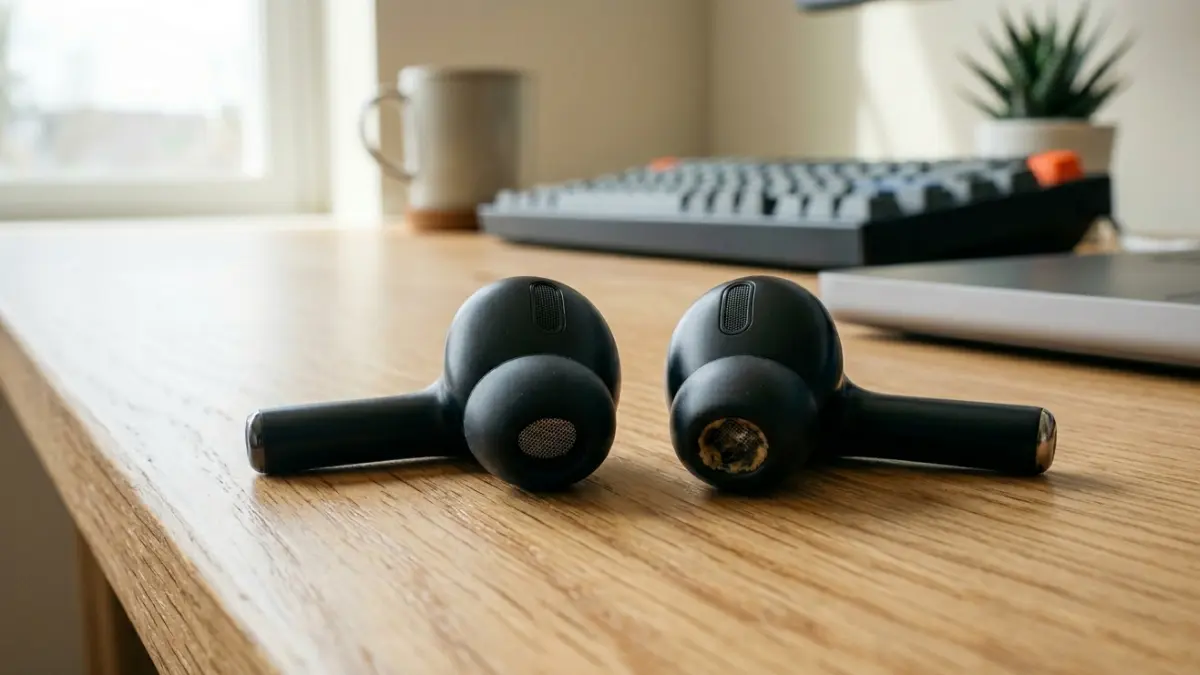
If your earbuds seem better some days and worse on others, the cause is often physical, not psychological. Here is why the same pair can shift in bass, clarity, loudness, and comfort without any obvious damage.
Most day-to-day sound changes come from fit, seal, earwax, ear canal condition, volume level, fatigue, and software behavior — not from the earbuds suddenly aging overnight. In other words, what changes is often the listening situation, not the hardware itself.
Most common causes
- Ear tips sealing differently from one day to the next
- Small earwax buildup on the nozzle mesh
- Different insertion depth in each ear
- Listening fatigue changing your perception
- Humidity, sweat, or temperature affecting comfort and seal
- Phone, app, or Bluetooth codec settings changing quietly in the background
What people often assume incorrectly
- That the drivers are failing every time the sound shifts
- That louder always means better sound
- That both ears hear identically every day
- That ANC performance never changes with seal quality
- That earbud apps never alter sound settings after updates
- That a clean-looking mesh is always acoustically clean
Why it happens at all
Wireless earbuds sit in one of the least stable listening environments possible: your ears. Unlike speakers in a fixed room or full-size headphones with larger pads, earbuds depend on tiny physical conditions staying consistent. But your ears are never truly identical from morning to night, and they are not the same from one day to the next either.
A small shift in angle, pressure, moisture, or tip compression can change bass response, clarity, stereo balance, and even how strong ANC feels. That is why earbuds can sound warm and full on Monday, then sharper, thinner, or quieter on Tuesday, even though nothing obvious has happened to the hardware.
Earbuds do not just play sound. They interact with your ear canal, your skin, your hearing, and your device settings. Change one of those, and the sound can change too.
The seal changes more than you think
The biggest reason earbuds sound different every day is the seal. If the ear tip closes your ear canal well, bass becomes fuller, outside noise drops, and the overall sound feels more solid. If the seal is weaker, bass leaks out, vocals can seem more distant, and the earbuds may suddenly feel “cheap” or thin.
This can happen because you inserted them more shallowly, changed ear tip pressure without noticing, or wore them after exercise when your ears were slightly warmer or more humid. Even chewing, walking, or lying down can shift the fit enough to change the sound.
Many people assume a seal problem only affects bass. In reality, it can change the entire tuning. The same earbuds can go from balanced to hollow simply because the tip is sitting a millimeter differently.
Play the same bass-heavy song, gently press each earbud inward for two seconds, and listen. If bass suddenly increases, your normal seal is inconsistent.
Earwax changes sound faster than most people realize
Earwax is one of the least dramatic-looking but most powerful sound killers in earbuds. It does not need to fully block the nozzle to matter. A thin film over the mesh can soften treble, reduce vocal clarity, and make one side sound quieter or duller than the other.
This is why earbuds may sound fine after cleaning, then subtly worse a few days later. The change is often gradual enough that you only notice it when one listening session suddenly feels off. In many cases, what sounds like aging hardware is actually a tiny acoustic blockage right where the sound leaves the earbud.
Because buildup is rarely identical on both sides, earwax also helps explain why balance can feel different from day to day. One ear may sound slightly more open, brighter, or louder than the other without any real electronic fault.
A mesh can look mostly fine and still be partially clogged. That small layer is enough to reduce clarity and shift the sound signature.
Your ears and brain do not hear the same every day
Not every sound change comes from the earbuds. Some come from you. Hearing is not a static measurement. Sleep, stress, congestion, listening fatigue, and even what you heard earlier in the day can change how music feels.
If you spent the afternoon in traffic, at the gym, or in a loud office, your ears may feel more sensitive or more tired by evening. Treble can seem harsher. Bass can feel weaker. Detail can feel less exciting. On a quiet morning, the same earbuds might seem smoother and more spacious.
This is not imagination. Perception shifts constantly. That is why comparing earbuds on different days, in different moods, and at different times often produces inconsistent results.
Software can quietly change the experience
Sometimes the earbuds themselves have not changed, but your phone has. App updates, firmware updates, Bluetooth codec changes, EQ presets, loudness normalization, adaptive sound features, and even spatial audio settings can alter what you hear.
This is especially common when people switch between apps, move between devices, or update their phone without revisiting sound settings. A pair that sounded rich on one device can seem flatter on another if the codec changes from a higher-quality mode to a more basic one, or if the app re-enables sound processing you forgot about.
That does not mean software is always the main cause. But if your earbuds suddenly sound different and the fit seems normal, your device settings are worth checking before you assume hardware failure.
The same earbuds can sound different on the same phone if app EQ, Dolby, spatial audio, or volume leveling was changed automatically or after an update.
How to test what is actually wrong
If you want to know whether the problem is real or just temporary, test it methodically. Use the same song, same app, same phone, and same volume. Then work through the basics one by one instead of changing everything at once.
| Step | What to check |
|---|---|
| 1 | Clean the nozzle mesh gently and inspect both sides under light |
| 2 | Reinsert both earbuds carefully and match depth as closely as possible |
| 3 | Try a different ear tip size if bass or ANC feels inconsistent |
| 4 | Disable EQ, spatial audio, and adaptive sound features temporarily |
| 5 | Compare the same track on the same device at the same volume |
| 6 | Swap left and right earbuds between ears to see if the issue follows the earbud or your ear |
| 7 | Check if your ears feel congested, irritated, or fatigued that day |
This process matters because random testing usually creates more confusion. A proper comparison often reveals that the “bad sound day” was caused by seal or buildup in less than five minutes.
Fast diagnosis table
| Symptom | Most likely cause | What to do |
|---|---|---|
| Less bass than yesterday | Weaker seal or shallower insertion | Reinsert and test a different tip size |
| One side sounds duller | Partial earwax blockage or different ear canal condition | Clean the mesh and swap sides to test |
| ANC feels weaker | Poor seal, tips worn out, or fit changed | Check tip condition and insertion depth |
| Treble sounds harsh today | Listening fatigue or higher volume than usual | Rest your ears and lower the volume |
| Sound changed after update | Codec, EQ, or sound processing changed | Review Bluetooth and app settings |
| Sound is less clear after workouts | Moisture, sweat, or shifted fit | Dry earbuds fully and test again later |
How to make your earbuds sound more consistent every day
You cannot control every variable, but you can reduce most of them. Start by using the correct tip size and inserting the earbuds the same way each time. Clean the mesh regularly, especially if one side starts to sound softer. Keep your listening volume moderate so fatigue does not trick you into thinking the tuning changed.
It also helps to keep one reference track. Pick a song you know extremely well and use it whenever you think the sound has changed. That makes comparisons more honest and prevents mood, genre, and recording quality from confusing the result.
Most importantly, do not panic every time the sound feels off. Earbuds often seem inconsistent because the conditions around them are inconsistent. Once you understand that, the pattern becomes much easier to diagnose.
Do this
- Clean both earbuds regularly
- Use a consistent tip size and insertion style
- Test with one familiar track
- Keep sound settings simple when troubleshooting
- Compare at the same volume every time
Avoid this
- Changing EQ, tips, app, and device all at once
- Assuming louder means better
- Ignoring small nozzle buildup
- Comparing after a long loud day
- Thinking every change means hardware failure
Frequently Asked Questions
The usual causes are a different seal, small earwax buildup, insertion depth changes, ear fatigue, or sound settings changing on your device. In most cases, the earbuds themselves are not damaged.
Yes. Even a small film over the nozzle mesh can reduce treble, soften vocals, and make one earbud sound quieter or less clear than the other.
ANC depends heavily on fit and seal. If the earbuds sit more securely and block passive noise better, ANC will also seem stronger and more effective.
It can. Updates sometimes alter Bluetooth codec behavior, EQ defaults, adaptive sound features, or app-level audio processing. That can make the same earbuds feel different overnight.
Swap the left and right earbuds between ears. If the problem follows the earbud, it is likely the earbud or its mesh. If the issue stays with one ear, your ear canal condition or hearing that day may be the cause.